
Audi Maintenance Schedule and Service Intervals
An Audi service plan must match the VIN, model year, engine, gearbox, drivetrain, market specification, service display and actual use. Use this hub to organize due items, measured wear and active faults without turning a generic mileage list into an unsupported parts order.
Scheduled maintenance is not the whole workshop estimate
A useful estimate separates the work Audi schedules from wear found during inspection and faults that require diagnosis. Mixing all three into one package makes quotes difficult to compare.
Scheduled by time or distance
Oil, specified filters, brake fluid and driveline items are planned using the exact vehicle schedule. Time limits still matter when annual mileage is low.
Condition-based wear
Brake pads, discs, tires, wipers, suspension joints, mounts and the battery are measured or tested. They should not be replaced from mileage alone.
Diagnosed repairs
Leaks, warning lights, noises, overheating, rough shifting or weak AC belong on a separate fault report with evidence and priority.
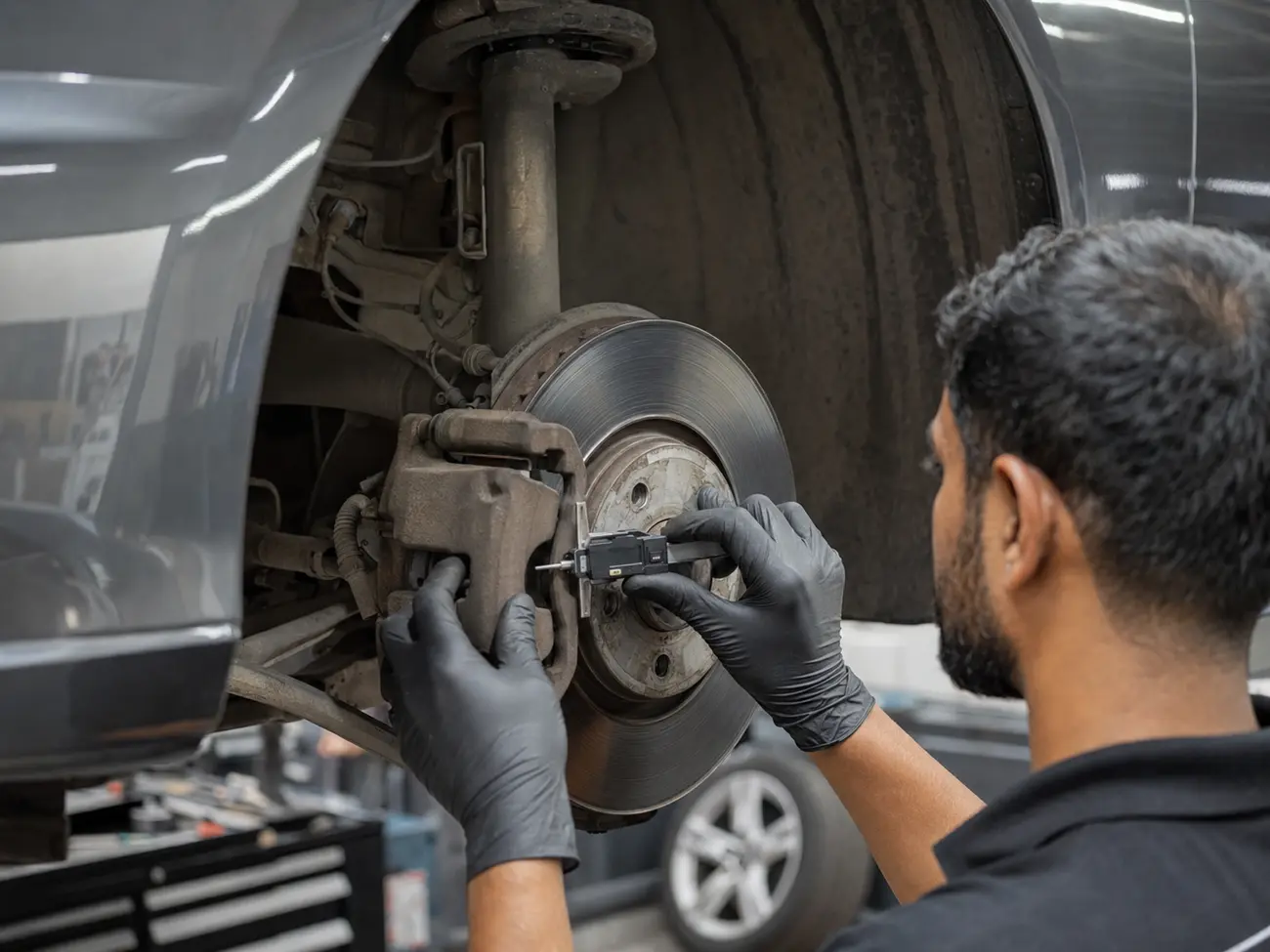
Measure wear before adding parts to the schedule.
Time and mileage create inspection points. Brake dimensions, tire condition, battery testing and suspension measurements decide what belongs in the approved work.
Common published Audi service intervals
The table below is a reference drawn from Audi’s published model-year 2022 interval document. It is not a universal schedule for every GCC Audi. Confirm each item against the VIN, current Audi service data and the vehicle’s own service display.
| Maintenance item | Published reference | How to use it correctly |
|---|---|---|
| Engine oil service | 15,000 km or 12 months for listed TFSI and TDI models | Confirm the oil approval, capacity and interval for the exact engine. Do not choose oil by viscosity alone. |
| Inspection with oil service | 30,000 km or 24 months for listed TFSI and TDI models | The inspection scope changes with mileage, age and equipment. Review previous invoices to avoid omissions or duplication. |
| Battery-electric inspection | 30,000 km or 24 months in the referenced e-tron BEV schedule | Market and warranty schedules can differ. Verify the VIN and active warranty requirements before setting the date. |
| Dust and pollen filter | 30,000 km or 24 months for listed models | Airflow, odor, dust exposure and previous replacement history may justify earlier inspection. |
| Air-filter element | 30,000 km for listed TFSI and TDI models | Inspect the correct element and airbox. Dust exposure is a condition factor, not permission to invent a universal interval. |
| Spark plugs | 60,000 km or 72 months for listed TFSI models | Confirm engine code and plug specification. A misfire still needs diagnosis rather than automatic plug replacement. |
| Brake fluid | 24 months for listed models | Use the specified fluid and a complete procedure. Fluid age is separate from pad and disc wear. |
Audi states that intervals may change with vehicle use and environmental conditions. Review the official Audi interval reference, then verify the exact vehicle rather than copying the table into an estimate.

Plan around milestones without replacing the VIN schedule
These milestones are review points, not fixed packages. The correct job list depends on what was completed previously, elapsed time and the equipment installed on the vehicle.
Establish the baseline
Confirm VIN, engine, gearbox, mileage, service display, warnings, tire dates, fluid history and supporting invoices.
Annual planning point
Check the applicable oil-service requirement, inspection findings and any time-based items.
Broader inspection point
Review filters, fluid leaks, brakes, tires, suspension, battery condition and the model-specific schedule.
Driveline and ignition review
Check whether spark plugs, S tronic fluid or other engine-code-specific work applies. Not every variant shares the same interval.
Time matters too
Brake fluid, rubber, batteries, tires, seals and low annual mileage can create needs that the odometer does not show.
Baseline check
Use the 10,000 km guide to verify records, condition and the next VIN-based tasks. 30KBroader review
Check filters, brakes, tires, battery condition and items tied to time as well as distance. 60KPowertrain checkpoint
Verify spark-plug and gearbox requirements by engine and transmission code. 90KHistory audit
Reconcile previous work with measured wear and the current service schedule. 120KLong-term plan
Build a condition-led plan for cooling, driveline, suspension and age-related needs.Each checkpoint opens a planning guide. It does not authorize a fixed package for every Audi at that mileage.
Add measured condition to the calendar
Heat, dust, short trips, traffic, long idle periods and infrequent use can change what requires inspection. They do not make every Audi need the same shortened interval.
- Check coolant level and leak evidence only when the system is cold and safe.
- Measure tire pressure cold, tread depth, age, repairs and axle matching.
- Measure brake friction material and disc condition instead of using a mileage guess.
- Test the 12-volt battery and charging behavior before replacement.
- Inspect AC cooling performance, cabin airflow and condenser condition.
- Check fluid leaks, undertrays, mounts, suspension joints and uneven wear.
Choose the correct engine oil
The label should show the required Audi or VW approval, not only a viscosity grade. Capacity, filter, drain procedure and reset also vary by engine.
Read the Audi oil interval and specification guide →Do not bundle brakes into a fixed service package
Pad thickness, disc dimensions, sensor status, caliper movement and driving behavior decide the brake scope.
Review Audi brake measurements →
Let measured condition refine the service plan.
Mileage and time identify what should be reviewed. Lift inspection, leak evidence and brake, tire or suspension measurements decide what enters today’s estimate.
What a clear Audi service record should contain
Exact identity
VIN, mileage, model year, engine, gearbox and market specification.
Part and fluid details
Brand, part number, oil or fluid approval, quantity and filter information.
Measurements
Brake, tire, battery, leak and inspection findings with priorities.
Due date logic
The next date and mileage based on the applicable schedule and completed work.

Record today’s evidence and the next due point.
The Audi workshop in Al Quoz 4 can review available invoices and create a now, soon and monitor list before work is approved. A missing history should be treated as unknown, not automatically repeated in full.
Open the maintenance page for the work due
Reconstruct the maintenance history before repeating work
A stamped book, digital entry or “full service history” statement is not enough unless it identifies what was actually completed. Review invoices by date and mileage. Record the oil approval, filters, spark plugs, brake fluid, gearbox or differential service, coolant work, battery replacement, brakes, tires and major repairs. Missing evidence should be marked unknown rather than treated as completed. When the car is being considered for purchase, use the Used Audi buying and inspection hub to combine those records with a cold-start, diagnostic and road-test plan.
List every supported event
- Date and odometer reading at each service
- Workshop name and invoice or digital record
- Exact engine oil approval and quantity where shown
- Part numbers or brands for filters, plugs, brakes and batteries
- Gearbox, quattro, differential and brake-fluid entries
- Repairs that disturbed coolant, AC, suspension or electrical systems
Prioritize by consequence
Do not automatically replace every item with missing paperwork. First confirm the VIN schedule and inspect the vehicle. Give priority to fluids or components where unknown history creates a meaningful safety or damage risk. An undocumented cabin filter and undocumented transmission service do not carry the same consequence.
If a previous invoice says only “major service,” request the itemized scope. Workshop package names are not standardized and may describe completely different work.
Review every system without replacing every component
A hub page should show the whole vehicle. The inspection column below identifies what can be checked, while the service column identifies work that should follow the exact schedule, specification or measured limit.
| System | What maintenance planning should review | What must not be assumed |
|---|---|---|
| Engine oil and filter | Due date, mileage, engine code, Audi or VW oil approval, viscosity allowed by that approval, quantity, filter and leak condition. | That every Audi uses the same oil, capacity, drain method or interval. |
| Intake and ignition | Air filter, spark plugs, coils, intake hoses, crankcase ventilation, deposits and any stored misfire evidence. | That rough running automatically means plugs or that an air filter should be replaced without inspecting it. |
| Cooling system | Correct coolant specification, cold level, concentration where applicable, leak residue, pressure, water-pump and thermostat behavior, fans and bleeding history. | That coolant color proves specification, or that topping up corrects a leak. |
| Transmission | Gearbox code, applicable oil and filter interval, leaks, previous fluid, adaptation data, clutch behavior and shift quality cold and hot. | That all S tronic, Tiptronic or other units share a universal 60,000 km service. |
| quattro and differentials | Exact driveline configuration, coupling or differential fluid requirements, leaks, tire matching, noise and prior service evidence. | That “quattro service” means the same procedure on every platform. |
| Brakes | Pad thickness, disc dimensions and surface, sensor status, caliper movement, hoses, fluid age, parking brake and warning history. | That pads, discs and fluid are one mileage-based package. |
| Tires and wheels | Approved size, pressure, tread, age, repairs, sidewalls, axle matching, load and speed rating, wheel damage and alignment wear. | That tread depth alone proves a tire is suitable or safe. |
| Steering and suspension | Control arms, bushings, joints, dampers, air springs, compressor behavior, ride height, bearings, boots and geometry. | That an alignment corrects worn parts or a low corner always requires a compressor. |
| Electrical and 12-volt battery | Battery type, age, test result, charging performance, registration or adaptation, connections, grounds and abnormal drain evidence. | That several warning lights prove several failed modules. |
| AC and cabin | Cooling output, refrigerant or oil specification, leak evidence, compressor control, condenser, blower, flaps, cabin filter and drains. | That adding refrigerant is routine maintenance when the system has a leak. |
| Lighting and driver assistance | Lamp operation, moisture, level sensors, cameras, radar areas, windshield replacement history and calibration requirements. | That a warning can be cleared permanently without correcting alignment, wiring or calibration. |
| Body and underbody | Undertrays, corrosion, impact damage, fluid evidence, drains, seals, windshield chips and previous structural repair. | That a clean exterior proves the underbody and safety systems are undamaged. |
Combustion, hybrid and electric Audis do not share one service package
Engine and emissions requirements
Plan engine oil, filtration, ignition or fuel-system items, belts where fitted, cooling, leaks and emissions equipment using the exact engine. TDI fuel-filter and particulate-filter requirements differ from TFSI spark-ignition items. Do not transfer intervals across engines.
Short trips and long idle time can affect oil, battery, deposits and aftertreatment behavior even when annual mileage is modest.
Two systems in one vehicle
Hybrid hardware does not remove combustion-engine maintenance. Review engine, gearbox, cooling circuits, 12-volt and higher-voltage systems, charging where applicable, brake condition and software requirements. The engine may run less often but can still age by time and operating pattern.
High-voltage inspection and repair scope must be confirmed before work begins.
Inspection without engine oil
Battery-electric models still need a VIN-specific inspection plan covering brakes, fluid age, tires, steering, suspension, cabin filtration, AC, cooling, 12-volt systems, charging and underbody condition.
Warranty, battery and manufacturer-controlled work may require an authorized route.
Compare itemized scope instead of package names
“Minor service,” “major service,” “full service” and mileage packages are workshop labels, not universal Audi schedules. One quote may include only oil and a filter, while another includes inspection, scan, several filters, fluid work and measured wear. Ask each workshop to show the same categories.
| Quote category | Questions to ask | Why it matters |
|---|---|---|
| Scheduled items | Which items are due by the VIN schedule, time or mileage? What supporting data was used? | Prevents a generic package from replacing the correct vehicle plan. |
| Parts and fluids | Which brands, part numbers, approvals and quantities are included? Genuine, OEM or aftermarket? | Two prices are not comparable if the parts route or fluid approval differs. |
| Inspection | Which systems are inspected, scanned or measured? Will findings be documented? | “100-point check” is not useful unless the points and results are clear. |
| Wear items | Are pads, discs, tires, wipers or suspension parts included only after measurement? | Condition-based work should not be hidden inside a fixed package. |
| Active repairs | Are leaks, warnings, noises or AC faults separately diagnosed and approved? | Maintenance cannot be used as proof of an unrelated repair. |
| Completion | Are resets, adaptations, coding, leak checks, road tests and final scans included where required? | A service is incomplete when the procedure or verification step is missing. |
Record what went into the Audi
The invoice should identify enough detail for the next workshop to understand the work. “Oil changed” does not show whether the required approval was used, and “gear oil” does not identify a transmission or differential fluid.
- Engine oil brand, grade, manufacturer approval and quantity
- Filter brands or part numbers
- Spark-plug part number and gap procedure when applicable
- Brake-fluid specification and date
- Gearbox, coupling and differential fluid specification
- Coolant specification and whether the circuit was opened or bled
- Battery type, rating and registration or adaptation record
Genuine, OEM and aftermarket are not interchangeable labels
Genuine parts are supplied in the vehicle manufacturer’s branded route. OEM is commonly used for a manufacturer that supplies original-equipment components, but the exact product and specification still require verification. Aftermarket quality varies widely.
Choose the route based on safety, compatibility, warranty, availability and value. The estimate should state the chosen brand and warranty rather than using “original” loosely.
Turn one service visit into a maintenance forecast
A good handover shows more than the work completed today. It should identify the next time-based service, projected mileage item, measured wear, unresolved fault and evidence to monitor. This lets the owner budget without approving everything at once.
Due or unsafe
Scheduled work already due, safety concerns and faults likely to cause further damage.
Plan within months
Wear approaching a limit, time-based items approaching due and non-urgent repairs.
Record the measurement
Stable conditions with a defined review date, threshold and symptom trigger.
Date and mileage
The next due point calculated from the completed work and applicable schedule.
Continue with the vehicle, warning, cost or specification
Model repair hub
Choose the correct standard, performance, electric or allroad route. WarningsDashboard lights
Separate a service reminder from a fault that needs diagnosis. Electrice-tron ownership
Plan EV inspections without combustion-service assumptions. BudgetRepair cost guide
See what changes an estimate before authorizing work. PartsParts guide
Compare genuine, OEM and aftermarket choices by application. SpecificationsFluids guide
Verify approvals and part-number-specific fluids before service.Audi maintenance schedule FAQs
How often should an Audi be serviced in Dubai?
The exact interval depends on the VIN, model year, powertrain, market schedule, service display, elapsed time and use. A published Audi reference lists 15,000 km or 12 months for engine-oil service on listed TFSI and TDI models, but it must be verified for the vehicle.
Does low mileage mean my Audi does not need service?
No. Time-based fluid, filter, battery, tire and rubber condition still matters. Review both elapsed time and mileage.
When does S tronic gearbox oil need changing?
The interval varies by gearbox and vehicle application. Some published Audi applications specify 60,000 km, while others differ. Confirm the gearbox code and current schedule before ordering service.
Are brake pads replaced at a fixed Audi service interval?
No. Pads and discs are wear items. Measure remaining material, disc condition, sensor status and caliper operation, then replace only what is required.
What should I provide for an accurate maintenance quote?
Provide the VIN, model year, mileage, service display, available invoices, recent work, current warnings and how the vehicle is used. This separates scheduled work from wear and active repairs.
Send the VIN and service history before choosing a package
Receive a clearer list of what is due now, what depends on inspection and what is not yet proven necessary.
Budget for routine Audi maintenance in Dubai
These market ranges help plan routine service. The VIN, service history and exact approved fluids or parts decide the finished scope.
| Service or repair | Typical Dubai market range | Confirm in the estimate |
|---|---|---|
| Oil and filter service | AED 350 to AED 1,100 | Approved oil, capacity, filter and drain hardware |
| Scheduled major service | AED 1,500 to AED 4,500 | Actual filters, plugs, fluids and inspection lines |
| Brake-fluid service | AED 250 to AED 600 | Correct fluid and complete bleeding procedure |
| Gearbox fluid service | AED 900 to AED 2,800 | Gearbox code, fluid, filter or pan and level method |