
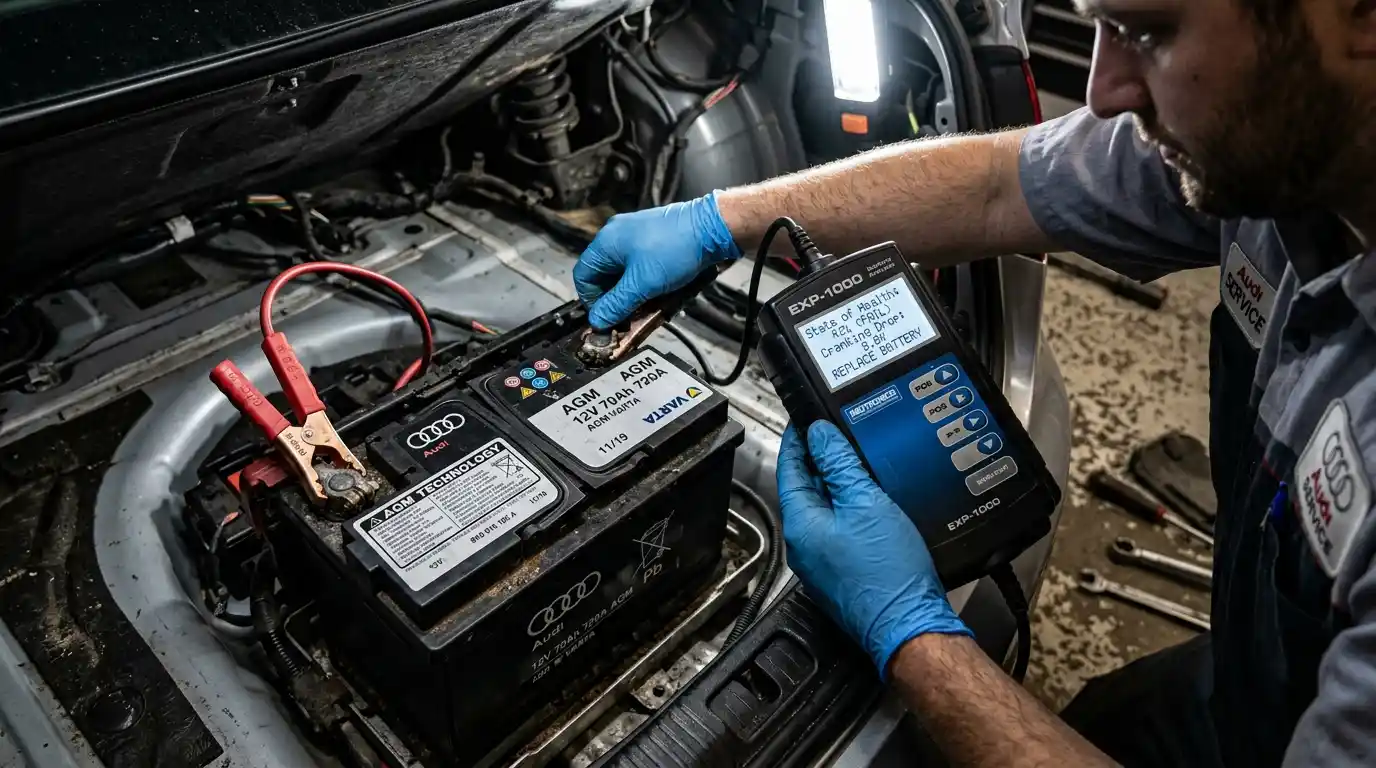
Audi battery replacement in Dubai
A reliable replacement begins with testing. We check the battery, starting supply, charging behaviour and connections before matching the correct technology, capacity, case and registration procedure to your Audi.
Four faults can feel like one weak battery
Slow cranking, repeated flat-battery events and several unrelated dashboard warnings can share the same starting point. The test route changes according to when the voltage falls and whether the vehicle is parked, cranking or running.
Battery condition
Low reserve capacity, internal deterioration or prolonged undercharge may prevent the battery from supplying stable cranking current. A condition and load test is interpreted with battery age, charge state and vehicle history.
Charging behaviour
Alternator output, regulation, wiring, belt drive or a platform-specific converter can leave a serviceable battery undercharged. Voltage alone may not describe an intelligent charging strategy, so behaviour matters.
Standby current
A module, accessory, light, latch signal or network that does not enter sleep mode can discharge the battery while the Audi is parked. The draw must be measured after the vehicle has settled.
Cable resistance
Loose terminals, damaged grounds, corrosion and high-resistance cables can imitate a failed battery. Voltage-drop testing checks whether current can travel through the circuit during load.
One dashboard message is not the diagnosis
Stable voltage supports many Audi control units. A low-voltage event can therefore create communication, convenience and assistance warnings that look unrelated. We record the messages before clearing them and separate temporary supply faults from warnings that remain after power is restored.
Battery output and cable voltage drop are checked before blaming the battery or starter motor.
This is treated as a charging-system concern until tests establish the actual cause.
Charge state, standby current, accessories and module sleep behaviour may need investigation.
Fault history is retained, supply is stabilised and persistent systems are checked separately.

Heat, short trips and long parking change the result
Dubai use can combine high under-bonnet temperature, heavy cooling demand and long periods between journeys. Those conditions influence charge state and battery ageing, but they do not remove the need for measurement.
Repeated short journeys
Starting uses stored energy. If each drive is brief and electrical demand is high, the charging system may not restore the previous state of charge. The battery can test low without an internal failure, so charge history matters.
Vehicles parked for weeks
Normal standby loads continue while the Audi is locked. A healthy vehicle and battery can still become undercharged during extended storage. An excessive draw is considered when discharge is faster than expected or repeats after full charging.
High temperature exposure
Heat can accelerate battery deterioration and change the way symptoms appear. It can also affect connections and charging components. Replacement should follow the measured condition rather than a seasonal assumption.
What a useful battery assessment should establish
A battery tester can produce a quick result, but the result becomes useful only when it is connected to the vehicle condition. Charge state, temperature, battery identification, recent jump-starting and the reported symptom can all affect interpretation.
Can the battery store and deliver energy?
The test should distinguish a discharged battery from one that has lost usable capacity. A low state of charge can require controlled charging and another test before replacement is justified. The battery label, approximate age and installed specification help explain whether the result fits the history.
What happens under cranking load?
Voltage and current behaviour during starting help separate weak stored energy from cable resistance or a starter-related concern. Sound alone is not enough. A slow crank may follow a poor ground, terminal problem, mechanical load or battery weakness, so the circuit needs context.
Is charge being restored?
Charging output is considered with operating conditions and the vehicle’s control strategy. A single idle-voltage reading may not describe all platforms. Warning history, load, belt condition, wiring and measured behaviour can direct the next step toward an alternator or supply repair.
Does the Audi enter sleep mode?
A standby-current test needs the vehicle to be closed, locked and allowed to settle. Opening a door, waking a keyless system or communicating with a module can restart network activity. The test plan must account for normal timed functions before identifying an excessive draw.
Does the new unit fit the system?
The approved battery should match required technology, electrical rating, case, terminal orientation, hold-down and vent path. The estimate should also state whether registration, adaptation or another completion procedure applies to the exact Audi.
Did the original symptom change?
After installation, the vehicle is started and the supply is reviewed. Stored low-voltage faults may be documented and cleared as appropriate, but a warning that returns is not dismissed as old history. The handover should identify remaining work instead of treating a new battery as a universal reset.
Location changes the installation plan
The 12-volt battery may sit in an engine-bay enclosure, luggage compartment or another protected location depending on model and generation. Access can involve covers, trim, hold-downs, vent pipes, monitoring sensors and nearby electrical connections.
Confirm the safe isolation sequence, preserve relevant settings or records where appropriate and inspect the surrounding area for moisture, corrosion or previous cable damage.
Protect the terminals, cables, monitoring sensor, venting and hold-down. A battery that is electrically correct but physically unsecured is not a correct installation.
Complete platform-required registration or adaptation, verify starting and supply behaviour and check whether windows, steering, clock or other functions need a normal relearn procedure.
Identify the vehicle
We confirm the VIN, model year, powertrain, installed unit and relevant build information before selecting a replacement.
Preserve the evidence
Warnings, scan data, battery identification and recent repair history are recorded before disconnection.
Test the supply path
Battery condition, cranking behaviour, charging performance and connections are checked. A drain test is added when the pattern supports it.
Fit the approved battery
The correct unit is secured with the required hold-down, cable routing, protective covers and venting.
Register when required
Replacement data or adaptation is completed only where the vehicle platform and diagnostic procedure require it.
Recheck the result
Starting, charging and remaining faults are reviewed so the handover explains both the repair and anything still under observation.
The right battery is more than the right size
Two batteries can look similar while differing in construction, reserve capacity, starting-current rating, polarity, venting and energy-management compatibility. Installing by dimensions alone can create poor performance or an unsupported charging strategy.
Battery technology
Stop-start operation, charge cycling and vehicle specification influence the required construction. Technology is confirmed rather than guessed from appearance.
Capacity and rating
The selected unit must support cranking demand and fitted electrical equipment without an unsupported upgrade or downgrade.
Physical installation
Dimensions, hold-down, terminal position, cable reach, protective covers and vent routing must all remain secure.
Energy management
Some Audi platforms use battery information when controlling charge. Registration or adaptation is confirmed by platform and procedure.
System distinction
A conventional 12-volt supply battery, mild-hybrid component and electric traction battery require different safety controls and service scopes.
Previous work
A new battery that repeatedly goes flat needs investigation. Replacing it again may leave a drain, connection or charging fault unresolved.
Audi battery replacement cost in Dubai
A useful estimate identifies the battery, access, testing and any required registration rather than presenting one universal price.
Indicative starting point
Smaller or simpler 12-volt applications may begin around this level when the failure is confirmed and access is straightforward.
Upper indicative range
Larger AGM units, difficult access, registration and current parts availability can move the replacement toward this level.
Diagnostic or system work
Parasitic-drain diagnosis, alternator repair, auxiliary batteries, 48-volt components and traction-battery work are separate scopes.
Know which battery needs attention
Owners often use the word battery for several unrelated components. Identifying the system prevents an incorrect booking and makes the first estimate more useful.
Stop when electrical supply is becoming unsafe
A car that starts after assistance is not automatically ready for normal driving. If charging is not restored, available battery energy may continue falling until steering assistance, lighting, cooling control or other systems are affected.
- The red battery or charging warning remains on while the engine is running.
- Lights dim, steering assistance changes or the instrument display resets.
- There is smoke, heat, swelling, leakage or a strong chemical smell near the battery.
- The vehicle repeatedly stalls, will not stay running or cannot be secured normally.
- A high-voltage warning appears on an electric or plug-in hybrid Audi.
When the battery is not the whole repair
Testing may direct the next step to another system. These focused pages explain related work without turning battery replacement into a catch-all service.
Audi battery replacement questions
Does every new Audi battery need registration?
No. The requirement depends on the vehicle platform, energy-management system, battery specification and diagnostic procedure. It should be confirmed by VIN and installed equipment.
Can a weak battery cause several warning lights?
Yes. Unstable low voltage can produce communication and control-module faults. Messages should be recorded before clearing, and persistent warnings still require diagnosis.
Is a jump-start proof that the battery has failed?
No. It only shows that usable starting supply was insufficient at that moment. Battery condition, low charge, drain, poor connections or a charging fault may be responsible.
Can you replace the Audi battery at any capacity?
No. Capacity, construction, case, starting-current rating, polarity, venting and energy-management compatibility should match the exact vehicle specification.
Why did my recently replaced battery go flat again?
Possible causes include incomplete charging, charging-system faults, excessive standby current, a module that does not sleep, wiring problems, accessory loads or an unsuitable replacement.
Is a key-fob battery part of this service?
It is a separate small-cell replacement. A weak remote battery can reduce key range but does not normally cause slow engine cranking or vehicle-wide shutdown.
Do you replace Audi e-tron traction batteries?
This page covers low-voltage battery diagnosis and replacement. High-voltage traction-battery diagnosis is a separate safety-controlled scope. Contact the workshop with the exact model and warning before booking.
Send the VIN and dashboard photo
Add the model, year, mileage, starting behaviour, warning message and how long the Audi was parked. This helps us prepare the right test route before you arrive.