Dual-clutch transmission
Wet- and dry-clutch versions do not share one fluid circuit or service plan. Clutch, mechatronic, hydraulic and internal gear evidence must be separated.

Harsh shifts, delayed engagement, slipping, judder, warning messages and fluid loss can come from different mechanical, hydraulic, electrical or control faults. We identify the installed gearbox and test the symptom before recommending service, a targeted repair or deeper transmission work.
Audi gearbox repair should begin with identification and evidence. The same symptom can be caused by fluid level or specification, a leak, battery voltage, a selector issue, clutch wear, a mechatronic fault, a valve-body problem, software or adaptation, mounts, a driveshaft concern or internal damage. Changing fluid or ordering a mechatronic unit before separating those possibilities can waste money and hide the original evidence.
The useful first step is to record when the problem occurs, scan the relevant modules without erasing the fault history, verify the VIN and gearbox code, and compare electronic data with the physical behavior. Only then can service, repair, rebuild or replacement be priced responsibly.
Symptoms guide the inspection, but they do not name the failed part. Note whether the issue appears cold, hot, after traffic, during one gear change, when selecting D or R, under load, or after recent battery or gearbox work.
| What you notice | Systems that may be involved | Evidence to collect next | Driving decision |
|---|---|---|---|
| Delayed D or R engagement | Fluid pressure, clutch control, selector input, mechatronic function, internal wear | Engagement time, pressure or clutch values, faults, fluid level and leak status | Inspect promptly |
| Judder when moving away | Clutch condition, adaptation, mounts, flywheel, contamination or software context | Temperature pattern, clutch values, vibration source and recent service history | Avoid hard use |
| Engine revs rise between shifts | Clutch slip, pressure loss, fluid condition or internal wear | Requested and actual gear, slip values, fluid evidence and road-test reproduction | Stop if severe |
| Bang or harsh downshift | Adaptation, mechatronic or valve-body control, mounts, voltage or mechanical play | Fault memory, operating temperature, learned values, mounts and driveline movement | Inspect promptly |
| PRNDS or transmission warning | Control module, voltage, sensors, wiring, hydraulic, clutch or mechanical fault | Exact message, warning color, freeze-frame data and complete module scan | Follow display |
| Fluid below the vehicle | Pan, seal, cooler line, connector sleeve, casing or another nearby system | Fluid identification, leak source, level procedure and contamination risk | Recover if active |
Audi uses different transmission designs across models, years, engines and markets. The marketing name alone is not enough to choose fluid, parts, procedures or electronic setup. The VIN, gearbox code and installed hardware must agree.
Wet- and dry-clutch versions do not share one fluid circuit or service plan. Clutch, mechatronic, hydraulic and internal gear evidence must be separated.
Torque-converter, valve-body, pressure, cooling and internal mechanical concerns can create similar symptoms but require different tests.
Application-specific clutch, control, chain and pulley concerns require correct unit identification and careful viability assessment.
Manual clutches and gearsets require a different route. Electric drive units add high-voltage safety, cooling and reduction-gear considerations.
A scan is one part of diagnosis, not the whole result. The inspection should connect identity, fault history, operating data, fluid evidence and the physical symptom.
Do not clear fault codes before the first record is saved. Intermittent warnings can leave useful freeze-frame conditions even when the dashboard appears normal after a restart.
Record VIN, model year, engine, gearbox code, mileage, modifications and recent battery, software or transmission work.
Capture warning wording, selector display, cold or hot state, affected gear, traffic conditions and a safe reproduction pattern.
Read relevant modules, freeze-frame information, supply voltage, requested and actual states, temperatures and gearbox-specific values.
Check leaks, connectors, mounts, cooling lines, fluid condition or level where appropriate, and driveline components that can imitate gearbox faults.
Approve only the evidence-supported scope, complete required setup or adaptations, re-scan and road-test against the original symptom.
The final work list depends on the installed unit and findings. These services are not automatically bundled together, and no part should be promised before the fault boundary is established.
Correct specification, temperature-sensitive level procedure, filter or pan requirements, seals and a leak check for the identified gearbox.
Trace the actual source before replacing seals. Check whether low fluid, contamination or heat has affected operation.
Use faults, live values, adaptation data and physical evidence to separate clutch, actuator, solenoid, hydraulic and control concerns.
Inspect selector input, interlock, wiring and module communication before treating a no-engagement complaint as internal gearbox failure.
Evaluate fluid temperature, cooler condition, lines and related cooling problems when the symptom appears after heat or heavy traffic.
Complete applicable coding, software, basic settings or adaptations only for the exact model, control unit and approved repair.
A gearbox fluid service must follow the identified unit, not a universal machine procedure. Some applications require a defined drain-and-fill, a filter or pan assembly, replacement seals or fasteners, a temperature window and a specific level check. Separate circuits may use different fluids even on the same vehicle.
Before approving service, confirm the gearbox code, service history, leak status and exact fluid approval. If the vehicle already slips, has lost drive, contains significant debris or shows an active internal fault, fluid replacement should not be presented as a guaranteed cure. The condition must be documented, and the customer should understand whether the job is maintenance, part of diagnosis or one step inside an approved repair.
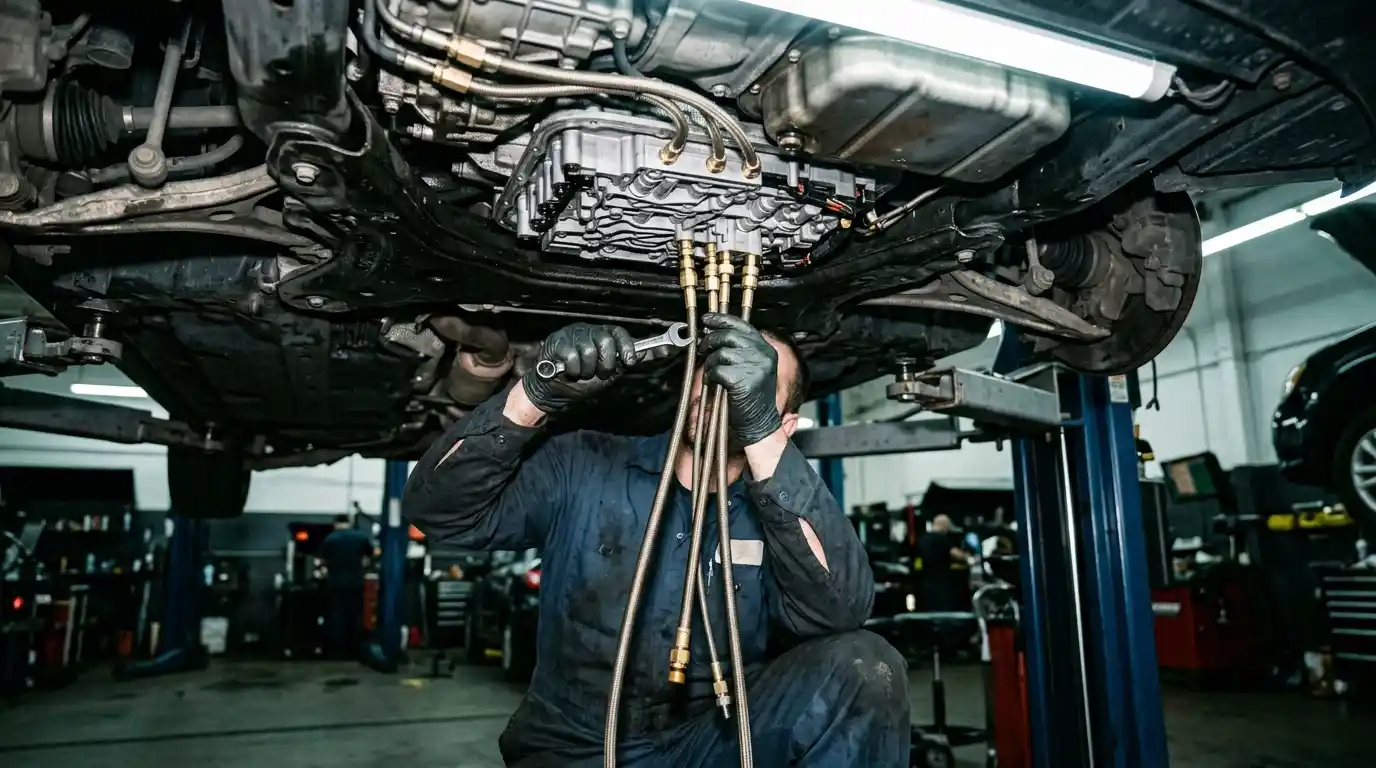
A fault code identifies a monitored circuit or operating condition. It does not automatically prove that the component named in a scan description has failed. Fluid color can show deterioration or contamination, but it cannot define every internal part that needs replacement.
Use the route that matches the current evidence. This avoids turning every gearbox symptom into a rebuild quote and keeps the next step clear.
If the dashboard message and driving risk are still the main questions, start with the Audi transmission malfunction guide.
This page covers fluid and filter work, shift-quality complaints, leaks, gearbox identification and the first evidence-led repair decision.
When diagnosis already proves a failed layer, compare targeted work, rebuild and replacement on the Audi transmission repair page.
A meaningful estimate needs the exact gearbox and fault boundary. A dashboard warning, model badge or generic scan description cannot reveal the full parts list.
Use the Audi repair cost guide for Dubai for broader budgeting categories. The final written estimate depends on inspection, exact vehicle specification, fault severity, parts choice and current availability.
Qualifying gearbox work follows the stated workshop policy of 15 days or 10,000 km, whichever comes first. The written estimate should identify the covered repair, parts condition, exclusions and any operating or follow-up requirements.
Coverage cannot replace correct diagnosis. A replacement unit also needs compatibility checks, fluid, installation, electronic setup where applicable and acceptance testing.
We can inspect gearbox concerns across Audi cars and SUVs, but the installed unit can vary within one model. Share the VIN, year, engine, mileage and symptom before parts or fluid are selected.
For generation and powertrain context, use the Audi model repair hub. For fluid approvals and why color is not a specification, review the Audi fluids and specifications guide.
Follow the dashboard instruction. Stop and arrange recovery for a red warning, loss of drive, severe slipping, grinding, smoke, a burning smell, unsafe behavior or a large active fluid leak. A mild amber warning still needs prompt diagnosis.
Not automatically. Incorrect level or degraded fluid may affect operation in some applications, but harsh shifting can also involve voltage, software, adaptation, mounts, clutch control, mechatronic, valve-body or internal faults. Diagnose before treating fluid service as a repair.
There is no safe universal interval for every Audi gearbox. Requirements vary by VIN, gearbox code, model year, market, fluid circuit, service history and operating conditions. Use the correct maintenance information for the installed unit.
S tronic is Audi terminology for dual-clutch transmissions available in different versions. Tiptronic is used for conventional automatic applications such as an eight-speed torque-converter transmission. Their fluids, parts, test data and procedures are not interchangeable.
No. A scan description or symptom alone is not a replacement verdict. Wiring, voltage, fluid, solenoid, hydraulic, clutch, software and internal evidence may need separation. The viable repair depends on the exact mechatronic unit and findings.
Temperature can change fluid behavior, clutch control, pressure, electrical response and adaptation. The repeatable hot condition is useful evidence and should be recorded during safe testing rather than hidden by clearing codes.
Send the VIN, model, year, mileage, exact warning message, when the symptom occurs, whether D and R engage, any visible leak and details of recent battery, software, fluid or gearbox work.
Applicable checks can include fluid level and leaks, connectors and mounts, coding or basic settings, adaptation, final fault scan, operating data and a controlled road test against the original complaint.
Prepared by Audi Service Advisor. Updated 30 August 2026. Audi Repair Dubai is an independent workshop and is not Audi AG or an authorized Audi dealer. Vehicle safety, procedures, fluid and part compatibility depend on the VIN, gearbox code and inspection findings.
Share the VIN, model, year, mileage, exact symptom, dashboard message and when the problem occurs. If the car has lost drive or is leaking heavily, ask about recovery instead of driving it.