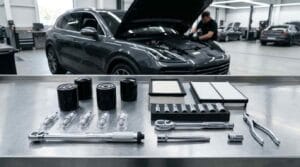
History reconciliation checkpoint
Audi 90,000 KM Service Checklist
By 90,000 KM, missing evidence matters as much as the odometer. Reconcile what should already have been completed before adding new work.
An Audi 90,000 KM service should audit the full maintenance history, complete the oil and inspection work due for the exact car, verify whether earlier plugs, filters, gearbox or quattro services were completed, and inspect cooling, leakage, belts, battery, brakes, tires, suspension and driveline condition. Certain Audi performance driveline items may be scheduled around this mileage, but they do not apply to every model. Do not automatically replace a timing chain, turbo, water pump or transmission because the odometer reached 90,000 KM. Diagnose symptoms and close documented service gaps first.
Gap audit
Reconstruct the work completed before 90,000 KM

Create a timeline with date, mileage, workshop, material specification and work performed. Mark oil services, plugs, filters, brake fluid, transmission work, coupling or differential service, coolant repairs and battery replacement. Empty cells become verification tasks, not automatic replacements.
Inspect parts and fluids for plausibility. A clean filter does not prove its installation date, and dark fluid does not alone prove failure. Use invoice detail, diagnostic information and condition together.
If the vehicle recently changed ownership, establish a baseline without repeating well-documented work. The goal is to remove uncertainty, not maximize the invoice.
Engine health review
Investigate new consumption, leakage and cold behavior
Check oil level history, leakage, smoke, coolant loss, cold-start sound, misfire and boost response. Compare requested and actual data where a symptom exists. A turbo code can involve leakage, control, sensor input, exhaust restriction or lubrication rather than the turbo alone.
Inspect cooling pressure, dried residue, pump and thermostat areas, fan operation and live temperature. The Audi coolant warning guide provides the correct distinction between top-up, leakage and overheating diagnosis.
Timing components are engine-specific. Noise or correlation faults require evidence, while a quiet engine with no applicable interval does not receive a chain replacement because of a round mileage number.
Driveline reconciliation
Verify previous fluid work before repeating or skipping it
Identify the transmission and confirm when its applicable service was completed. Check invoice materials, leakage and current behavior. If there is shift flare, harsh engagement, slipping or warning history, perform diagnosis before routine fluid work.
Review quattro coupling, differential and transfer-system records according to the fitted hardware. Some performance differentials can have specific 90,000 KM requirements, while ordinary configurations differ. Tire mismatch and wheel-speed problems can imitate driveline trouble.
Inspect mounts, joints, propshaft components and boots where vibration or leakage appears. Road speed, engine speed and load help localize the source.
Age and chassis
Expect time-based deterioration to become more visible
Rubber and mounts
Inspect cracking, collapse, leakage and movement under load.
Suspension
Check joints, bushes, dampers, air components and ride height.
Wheels and tires
Record age, tread pattern, repairs, ratings and inner-barrel condition.
Brakes
Record pad depth and rotor condition, then examine hoses and assess fluid history.
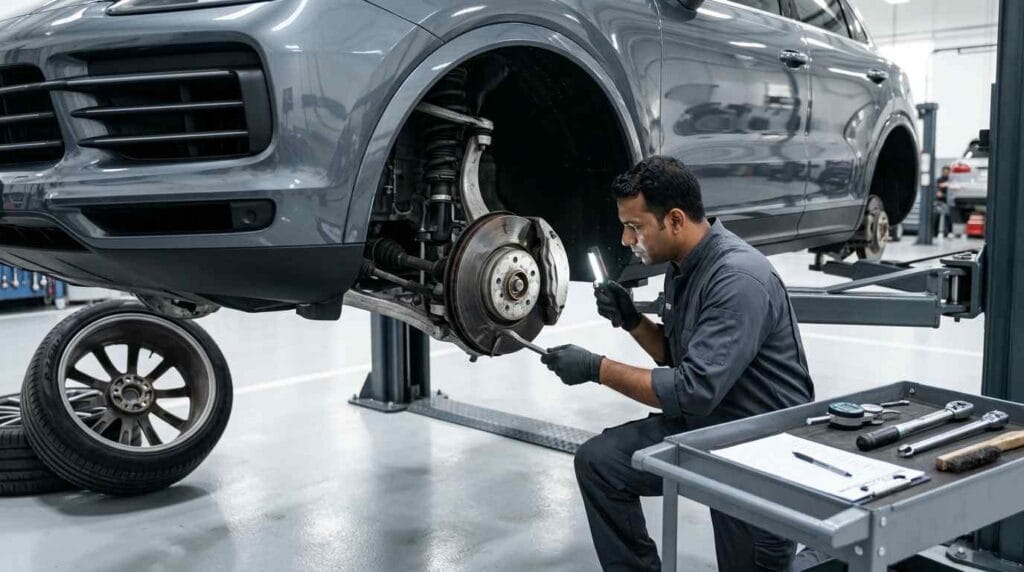
Bushes, joints, boots, brakes and tires measured on the lift – age-based wear is recorded, not guessed.
Some components may still be healthy at this mileage. Record their condition so later change can be measured. Preventive replacement without a schedule or evidence should be labeled optional, not essential.
Electrical and cabin
Treat intermittent warnings as stored evidence
Test battery condition, charging response and undervoltage history. Include applicable 48-volt systems and high-voltage equipment. Several chassis or assistance warnings may share one supply or communication event.
Operate MMI, cameras, locks, seats, climate zones, lighting and powered closures. Inspect for water entry around carpets, luggage areas and previous windscreen or body work. A module replacement will not correct moisture or a damaged power feed.
For an electric Audi, assess charging, thermal-system faults, tire condition, braking hardware and auxiliary-battery health. High-voltage battery replacement is not a 90,000 KM maintenance item.
Ninety-thousand estimate
Budget for catch-up work without presenting it as mandatory
A scheduled 90,000 KM visit may broadly range from AED 1,200 to AED 3,500 before missed earlier work. Catch-up transmission, differential, plugs or fluid items can raise the combined plan to roughly AED 2,500 to AED 7,500. Tires, brakes, suspension and diagnosed faults remain separate.
These are non-binding editorial allowances. A written estimate must identify known history, assumed gaps, VIN, parts, labor, VAT, coding, calibration and exclusions. Approve uncertain work only after the workshop explains whether it is due, measured or diagnostic.
Ninety-thousand questions
Build a 90,000 KM evidence map before approving catch-up work
Start with four sources that may disagree: the vehicle service display, dated invoices, parts or fluid evidence, and the current condition report. Give each claimed operation a status of confirmed, plausible but unverified, overdue, or not applicable to this vehicle. This prevents a handwritten note from being treated as proof and prevents a missing invoice from triggering unnecessary replacement when reliable physical or digital evidence exists.
Use the VIN to identify the engine, transmission, driven-axle system, brakes, suspension and market schedule. Then match every historical line to the installed hardware. A generic invoice that says gearbox service does not establish which unit was serviced, which fluid approval was used, whether a filter was included, or whether the required temperature and level procedure was followed. The same caution applies to quattro, differential, brake-fluid and cooling-system work.
Evidence that can support a completed service
- a dated invoice showing mileage, part numbers, fluid approval and quantity
- a workshop record linked to the VIN and the correct installed system
- service-display history that agrees with dated supporting documents
- identifiable components or labels where inspection can reasonably confirm recent work
- measured condition that supports, but does not by itself prove, the claimed operation
If the evidence remains uncertain, record the uncertainty. The owner can then choose a conservative baseline service, a targeted test, or continued monitoring based on consequence. This is more useful than marking every undocumented item as failed.
Separate calendar aging from distance traveled
Ninety thousand kilometers can be reached quickly by a motorway-driven car or slowly by a vehicle exposed to years of parking, short trips and traffic heat. Those histories create different priorities. A younger high-distance Audi may need careful review of tires, brakes, driveline fluids and accumulated wear. An older low-use car may show battery reserve loss, hardened seals, aged tires, contaminated brake fluid, weak air-conditioning performance or corrosion at connections even when the odometer looks modest.
Record the first-registration date, recent annual mileage, typical trip length and storage pattern. Check tire manufacturing dates alongside tread depth. Compare battery test results with installation age and the car’s parked-current behavior. Inspect rubber components for cracking, deformation and leakage rather than replacing them from age alone. For fluids, use the relevant time limit, mileage rule, installed system and documented history instead of relying on the odometer by itself.
Test the car in the conditions that reveal a 90,000 KM concern
Cold start and first engagement
Before the engine is warmed, record cranking speed, warning messages, idle quality, chain or belt-area noise where applicable, coolant level, exhaust behavior and the first selection of drive or reverse. A fault that appears only after overnight parking can disappear by the time a routine workshop road test begins. Do not clear messages or top up fluids before the original evidence is captured.
Low-speed heat and parking maneuvers
In a controlled test, check steering effort, driveline shudder, suspension noises, cooling-fan operation and cabin temperature while the vehicle is maneuvered at low speed. A symptom during tight turns may involve tire mismatch, driveline loading or a joint rather than the transmission. Weak cabin cooling at idle requires refrigerant-pressure and airflow evidence, while a rising engine temperature changes the issue from comfort to an urgent cooling diagnosis.
Steady cruise, braking and controlled acceleration
Separate road-speed vibration from engine-speed vibration by repeating the observation safely in a different gear. Record whether a pull exists at steady speed or only during braking. Use measured tire condition, wheel runout, suspension play, brake temperature and hub or disc measurements as the evidence requires. If controlled acceleration produces a flashing engine warning, severe misfire, smoke or unstable boost, stop the test and arrange recovery rather than trying to complete the service checklist.
Rank 90,000 KM findings by consequence
- Stop and recover: red oil-pressure or temperature warnings, severe fluid loss, smoke, fuel odor, loss of drive, unsafe steering or braking, structural tire damage or a persistent violent misfire.
- Reduce load and inspect promptly: stable amber powertrain, charging, suspension or driver-assistance warnings, new shift behavior, moderate leakage, emerging vibration or cooling performance that has changed without an overheat warning.
- Schedule condition work: measured brake or tire wear that remains within a documented limit, minor seepage, aging mounts, weak battery reserve or comfort faults that do not change safe control of the car.
- Complete confirmed maintenance: work supported by the VIN schedule, time, mileage and service history after active faults have been separated from routine service.
The estimate should preserve these categories. A service package cannot prove that an active warning has been repaired, and a warning code cannot prove that an unrelated scheduled item is due.
Use measurements to decide what can wait
Ask the report to include values that can be compared at the next visit. Useful examples include tire tread and pressure at each position, brake friction and disc condition, battery conductance or capacity evidence, charging voltage, fluid level and leakage location, suspension play, ride height where relevant, and diagnostic fault status before and after testing. The measurement method and applicable limit matter more than a green or red box on a generic checklist.
Deferred work needs a trigger and a review point. Instead of writing monitor leak, record the source area, current severity, level change and the mileage or date for reinspection. Instead of brakes soon, record the measured condition, use pattern and recheck plan. If a limit cannot be established, label the finding as unresolved and explain the next test rather than converting uncertainty into a replacement recommendation.
Plan a two-stage visit when the history is incomplete
A car with several undocumented systems may not need every operation in one appointment. Stage one should protect safety, stabilize active faults and establish the vehicle identity and condition baseline. Stage two can complete confirmed catch-up maintenance after diagnosis has shown that the related system is suitable for service. For example, an active transmission complaint should be diagnosed before a routine fluid operation is sold as a cure, and a cooling leak should be located before new coolant is used to hide the loss.
Close the visit with a written list showing completed work, confirmed overdue work, measured wear, diagnosed faults and unresolved exposures. Include parts, fluid approvals, labor scope, programming or calibration needs, and the verification performed after each repair. That record makes the 90,000 KM service useful even when the previous history was fragmented and gives the next technician a clean starting point.
What to ask at an Audi 90,000 KM service
What should an Audi 90,000 KM service include?
It should complete due scheduled work, audit earlier services, inspect wear and leakage, and diagnose any new engine, transmission, cooling or electrical symptoms.
Is a timing chain replaced at 90,000 KM?
Not universally. Chain decisions depend on the engine, applicable guidance, lubrication history, noise, faults and measurements.
Does every Audi need differential oil at 90,000 KM?
No. Some specific performance differentials may have a 90,000 KM requirement, while other systems use different intervals.
Should I repeat a service if the invoice is unclear?
First verify parts, fluid and physical evidence. If completion cannot be established, the workshop can explain the risk and create a baseline.
How much can 90,000 KM maintenance cost?
A scheduled visit may be around AED 1,200 to AED 3,500. Catch-up work can raise the plan, depending on missed items and configuration.
Extra Checks for Audi Electric Models at 90,000 KM?
Focus on charging, high-voltage thermal systems, 12-volt supply, tires, brakes and drive-unit condition rather than combustion-engine service.