
Configuration-led diagnostics
Audi R8 Repair and Service in Dubai
An R8 service plan must begin with its VIN, generation, engine, transmission, brake package, suspension hardware and recent use. A generic performance-car package cannot safely decide the correct fluid procedure, clutch test, brake measurement or repair scope.
Begin with the decision the driver needs
Compare the front-engine performance coupe on the Audi RS5 repair page and the compact five-cylinder route on the TT RS repair page. Confirm consumables with the Audi fluids guide.
Some owners need routine maintenance, while others are trying to understand a warning, a new sound, a heat-related fault or a used-car risk. State the event, when it began and what changed immediately before it. Record cold or hot operation, engine speed, road speed, selected mode, warning color and whether the vehicle still responds normally.
Maintain
Confirm the exact service history and due items. Select procedures from the R8 configuration rather than mileage alone.
Diagnose
Preserve the initial scan, operating conditions and fluid evidence before clearing faults or replacing components.
Inspect before purchase
Verify identity, accident repair, cold-start behavior, driveline operation, brakes, tires and electronic equipment.
Identify the R8 before selecting a procedure
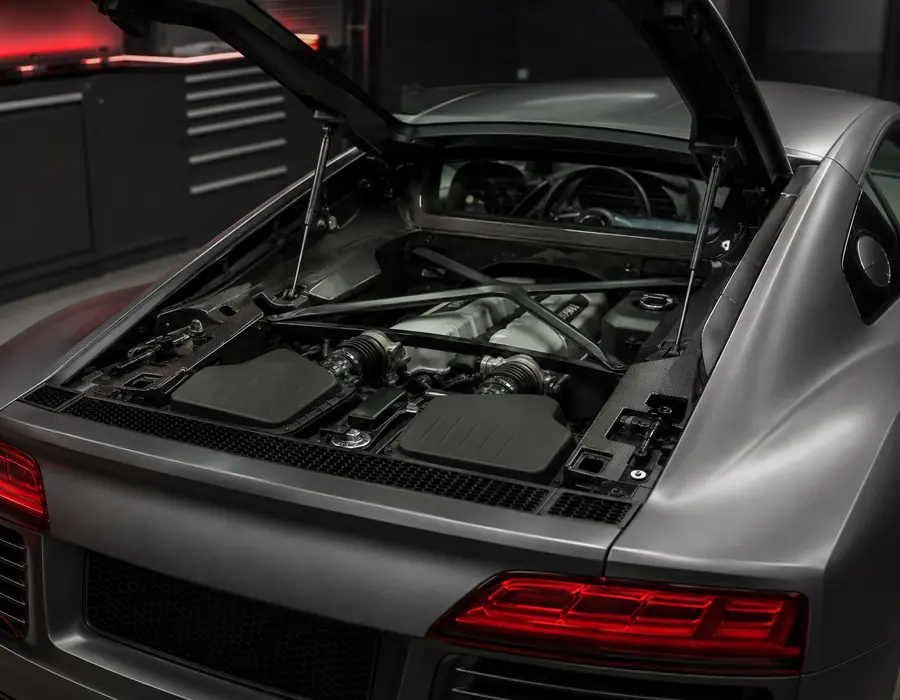
The R8 name covers materially different vehicles. Earlier cars may use a V8 or V10 and can have a manual gearbox or R tronic, while later V10 cars use a seven-speed S tronic. Drivetrain, suspension and brake equipment also vary. Audi’s own R8 history confirms that dry-sump lubrication and Audi magnetic ride were defining technical elements, but the fitted hardware still needs VIN-level verification. See the Audi MediaCenter R8 history for manufacturer context.
| Identity question | Why it changes the job | Evidence to record |
|---|---|---|
| Generation and model year | Changes diagnostics, service information, electronics and parts compatibility. | VIN decode, registration, physical build data and diagnostic identity. |
| Engine and drivetrain | Changes access, fluid procedures, cooling layout and fault strategy. | Engine code, driven axle configuration and prior major work. |
| Transmission | Manual, R tronic and S tronic complaints require different tests and estimates. | Gearbox identity, adaptation data, clutch evidence and fluid history where applicable. |
| Brake and suspension package | Steel and ceramic brakes need different assessment; damper hardware affects diagnosis. | Physical component identification, measurements and controller data. |
First evidence
Protect the cold-start and baseline scan
A warm engine can hide starting noise, leakage, mixture correction and secondary-air behavior. If practical, leave the R8 unstarted before inspection. Record oil level according to the correct procedure, coolant state when safe, battery voltage, warning sequence and the first minute of sound. Do not open a hot cooling system.
Scan every available controller before clearing anything. Note fault status, frequency, environmental data and communication errors. A low-voltage history can create several secondary messages, but it should not be used to dismiss a fault that returns with stable supply. Photograph the instrument cluster and preserve relevant diagnostic reports with the estimate.
Recent work shapes the test route. A new noise after engine, exhaust, undertray or suspension access should trigger inspection of disturbed mounts, shields, fasteners, wiring and fluid connections before an unrelated assembly is condemned.
Service the lubrication system by procedure, not habit
Dry-sump architecture makes oil-level verification especially procedure-sensitive. The correct check can depend on temperature, engine state, timing and vehicle position. The workshop should identify the approved oil specification and quantity for the exact engine, document the level-check method and inspect for leakage at accessible lines, seals, housings and connections.
An oil-pressure warning is not a request for a routine oil change. Preserve the warning condition, check level without creating additional risk and measure pressure using the relevant procedure where diagnosis requires it. Do not assume that a new sensor will correct a lubrication problem. Conversely, do not authorize engine disassembly from one stored code without pressure, wiring and mechanical evidence.
Heat management needs a complete circuit view
Dubai heat can expose a marginal cooling system during traffic, restart or sustained load. Check coolant condition and loss, fan operation, pump control, radiator airflow, pressure behavior and fault history. Air-conditioning performance is a separate system but can increase thermal demand, so reproduce the owner’s complaint with ambient temperature, vent readings and operating conditions recorded.
Diagnose the gearbox that is actually fitted
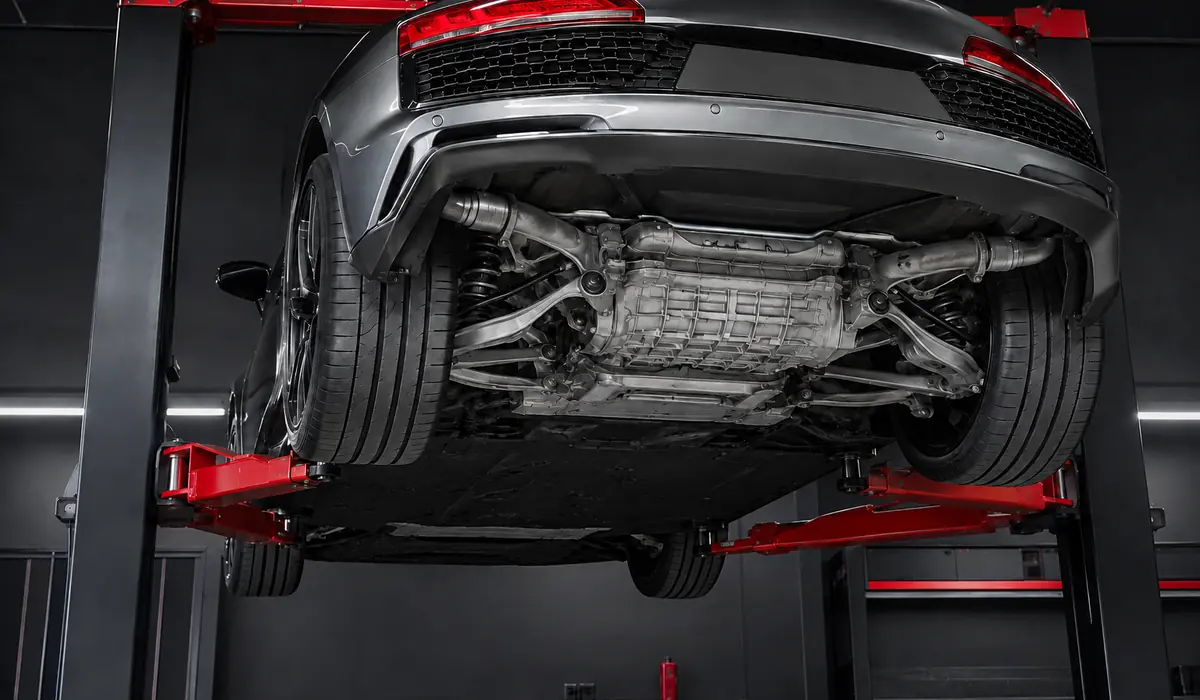
A manual shift concern may involve clutch release, hydraulics, linkage, mounts or internal wear. R tronic behavior must be assessed through its automated-manual operating logic, clutch condition, hydraulic control and adaptations. A later S tronic complaint can involve clutch control, fluid condition, mechatronic operation, engine torque delivery or driveline movement. These routes are not interchangeable.
Describe the symptom as a condition: cold selection delay, low-speed judder, shift flare, harsh engagement, warning under load or noise on overrun. Compare commanded and actual behavior on a controlled route. Check mounts, joints and axle components before attributing every vibration to the gearbox.
A repair estimate should distinguish diagnosis, access, parts, fluids, coding or adaptation and verification. If a clutch or internal repair is proposed, request the measurements or data that support it and the completion test that will prove the original symptom is gone.
Measure the chassis rather than judging it through the wheel
Large wheels, low-profile tires and rigid suspension paths can make several faults feel similar. Record tire make, size, age, pressure and damage. Measure tread and inspect wheel condition. Separate engine-speed vibration from road-speed vibration, braking feedback and steering input before selecting parts.

Magnetic ride and conventional dampers
Identify the fitted suspension physically and through the VIN. For a damper complaint, inspect leakage, wiring, sensors, mounts, joints and geometry. A mode change alone does not prove that every damper is healthy. Uneven tire wear can be a clue, but alignment numbers and component condition are required before correction.
Steel and carbon-ceramic brakes
Confirm the brake package before pricing. Inspect friction surfaces for the condition relevant to that material, measure where the approved procedure calls for measurement, and check pads, calipers, hoses, hubs and wheel fitment. A visual glance cannot establish remaining life or identify every cause of vibration. Avoid wheel-cleaning practices or handling that conflict with the applicable brake guidance.
Treat performance loss as a system question
Reduced power can begin with air measurement, fuel delivery, ignition, exhaust restriction, temperature control, sensor plausibility or a protective response to another fault. Record whether the change occurs at a specific rpm, after heat soak, during one gear or with a warning. Use scan data and a safe, controlled load test rather than repeated full-throttle runs.
A rattle under acceleration also needs separation by frequency and direction. Inspect exhaust valves and shields, mounts, underbody contact, accessory components and driveline movement before assuming internal engine damage. When misfire, oil pressure, overheating or heavy knock accompanies the sound, recovery is the correct next step.
Carbon-related claims require evidence. Direct-injection engine deposits, injector behavior, ignition weakness and mechanical sealing can overlap in symptoms. Confirm the affected cylinders and test results before recommending cleaning or internal work.
Build routine maintenance from records and use
Start with the digital and paper history, then compare it with current time, mileage and condition. Confirm engine oil, filters, brake fluid, spark plugs and transmission or driveline items against the exact vehicle information. Track tires, brakes, battery and coolant concerns by measurement and age, not a sales package name.
Track use matters. High temperatures, repeated hard braking and circuit operation can change inspection needs and may affect warranty or component life. Ask what happened, which consumables were used and whether the car received a post-event inspection. Do not present road maintenance guidance as preparation for competition use.
For manufacturer service and parts context, Audi Dubai describes its aftersales support and Genuine Parts on its official service page. Warranty coverage and service-plan eligibility should be confirmed directly for the VIN before work is approved.
Make an R8 estimate explain uncertainty
| Estimate layer | What belongs there | Approval question |
|---|---|---|
| Initial diagnosis | Inspection, baseline scan, reproduction and measurements needed to define the system. | What evidence will this stage produce? |
| Confirmed repair | Parts, labor, fluids, seals, fasteners and required related operations. | Which finding proves each line is needed? |
| Conditional work | Items visible only after access or dependent on a measured result. | What threshold triggers additional approval? |
| Completion | Adaptation, coding, alignment, road test, leak check and final scan where applicable. | How will the original complaint be verified? |
A fixed price is useful only when the configuration and scope are known. For an intermittent fault or unknown previous repair, authorize a bounded diagnostic stage first. The report should separate required safety work, overdue maintenance, measured wear and optional improvement so the owner can make a defensible decision.
Inspect a used R8 without letting appearance lead
Verify VIN identity, keys, records, accident history and imported or GCC specification before assessing cosmetics. Inspect cold-start behavior, fluid evidence, underbody condition, tire dates, wheel repairs, brake package, suspension hardware and warning history. Operate every exterior and cabin function, then scan before and after a controlled road test.
Look for repeated repairs, missing invoices and modifications without documentation. An aftermarket exhaust, suspension component or software change should be identified and evaluated for installation quality, calibration, legal use and warranty implications. A seller’s claim that a modification is reversible does not establish the current condition.
Classify the result as verified, measured wear, confirmed fault or unknown. Known maintenance can be budgeted. Open-ended engine, transmission, structural or electronic uncertainty deserves more testing or a decision not to purchase.

Include body, cabin and Spyder-specific evidence
Body condition affects more than appearance on a low sports car. Inspect front splitters, underbody panels, wheel-arch liners, jacking points, cooling openings and panel alignment for contact or previous repair. Verify paint findings against invoices and accident evidence. A cosmetic respray and structural repair are different decisions, so the report should identify what can and cannot be established without further measurement.
On a Spyder, operate the roof through a complete cycle under the permitted conditions. Inspect seals, drainage paths, latches, trim alignment and stored roof-system faults. Water evidence near cabin electronics deserves source tracing before it is treated as a cleaning issue. Do not force a roof that stops or moves unevenly.
Inside every R8, test climate control, instruments, infotainment, cameras or parking aids, seat functions, exterior lighting and both keys. Check battery condition before concluding that several intermittent features have failed independently. If nonstandard audio, tracking or security equipment is present, document its wiring and current operation.
Record verification before collection
The handover report should restate the original complaint, tests performed, confirmed cause, parts and fluids used, adaptations or calibrations completed and the final reproduction result. Check fluid levels using the correct procedure, inspect for leakage, complete the relevant scan and save measurements that establish the new baseline.
If the symptom was temperature- or cold-start-dependent, acknowledge when same-day verification cannot reproduce it. Arrange a follow-up test rather than describing an untested condition as resolved.
For stored vehicles, also record battery support, tire pressures, fluid evidence and the first drive after inactivity. Long parking can change the diagnostic context without proving a permanent component failure.
Audi R8 repair questions
Can an R8 be driven with an oil-pressure warning?
No. Stop safely, switch off and arrange recovery. A pressure warning requires correct level checks and diagnosis, not repeated driving.
Does every R8 use the same transmission?
No. The model history includes manual, R tronic and S tronic configurations. Confirm the exact gearbox before choosing tests, fluids or parts.
Can brake condition be judged visually?
Not completely. Identify the brake package and use the applicable inspection and measurement procedures for friction material, discs, calipers, hubs and related hardware.
Why does the estimate begin with diagnosis?
Many symptoms cross engine, transmission, chassis and electrical systems. A bounded diagnostic stage defines the failure and prevents an unsupported parts list.