
Parts selection framework
Audi Genuine, OEM and aftermarket parts guide
Choose the part route by exact fit, safety function, software dependency, repair goal and total installed risk, not by the label on a box.
Audi Genuine, OEM-supplier, quality aftermarket, remanufactured and used parts can each have a defensible place, but they are not interchangeable categories. Start with the VIN, PR codes, original part number and supersession history. Then decide whether the component is safety-critical, calibration-sensitive, electronically protected or likely to create expensive repeat labor. The best choice is the correctly identified part with traceable origin and a written installed warranty.
For fluid-bearing parts, the part decision must agree with the Audi fluids and specifications guide. For a warning-led repair, identify the fault before ordering from the Audi fault code index.
Normal workshop route
Audi Genuine or original parts are the normal recommendation when catalog certainty, safety function, software dependency or repeat labor makes the application sensitive.
Customer-request alternatives
OEM-supplier and AFM or aftermarket options can be quoted on customer request when a traceable, correct-fit choice exists and the written estimate states the route.
The labels
What each parts category actually means
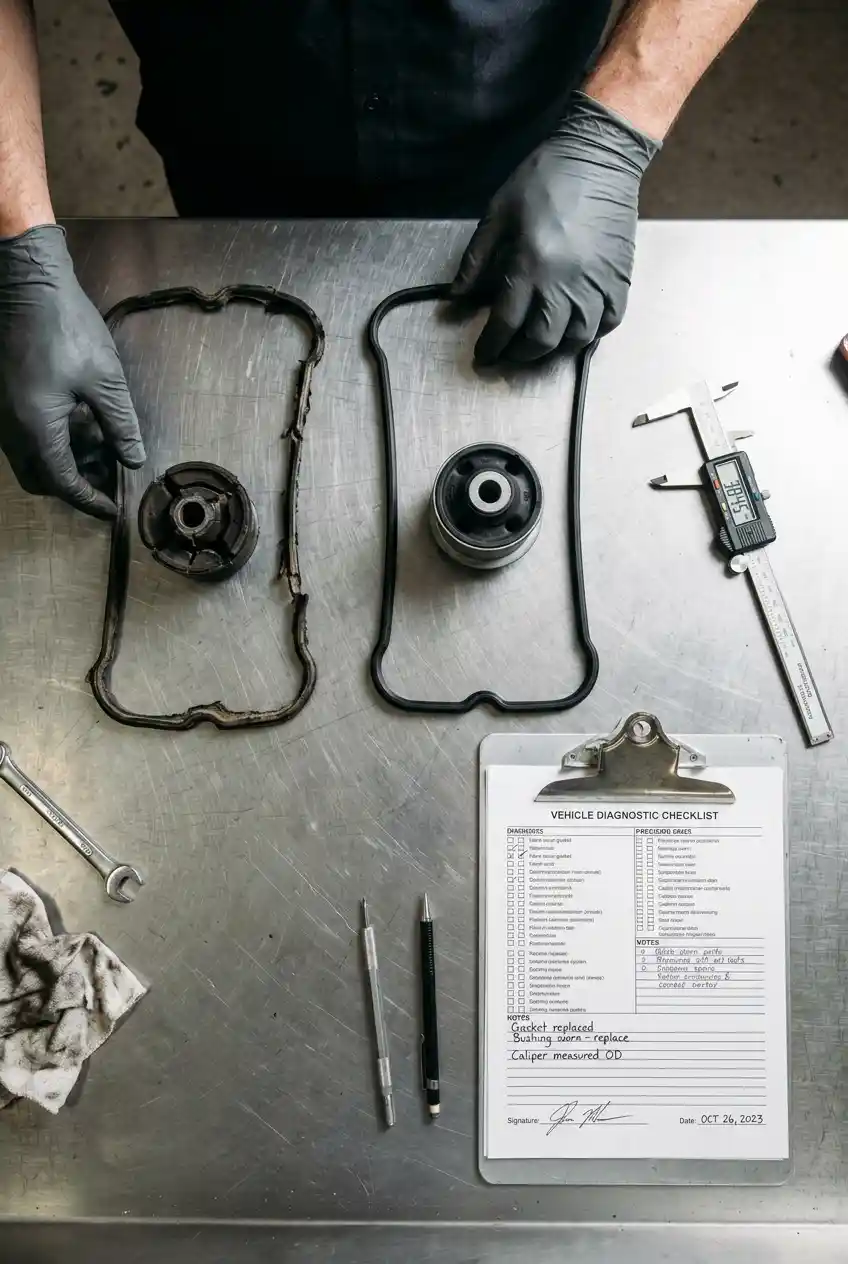
Start with fitment, consequence and evidence.
The packaging route matters, but the decision begins with the exact application, the cost of a wrong choice and the proof supplied with the part.
Audi Genuine parts
These are supplied through the Audi parts system in Audi packaging under an Audi part number. The route offers the clearest catalog trace, supersession information and compatibility with factory repair information. Audi states that its genuine parts are designed, supplied and tested against brand requirements. See the official Audi Middle East parts and accessories overview.
OEM-supplier parts
OEM is often used loosely. A manufacturer may supply one component to Audi yet sell a different specification in its independent range. Ask for the actual maker, part number, country of origin and application data. A logo or the phrase OEM quality is not proof of an identical part.
Aftermarket parts
Aftermarket covers a wide spectrum, from reputable engineering brands with strong catalogs to anonymous copies. Selection depends on the manufacturer, test evidence, materials, tolerances and local support. Compare the exact product, not the broad category.
Remanufactured and exchange parts
A properly remanufactured unit is dismantled, measured, renewed and tested to a defined process. A merely cleaned used part is not remanufactured. Audi also operates genuine exchange routes for selected components, described in its official exchange-parts explanation.
Parts by system
Common Audi spare parts owners ask for in Dubai
A useful parts guide should identify the component family before comparing brands or prices. The exact part still depends on VIN, engine, gearbox, brake package, market specification and production revision.
Engine and routine service parts
Oil, air and cabin filters, spark plugs, ignition coils, belts, tensioners, engine mounts, PCV components, diverter valves, injectors, fuel pumps, sensors, gaskets and seals are common requests. The correct specification can vary by engine code even when two cars share the same model badge.
Cooling and air-conditioning parts
Water pumps, thermostats, radiators, coolant valves, expansion tanks, hoses, fans, AC compressors, condensers, evaporator-related parts and pressure sensors must be matched to the installed system. Leak diagnosis should come before parts ordering.
Gearbox and drivetrain parts
S tronic and automatic gearbox filters, pans, seals, mechatronic units, clutch-related components, mounts, driveshafts, CV joints, wheel bearings, propshaft parts and differential components require gearbox code and drivetrain confirmation, not only model and year.
Brake, steering and suspension parts
Brake pads, discs, wear sensors, calipers, control arms, bushings, links, dampers, air-suspension components, wheel bearings and steering parts affect safety and geometry. Brake size, axle load and suspension option codes can change the required component.
Electrical, lighting and control modules
Starter batteries, auxiliary batteries, alternators, starters, ABS modules, parking sensors, cameras, MMI units, headlamps, tail lamps, window regulators and control modules can require coding, adaptation, component protection or calibration after installation.
Body, glass and interior parts
Bumpers, mirrors, grilles, lamps, undertrays, wheel-arch liners, trim, door hardware, seats, switches and windscreens can differ by S line, RS, driver-assistance equipment, camera position, market specification and finish code.
Performance S and RS parts
S and RS models can use different brakes, cooling packages, dampers, mounts, exhaust components, drivetrain hardware and electronics from the related standard model. Do not assume an A or Q family part fits the corresponding S or RS version.
e-tron and high-voltage parts
Charging hardware, high-voltage cooling components, electric-drive modules, isolation-related components and battery-system parts require model-specific high-voltage procedures. Diagnosis and authorization should be completed before ordering or fitting any high-voltage component.
Installed price guide
Indicative Audi parts and replacement costs in Dubai
Use these ranges to understand the likely scale of a common part-related job before a VIN-specific quote. They are installed-budget guides, not fixed parts-counter prices. The exact model, part route, access, supporting hardware, fluids, coding and calibration can move the final amount.
| Common part-related job | Indicative installed range | Main price drivers |
|---|---|---|
| Engine or cabin filter replacement | AED 250 to AED 800 | Filter type, model access and Genuine, OEM-supplier or aftermarket route |
| Battery replacement with registration where required | AED 650 to AED 1,800 | AGM or EFB specification, capacity, battery location and battery-management setup |
| Spark plug set replacement | AED 650 to AED 1,800 | Cylinder count, plug specification and engine access |
| Ignition coil replacement | AED 400 to AED 900 each | Coil type, brand route, diagnosis and engine layout |
| Brake pads per axle | AED 700 to AED 2,400 | Brake package, pad route, wear sensor and performance specification |
| Brake pads and discs per axle | AED 1,800 to AED 6,000 | Rotor diameter, brake package, hardware and performance-model parts |
| Water pump or thermostat repair | AED 1,500 to AED 5,500 | Engine layout, combined housing, coolant, seals and labor access |
| Control arm or suspension arm replacement | AED 900 to AED 2,500 each | Arm design, included joints or bushings, axle side and alignment requirements |
| Wheel bearing replacement | AED 800 to AED 1,800 | Hub design, axle position, quattro hardware and seized-component labor |
| Alternator replacement | AED 1,200 to AED 3,500 | Output rating, access, belt system and Genuine, supplier or remanufactured route |
| Radiator or major cooling component replacement | AED 1,200 to AED 4,000 | Cooling package, shutters or sensors, coolant and front-end access |
| MMI, lighting or other coded control module replacement | AED 2,500 to AED 7,000+ | New or used condition, software index, component protection, coding and calibration |
| S tronic or DSG mechatronic-related replacement | AED 7,000 to AED 15,000+ | Gearbox code, new or exchange unit, fluid, adaptation, diagnosis and associated clutch or hydraulic faults |
Dubai parts request
What to send before an Audi part is quoted or ordered
The fastest useful parts request is not just a model name. Send enough vehicle and component information to eliminate avoidable fitment errors before the car is dismantled or a non-returnable part is ordered.
Availability in Dubai
Common service and wear items are generally easier to source than model-specific modules, unusual body parts, performance hardware or older revisions. Stock status should be checked against the exact part number before promising collection or installation. A superseded number can also change what must be ordered with it.
Customer-supplied parts
A customer-supplied component still needs application, condition and supporting-hardware checks. If the part is wrong, used, incomplete or cannot be coded, the installation risk and any additional labor should be agreed before work starts.
Condition choice
New, used or remanufactured Audi parts
| Condition | Best use case | Main checks | Where caution is highest |
|---|---|---|---|
| New Audi Genuine | Safety-sensitive, software-dependent, deep-access or revised components where catalog certainty is valuable | VIN, supersession, included hardware, coding and warranty terms | Cost and availability can be higher than alternatives |
| New OEM-supplier | Service and mechanical parts where the exact independent specification is documented | Actual manufacturer, part number, application data and warranty | Do not treat the words OEM quality as proof of identical specification |
| New aftermarket | Lower-consequence or budget-sensitive repairs with a traceable reputable product | Brand, materials, certification where relevant, catalog fit and local support | Avoid unknown products for safety, high-voltage or calibration-sensitive systems |
| Remanufactured or exchange | Selected mechatronic, electrical or powertrain components when the rebuild process is defined | Rebuilder, replaced internals, test report, core return and commissioning requirements | Reconditioned can mean very different things if no process is documented |
| Used genuine | Obsolete trim, body hardware and selected non-safety components where condition is visible | Donor part number, provenance, damage, water exposure, coding restrictions and return rights | Restraints, steering, brakes, high-voltage and security-linked electronics need much stronger justification |
Audi itself distinguishes new Genuine parts, used Genuine parts and Genuine exchange parts. Its exchange program remanufactures selected components to a defined process rather than simply reselling a cleaned used item.
Warranty and records
Ask for job-specific terms before authorizing work
Current workshop terms state six months labor-only cover on qualifying repairs using original or Audi Genuine parts, three months labor-only cover on qualifying OEM-part jobs and one month cover on qualifying AFM or aftermarket work. Eligibility, exclusions and the written estimate control. These are independent-workshop terms, not an Audi manufacturer warranty.
A parts manufacturer may offer separate cover, but removal labor, shipping, fluids and consequential damage may be excluded. Record who handles a claim and what evidence is needed. Audi warranty terms published for other markets or dealer networks do not automatically apply to an independent Dubai workshop.
- Put the manufacturer and part number on the invoice.
- State whether the item is new, remanufactured or used.
- List coding, calibration and consumables separately.
- State the labor and parts warranty separately.
- Keep pre-repair and post-repair evidence.
Identification
The VIN is only the beginning of correct fitment

The VIN narrows the route. The installed hardware confirms it.
An Audi model name and year rarely identify every installed component. A model-year change, engine or gearbox code, brake package, market specification, production date and PR code can change the part. The original item may also have been superseded several times.
A catalog result that says the part fits is a starting point, not final authorization. Photographs and measurements help, but they cannot replace application data. When a car has a non-original engine, brake conversion or previous wiring modification, inspect what is actually installed.
Risk control
Use the strictest route where failure can change control or containment
Parts in braking, steering, restraints, fuel containment, high-voltage isolation and structural crash paths deserve the highest verification. The decision should consider the complete system, not only whether the new item can be bolted in.
| Part family | Minimum evidence before approval | Common hidden dependency |
|---|---|---|
| Brake and steering | Exact application, traceable maker, material and dimensional conformity | Single-use hardware, bedding, fluid, alignment or calibration |
| Airbag and restraint | VIN compatibility, provenance and approved repair path | Crash data, coding, connectors and related sensors |
| Fuel and cooling | Pressure, temperature and chemical compatibility | Seals, clamps, priming, bleeding and contamination |
| High-voltage system | Model-specific authorization, isolation procedure and test evidence | Component protection, software, coolant circuit and insulation tests |
| Suspension and wheels | Axle load, geometry, matched side strategy and documented brand | Ride-height calibration, alignment and driver-assistance calibration |
Do not approve an unknown part because the vehicle is old or the first quote is lower. Older Audis can be more sensitive to connector aging, brittle hoses and seized hardware, which raises the cost of repeating the job.
Electronics
Some correct parts still need coding and guided setup

Physical fit does not guarantee electronic acceptance.
A physically correct control unit, sensor, steering component, battery or lighting module may not function correctly until coding, parameterization, basic settings or adaptation is completed. Some modules are linked to immobilizer or component-protection systems. A used module can have restrictions that are not visible in a catalog listing.
Before ordering
- Save the complete scan and original coding.
- Confirm software and hardware index.
- Check whether online authorization is required.
- Identify calibration and test-drive requirements.
- Confirm whether the old unit must remain available.
After installation
- Record new part and serial numbers.
- Complete applicable coding and basic settings.
- Clear only after the pre-repair record is saved.
- Verify functions and related warnings.
- Attach a post-repair scan or measured result.
A cheap electronic unit becomes expensive when it cannot be commissioned, creates communication faults or has to be removed twice. Include diagnostic and programming time in the comparison before selecting the part.
Installed value
Compare total repair cost instead of box price
The purchase price is only one line. Add seals, fasteners, fluids, machining, programming, calibration, access labor, alignment, disposal and the probability of repeat removal. A lower-cost component can still be the rational choice when access is easy and failure has limited consequences. A higher-assurance route is usually easier to justify where labor is deep or a failure can damage connected systems.
| Question | Why it changes the decision |
|---|---|
| How much labor is required to reach the part again | Deep-access parts carry a larger repeat-labor risk. |
| Can failure damage another system | A weak tensioner, pump or seal can create a much larger repair. |
| Does the repair require one-time hardware | Reused bolts, seals or clips can invalidate an otherwise good part choice. |
| Is the car being retained or prepared for sale | The intended ownership period affects value, but not safety or correct fit. |
| What evidence will be supplied | Part number, brand, photos, test results and invoice make the repair traceable. |
Repair completeness
Supporting hardware often decides whether the repair lasts

The surrounding hardware can decide whether the repair lasts.
A replacement part does not correct worn connectors, contaminated fluid, restricted lines, damaged mounts or an unresolved root cause. Ask what caused the original failure and what must be inspected before the new unit is exposed to the same condition.
Typical supporting items
Seals, gaskets, O-rings, stretch bolts, circlips, clamps, filters, fluids, desiccant, mounting hardware and protective sleeves may be required by the procedure or by observed condition.
Typical connected checks
Oil or coolant contamination, wiring voltage drop, ground integrity, pressure control, blocked drains, wheel alignment, cooling airflow and software faults can determine whether the new component survives.
If diagnosis is uncertain, do not turn the parts catalog into the test plan. Preserve fault data and use measured checks first. A replacement that temporarily masks a symptom is not evidence of a correct root-cause repair.
Category decisions
Match the selection standard to the component family
Filters, plugs, belts and service items
Routine service parts are often where a documented OEM-supplier or established aftermarket option makes sense. Yet the part must still meet the exact specification. An oil filter is judged by media, bypass-valve behavior, anti-drainback function, housing dimensions and seal quality, not only thread size. A spark plug must match heat range, reach, seat, gap and electrode design. A belt needs the correct length, rib profile and material, while its tensioner and pulleys need inspection.
Ask whether the quote includes every seal and whether the fluid or lubricant has the correct approval. A filter from a respected maker can still be wrong for the engine code. Mixed service kits assembled by an unknown seller deserve more scrutiny than individually traceable components.
Cooling, fuel and air-management parts
Water pumps, thermostats, valves, hoses, fuel modules and charge-air components operate under pressure and temperature. Material compatibility and control behavior matter. Inspect mating faces, electrical plugs and connected pipes. A revised genuine part may address a known design change, while a credible supplier part may be appropriate when its cross-reference and specification are explicit.
Do not replace a pump simply because a low-pressure code is present. Measure supply, control and leakage first. Contaminated fuel, damaged wiring or a blocked pickup can damage the replacement. Similarly, a boost hose can be the visible leak while failed mounts or oil contamination are the reason it split.
Chassis wear components
Control arms, bushings, dampers, bearings and mounts affect geometry, noise and braking stability. Compare design, rubber hardness, joint articulation and included hardware. Replace by measured wear and axle behavior, then align where geometry has been disturbed. A premium part installed into a bent wheel or damaged subframe will not restore the intended result.
Body, trim and convenience equipment
For non-safety trim, switches and cosmetic pieces, a used genuine item may offer better fit than a poor copy. Verify color code, finish, connector and condition. Water-damaged modules and repaired lighting units can hide corrosion. Lamps may also require market-specific beam pattern, control units, coding and calibration, so a body-looking part can still be an electronic decision.
Choice matrix
Use a documented reason for every route
| Repair situation | Usually strongest starting route | What could change it |
|---|---|---|
| Deep-access seal, pump or timing-area component | Genuine or fully traceable high-assurance supplier | Verified equivalent specification, proven local support and complete hardware |
| Routine filter or wear item with easy access | Genuine, documented OEM-supplier or reputable aftermarket | Approval, filtration, fit and written warranty |
| Safety, restraint or high-voltage component | VIN-verified genuine or manufacturer-approved route | Only model-specific repair information and explicit authorization |
| Electronic module with protection or coding | Known-new or authorized exchange route | Commissioning ability, software index and return conditions |
| Obsolete cosmetic trim | Good used genuine part | Condition, finish, mounting points and seller evidence |
| Older car with budget limits | Prioritized repair using traceable alternatives | Never relax safety, correct fit or root-cause diagnosis |
The matrix is a discussion tool rather than a universal rule. A known problem on one engine or a revised factory component can move a repair toward the genuine route. Strong independent manufacturer data and a simple installation can make another route reasonable. The estimate should capture why the chosen option fits this car and this repair.
Supplier checks
Reject vague listings and incomplete evidence
Counterfeit, relabeled and incorrectly cataloged parts can look convincing. Packaging color, a hologram or a marketplace rating is not enough. Buy through a traceable route and preserve the label until the repair passes verification.
Warning signs before purchase
- No manufacturer name beyond a seller brand.
- No full part number or only a partial cross-reference.
- One listing claims fit across incompatible engines or years.
- Photos hide labels, connectors or manufacturing marks.
- The price is far below normal without a documented reason.
- Warranty requires overseas return with no local support.
Evidence worth keeping
- Supplier invoice and date.
- Packaging and component labels.
- Batch, serial or production code.
- Photographs before installation.
- Catalog fitment record and supersession note.
- Post-installation scan, alignment or pressure result.
Inspect the new part beside the removed item. Compare connector keys, mounting faces, ports, sensor orientation and supplied seals before the vehicle is dismantled further. If the removed part is damaged, retain it until the diagnosis and warranty position are clear.
Interactive parts route selector
Choose the route, then read the evidence it must carry
This selector does not approve a brand or part number. It shows what must be proven for each route before the component is fitted.
Use the catalog route as the reference
Match the VIN, PR codes, original number and current supersession. Confirm whether coding, one-time hardware, seals, fluids or calibration are required. This is the normal workshop route where the risk of a wrong application or repeat labor is high.
Prove that the independent part is the correct specification
Name the actual manufacturer and part number. Do not rely on “same factory” language. Compare dimensions, connectors, revision, material, software compatibility and application data with the catalog reference.
Use aftermarket selectively and transparently
State the brand, tier, origin, certification where relevant and written cover. Favor traceable products for low-consequence or budget-sensitive applications. Avoid vague listings for restraint, braking, steering, high-voltage or calibration-sensitive parts.
Define the rebuild standard and exchange conditions
Record the rebuilder, replaced internal components, test report, coding requirements, core return, contamination exclusions and warranty process. “Reconditioned” without a documented scope is not a usable specification.
Owner scenarios
Apply the framework to real repair choices
A coolant pump behind major access work
The repeat-labor exposure is high and a leak can lead to overheating. Confirm the root cause, revised part number, seals, fasteners, coolant approval and bleeding procedure. Compare the installed warranty, not only the pump price. A low-cost unknown unit is difficult to justify when replacement requires repeating extensive labor.
A front suspension arm with a split bushing
Confirm whether the joint, bushing or complete arm is serviceable, then check the opposite side, tire wear, wheel damage and alignment. A reputable supplier part may be reasonable if geometry and materials are documented. Replacing both sides should follow condition and axle behavior, not a blanket sales rule.
A lighting control module after water ingress
Do not install a module until the leak path and connector corrosion are corrected. Confirm hardware index, coding and component-protection requirements. A used unit with no return route may cost more than a new or authorized exchange unit once programming and repeat diagnosis are included.
A brake service on a daily-driven Audi
Compare rotor dimensions, pad compound, wear sensor, hardware and bedding requirements. The quietest, lowest-dust option may trade differently against initial bite or high-temperature behavior. State the intended use. Safety conformity and predictable axle balance remain non-negotiable.
These examples show why a single brand rule is inadequate. The component, failure consequence, access and evidence determine the defensible choice.
Owner questions
Common questions about Audi replacement parts
Are OEM and Audi Genuine parts always identical
No. The same industrial group may manufacture both, but specification, catalog route, included hardware, quality controls and warranty can differ. Compare actual part numbers and documentation.
Are aftermarket parts always lower quality
No. Some reputable aftermarket products are excellent, while others are poorly documented. Judge the named manufacturer, exact application, evidence and repair risk.
Can I fit a used Audi control module
Sometimes, but first confirm hardware and software index, component protection, immobilizer restrictions, coding route and return rights. Physical fit does not prove commissionability.
Should both sides be replaced together
It depends on wear pattern, axle behavior, manufacturer guidance and the item. Matched dampers or springs may be justified, while an undamaged electronic component may not be.
Can I supply my own part
Ask before purchase. The workshop must confirm application, condition, supporting hardware and responsibility if the part is incorrect or fails. Written terms should distinguish supplied-part risk from installation workmanship.
What should a good estimate show
VIN basis, diagnosis, brand, part number, condition, quantity, labor, supporting items, setup work, VAT, exclusions and separate warranty terms.
Bring the VIN and the evidence
Send the VIN, current part number, fault symptoms and any scan report. We can separate diagnosis, parts options and installation requirements before authorization.
Final fitment, repair scope and price require vehicle inspection and VIN-specific verification.