
Audi e-tron Repair and Service in Dubai
This page covers the original Audi e-tron SUV and Sportback, including e-tron 50, e-tron 55 and S derivatives built before the Q8 e-tron naming change. Its high-voltage battery, two-motor drivetrain, four connected thermal circuits, charging equipment, brake recuperation and air suspension need coordinated testing. We separate a charging-station problem, vehicle-side fault, cooling concern, 12-volt issue and mechanical defect before any major component is discussed.
The original e-tron is not a generic name for every Audi EV

The renamed successor is covered on the Audi Q8 e-tron repair page. The Q4 e-tron and e-tron GT use different vehicle platforms and should not inherit this page’s repair assumptions.
Audi first used e-tron as the name of its large electric SUV. Later, e-tron became the wider electric sub-brand and the original SUV evolved into the Q8 e-tron. Parts searches, scan plans and charging assumptions become unreliable when those uses are mixed.
Original SUV and Sportback
Confirm the GE platform vehicle, build date, market, battery version and whether it is an e-tron, e-tron Sportback or S model. Body shape alone does not identify every installed component.
Battery and dual-motor layout
The floor battery, front and rear drive units, power electronics and onboard charging equipment exchange data with thermal and brake controllers. A fault in one area can limit another.
Q8 e-tron needs its own data
The Q8 e-tron brought updated pack capacity and charging behavior. Use its dedicated page and VIN references rather than applying a pre-facelift e-tron procedure. The low-roof performance model has a separate Audi e-tron GT repair page because its 800-volt architecture and rear two-speed transmission create a different test path.
Six Audi e-tron concerns that require different test routes
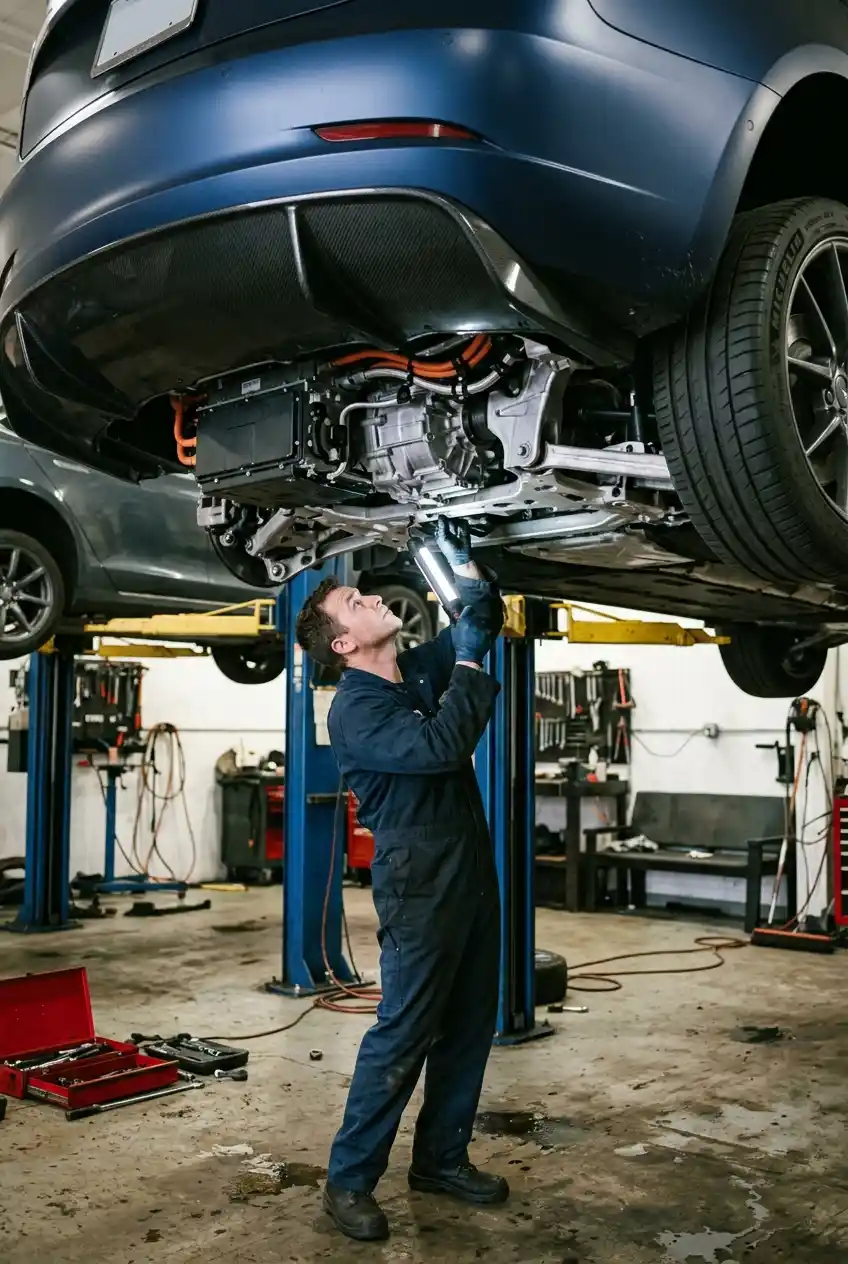
Preserve the exact message and conditions, then compare its urgency with the Audi dashboard warning lights guide.
A message on the dashboard is a starting point. The technician still needs to reproduce the event, scan all relevant controllers and decide whether the problem is external, low voltage, high voltage, thermal or mechanical.
| Driver concern | First evidence to preserve | Workshop direction |
|---|---|---|
| AC charging will not begin | Wallbox status, cable used, indicator sequence, timer settings and whether another charger works | Inspect inlet condition, communication, onboard charger data, low-voltage supply and thermal permissions. |
| DC fast charging is unexpectedly slow | Battery state of charge, starting temperature, route preconditioning, charger rating and charging curve | Compare requested and delivered power, battery temperature, cooling performance and station limitations. |
| Electrical-system warning appears | Exact text, time, weather, state of charge, recent work and whether propulsion remains available | Run a complete scan, check 12-volt stability, network communication, isolation data and related event memory. |
| Cabin cooling weakens in traffic | Vent temperature, fan behavior, parked versus moving performance and charging status | Test refrigerant circuit, electric compressor command, coolant valves, heat exchangers and battery thermal demand. |
| Range estimate drops quickly | Recent consumption, tire pressures, climate use, speed, payload and charging history | Separate normal energy use from brake drag, thermal inefficiency, battery imbalance or stored powertrain faults. |
| Ride height or comfort changes | Corner height, time after parking, drive mode, warning text and compressor sound | Measure air loss, compressor output, level sensors, links, dampers, control data and calibration. |
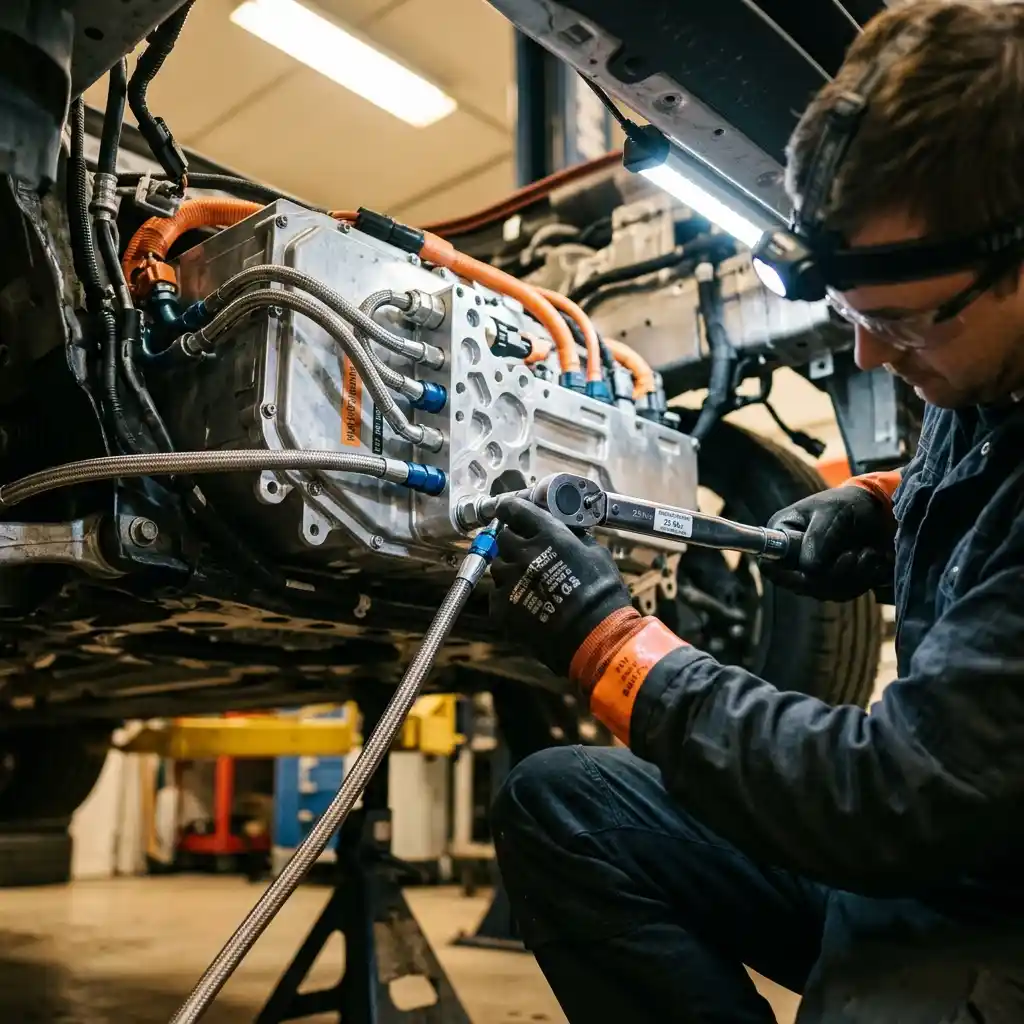
Thermal management deserves more than an AC check
The original e-tron uses four thermal circuits that can be connected as operating conditions demand. They control temperature for the high-voltage pack, two drive units, inverters, charging hardware and climate system. In Dubai, a complaint that appears during fast charging, long highway use or stationary cabin cooling needs temperature data from the complete system.
Battery temperature control
Inspect coolant condition, leakage evidence, pumps, valves, sensors and commanded flow. Charging performance can be restricted when the battery is outside its permitted temperature window or the system cannot remove heat as expected.
Electric drive and power electronics
Front and rear drive components generate and exchange heat differently under acceleration, cruising and recuperation. Compare temperatures and torque requests rather than assuming reduced output means a failed motor.
Cabin climate demand
The electric compressor and heat-pump functions interact with battery conditioning. Test vent output, pressure, coolant temperatures and control permissions under the conditions reported by the owner.
Charging hardware temperature
Inspect the inlet, cable interface and onboard charging path for heat or communication limits. A session that stops at one charger but succeeds elsewhere requires a controlled comparison.
Orange cables and battery housings are not owner inspection points
Do not open high-voltage connectors, lift on an unconfirmed battery point, probe orange wiring or touch a damaged underbody enclosure. After collision, flooding, smoke, unusual heat, isolation warnings or visible battery damage, keep people away from the vehicle and arrange recovery through a party equipped for the condition.
Workshop work begins with vehicle identification, hazard assessment and the approved de-energizing procedure. Isolation testing, absence-of-voltage confirmation and controlled reactivation belong in the documented job process. Replacing a 12-volt component does not remove the need to preserve high-voltage fault evidence when both systems are involved. Audi’s official e-tron rescue information also states that high-voltage components and the battery must not be opened or cut.
Build an e-tron service plan around EV equipment and measured wear
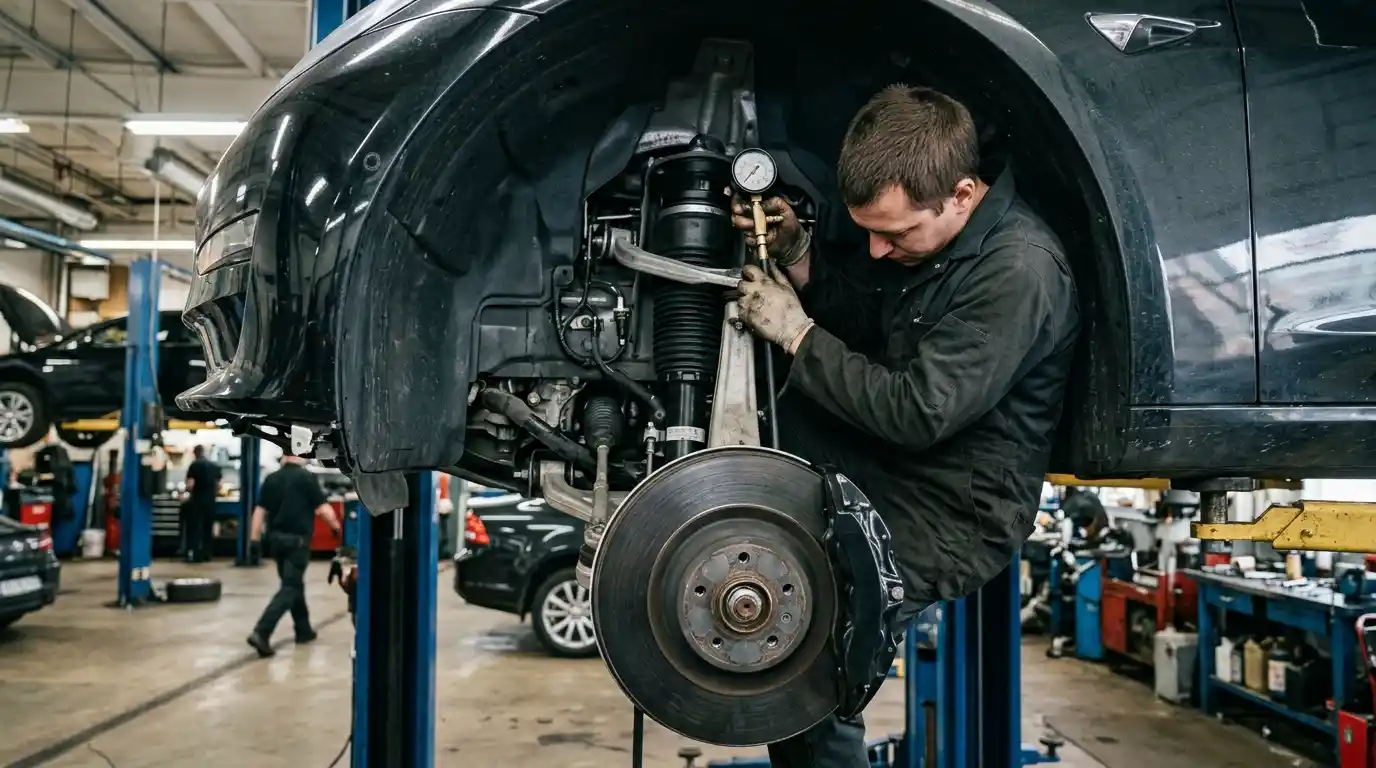
There is no engine oil, spark-plug or exhaust service on this vehicle. The useful plan combines the applicable Audi schedule with battery cooling, charging, braking, tires, suspension, 12-volt supply and software evidence.
Confirm campaign, software and service history
Use the VIN and production date to identify the correct maintenance information and any manufacturer action. Record software changes because charging or warning behavior may differ after an update.
Inspect fluid and thermal condition
Check brake fluid according to the applicable schedule, inspect coolant circuits for leakage or contamination and verify cabin cooling performance. Fluid specification must follow the exact system.
Measure brakes instead of judging pedal feel
Energy recovery can reduce how often the hydraulic brakes operate, but discs may still corrode and calipers can bind. Measure pad and disc condition, test hydraulic operation and compare wheel temperatures when drag is suspected.
Record tire and geometry evidence
Vehicle mass, torque and tire specification affect wear and energy use. Note specified dimensions, load index and speed symbol, pressures, age, repairs, axle matching, tread pattern, runout and alignment results.
Test the 12-volt system under load
The low-voltage battery wakes controllers, releases contactors and supports communication. A simple resting-voltage reading is not enough when warnings appear during startup or after parking.
Finish with the original complaint
After approved work, repeat the same charging session, road condition, thermal load or parking period that caused the problem. Keep the final scan and relevant measurements with the invoice.
Module, pack and non-battery faults must be separated
A reduced-range complaint can come from climate load, tire pressure, brake drag, recent driving pattern, cold or hot battery conditioning, software estimation or a powertrain fault. Battery state information, cell spread, isolation data, temperature history and charging behavior help define whether the concern is inside the pack.
Even when battery data points to an internal problem, the repair boundary is not decided by one code. The estimate should state whether the supported path is external wiring or cooling work, a serviceable battery component, authorized module-level work or complete pack replacement. Compatibility, transport, storage, commissioning and warranty conditions belong in the written scope.
Prove supporting-system faults
Charging inlet, contactor control, coolant flow, sensors, wiring, low-voltage condition and control software may influence battery operation without cell damage.
Use qualified HV procedures
Internal access requires controlled isolation, suitable facilities, protective equipment and a repair route supported for the exact battery.
Commission and verify
Complete prescribed sealing, isolation, coding, charging and road tests. Record the final values rather than relying on a cleared dashboard.
Buy the charging and thermal evidence, not only the displayed range
Arrange the inspection with enough battery charge for a controlled road test and, where practical, an observed charging session. Confirm VIN, import status, service evidence, keys, cables and software history. Ask whether the vehicle has had battery, cooling, collision or underbody work.
On the lift, examine the underfloor battery casing and guarded lifting areas without opening high-voltage components. Measure tires and brakes, check air-suspension height and look for coolant residue, impact marks and incorrect lifting damage.
During the drive, compare front and rear motor response, recuperation, friction-brake transition, steering, vibration, climate performance and warnings. Afterward, rescan the car and compare temperatures rather than treating a short silent drive as proof of condition.
Price service backlog, consumable wear, charging equipment and confirmed faults separately. Delay the purchase if the seller blocks a full scan, underbody inspection, independent charging test or documentation review.
AC and DC failures do not travel through the same e-tron hardware
Alternating-current charging sends power through the vehicle’s onboard charging equipment before the high-voltage battery receives it. Direct-current fast charging uses a different energy path and depends on the station supplying controlled DC power after communication and safety checks. A vehicle that accepts DC but refuses AC points the workshop toward different components than one that fails on both.
For AC concerns, preserve the wallbox message, available current, cable type, charge schedule, inlet lights and time until failure. Check whether the fault appears on single-phase or three-phase equipment where relevant to the vehicle and installation. The building supply and protective equipment should be assessed by an appropriately qualified party when external power quality is questioned. Vehicle work should concentrate on inlet condition, locking, communication, onboard charger data, low-voltage readiness and thermal permissions.
For DC concerns, record the initial battery percentage plus battery temperature before comparing power. Fast-charging output normally changes through the session, so a low number near a high state of charge is not equivalent to a low number from a prepared battery at a lower state of charge. Read requested versus delivered current, battery-imposed limits, coolant response, station restrictions and connector temperature. A second compatible station can help separate repeatable vehicle behavior from one site.
When both AC and DC fail, start earlier in the authorization chain. Check the 12-volt system, control-unit wake-up, inlet detection, charging settings, high-voltage contactor status, isolation information and stored events. Do not repeatedly disconnect the low-voltage battery to make the message disappear. That may remove useful timing evidence without correcting the initiating fault.
An e-tron diagnostic report needs values, conditions and exclusions
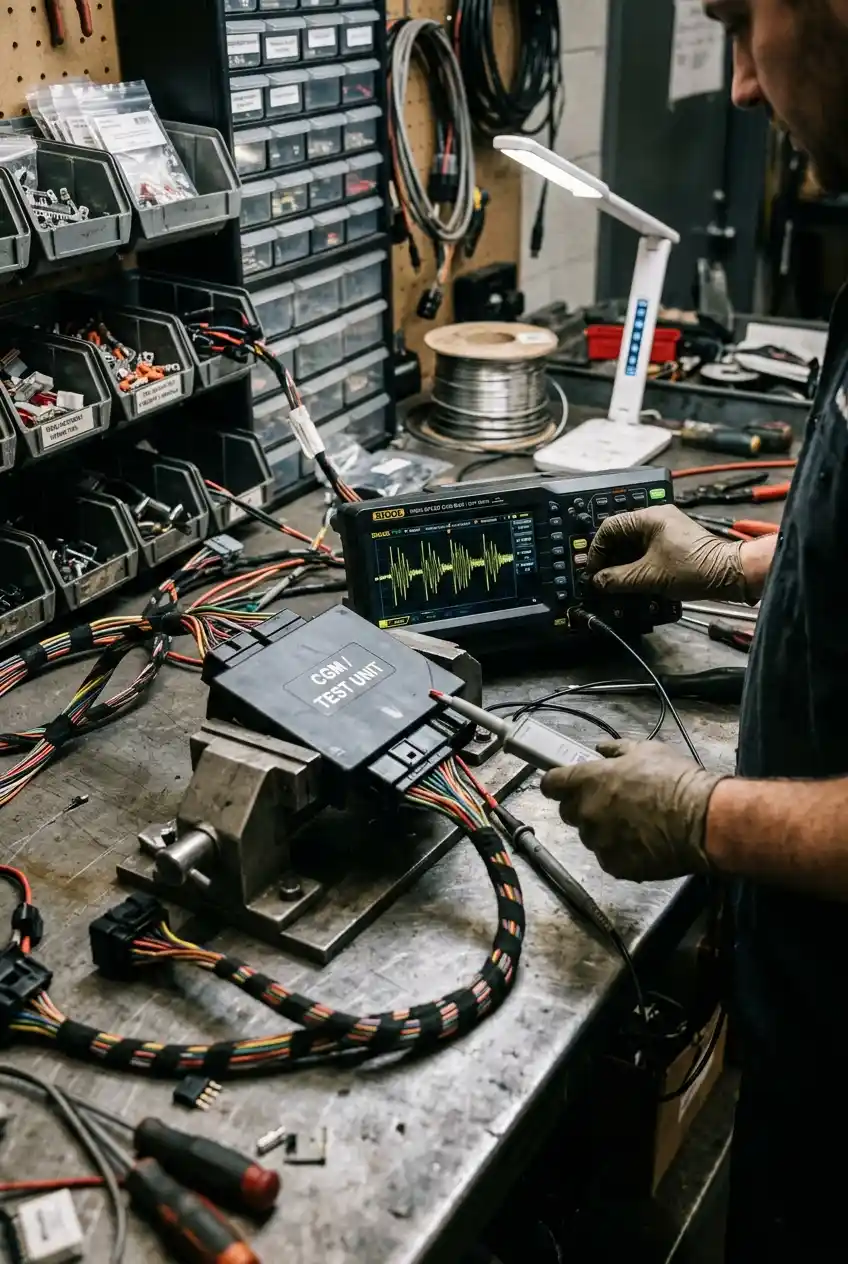
Arrival condition
Record state of charge, displayed range, battery and ambient temperatures, exact dashboard text, recent route, charging cable and whether the car arrived under its own power. Photograph any underbody or inlet damage before lifting or connecting equipment.
Controller evidence
Keep the complete scan, event status and useful freeze-frame information. Note which faults are active, intermittent or consequences of low voltage. Clearing all controllers before reviewing their sequence can make diagnosis longer.
Physical measurements
Add brake dimensions, tire data, ride height, 12-volt test results, coolant or refrigerant findings and any charging-session values relevant to the complaint. A scan should support physical testing, not replace it.
Excluded causes
State which external charger, cable, tire, brake, cooling or supply problems were checked and ruled out. This protects the owner from paying for a large assembly when a supporting system created the same symptom.
Keep immediate faults, scheduled work and future monitoring separate
Immediate work covers a confirmed condition that affects safety, charging, propulsion, cooling or reliable vehicle operation. Scheduled work follows the applicable maintenance information for the VIN. Monitoring covers a stable measured condition that does not yet justify parts, with a written review point and symptoms that require earlier action.
A clear estimate names the failed area and the evidence behind it. For example, an AC charging repair should identify whether the supported fault is the inlet, lock, communication wiring, onboard charger, low-voltage supply or thermal control. A battery-cooling estimate should distinguish an external pump, valve, heat exchanger, sensor or hose from an internal battery concern.
Parts descriptions also matter. The owner should know whether the proposed item is new genuine, OEM, aftermarket, remanufactured or used, whether coding or commissioning is included and what warranty terms apply to that qualifying job. High-voltage shipping, storage or return conditions may affect the available route for larger assemblies.
For longer ownership, keep charging history, software actions, tire replacements, alignment reports, brake measurements and cooling repairs with the service file. Those records make later range, vibration and charging changes easier to compare. They also provide stronger evidence during a used-car sale than a screenshot of the current range estimate.
Use local conditions to make future e-tron diagnosis faster
Keep a simple log when a charging concern is intermittent. Record the station, AC or DC connection, time of day, starting state of charge, ambient temperature, charging power shown at useful intervals and the exact point where the session slows or stops. Add a photo of the vehicle and station message. This evidence is more valuable than reporting that fast charging felt slow.
When range changes, compare a familiar route at similar speed, tire pressure, cabin setting and payload. Note heavy traffic, prolonged parked cooling and recent high-speed driving. If the difference remains, the workshop can check brake drag, wheel alignment, thermal efficiency, stored limits and battery information with a cleaner baseline.
After service, ask for the parts and fluid specifications used, the initial and final scan status and the actual test performed. Charging work should end with a completed session. Cooling work should include stable temperature and cabin-output evidence. Suspension work should show ride-height measurements and calibration where required. Battery-related work should state isolation, sealing, commissioning and warranty boundaries.
Audi e-tron repair and service FAQs
Does this page cover the Audi Q8 e-tron?
This page focuses on the original e-tron SUV and Sportback. The renamed and updated Q8 e-tron has a separate service page because battery, charging and model-year details can differ.
Why does my Audi e-tron charge at one station but not another?
The comparison is useful evidence. Connector condition, station communication, cable temperature, charge settings, battery temperature and vehicle fault memory should be checked before blaming the battery.
Can a weak 12-volt battery cause high-voltage warnings?
Low-voltage supply can disrupt control-unit startup and communication. Test the 12-volt battery, charging support and network condition while preserving the original fault data.
Does reduced displayed range prove battery damage?
No. Temperature, speed, climate use, tire pressure, recent consumption and battery state can change the estimate. Battery data and repeatable testing are needed before a repair conclusion.
What should be inspected after underbody impact?
Do not touch orange cables or a damaged battery enclosure. Arrange safe recovery and an inspection of the battery housing, cooling paths, isolation monitoring and nearby structure.
What information helps before an e-tron booking?
Provide the VIN, model year, mileage, warning photos, charging type, charger location, recent work, collision or water exposure and whether the car currently moves safely.
Book an original Audi e-tron assessment
Send the VIN, charging location, connector type, warning text, state of charge and conditions that reproduce the concern. The first appointment can then be scoped around the correct system.