
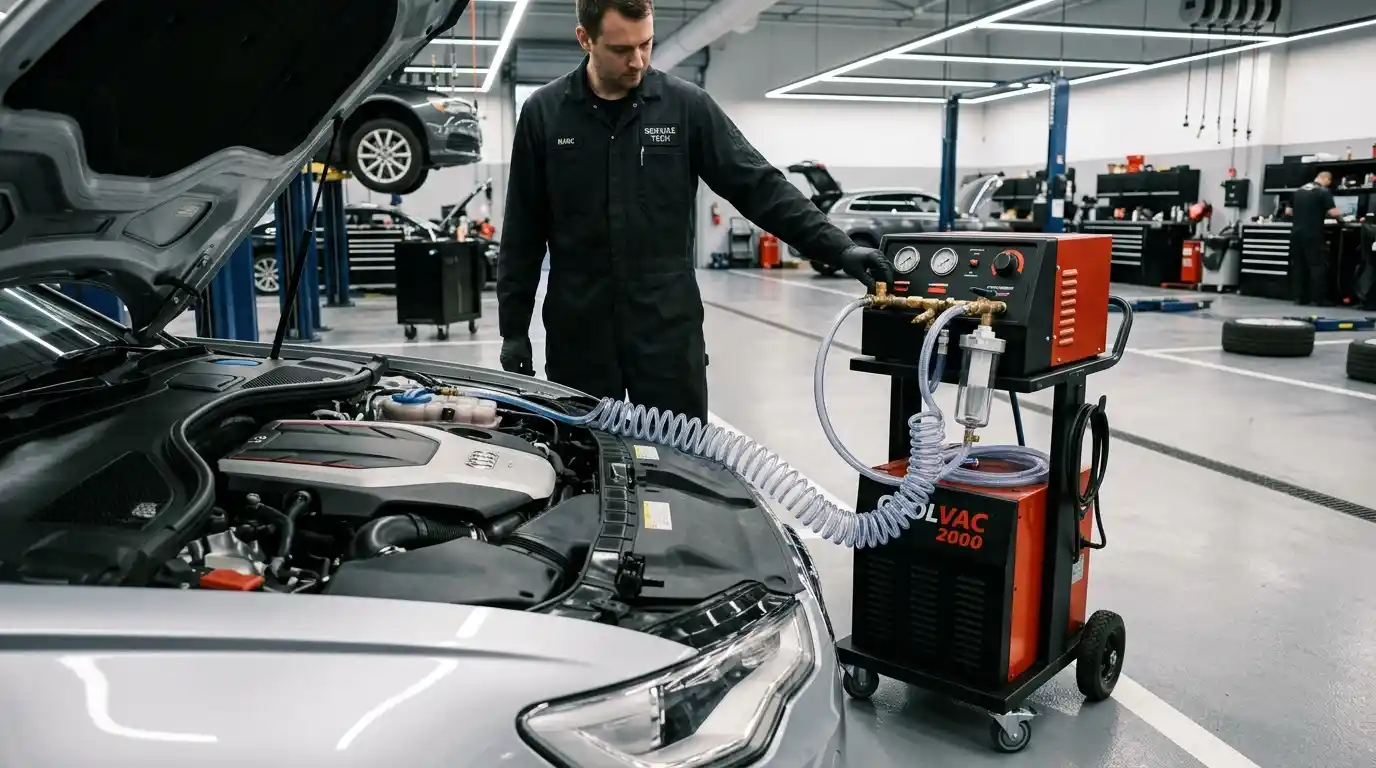
Audi Coolant Flush Service
An Audi coolant flush service should match the exact vehicle, installed cooling loops, existing fluid, and reason for service. We separate routine fluid renewal from contamination, leaks, trapped air, and overheating so the method treats the real need rather than masking a cooling-system fault.
First decide whether the Audi needs maintenance or diagnosis
A planned coolant service renews compatible fluid and restores the correct concentration and fill. It is appropriate only after the cooling system, history, and installed fluid have been considered. If the coolant is disappearing, the engine overheats, steam appears, the cabin heater changes unexpectedly, or fluid is contaminated, diagnosis comes first.
The term coolant flush is often used for several different jobs. A drain and refill removes the fluid that drains normally. A controlled exchange renews more of the system. Cleaning may be considered when contamination or incompatible fluid is confirmed, but the method must suit the system and material condition. Aggressive or unsuitable chemicals are not automatically safer or better.
On many Audi vehicles, air must be removed through a specific filling and bleeding process. Some configurations use pumps, valves, heaters, turbocharger circuits, auxiliary cooling, charge-air cooling, hybrid components, or electric-drive thermal loops. The VIN, model year, engine, drivetrain, and high-voltage configuration determine what is present.
Three routes that must not be confused
Each route has a different purpose. Starting with the wrong one can waste fresh coolant, leave air in the system, or delay repair of the fault that caused the complaint.
Routine fluid renewal
The engine behaves normally, there is no active loss, the fluid history is known, and the applicable service information supports renewal. The job focuses on the correct approval, concentration, controlled draining, refill, bleeding, and verification.
- Confirm the exact vehicle and coolant requirement.
- Inspect visible hoses, reservoir, cap, and connections.
- Choose drain and refill or exchange according to the system.
- Record the fluid and completed work.
Unknown or contaminated coolant
The fluid is mixed, the history is unclear, deposits are present, or oil or another substance may have entered the system. Assessment determines whether controlled cleaning is suitable and whether a failed cooler, gasket, or other component must be repaired first.
- Do not identify coolant by color alone.
- Check for material incompatibility and contamination source.
- Inspect rubber, plastic, alloy, and heat-exchanger condition.
- Plan repeat rinsing only when technically justified.
Leak or overheating diagnosis
The level drops, pressure is lost, a warning appears, fans behave abnormally, the heater goes cold, or temperature rises. The system needs testing before new fluid is treated as the repair.
- Pressure-test cold and assess hot behavior as appropriate.
- Check pump, thermostat, radiator, fan, cap, hoses, and flanges.
- Consider trapped air, sensor evidence, and internal leakage.
- Repair, refill, bleed, then verify under operating conditions.
Coolant approval matters more than the color in the reservoir
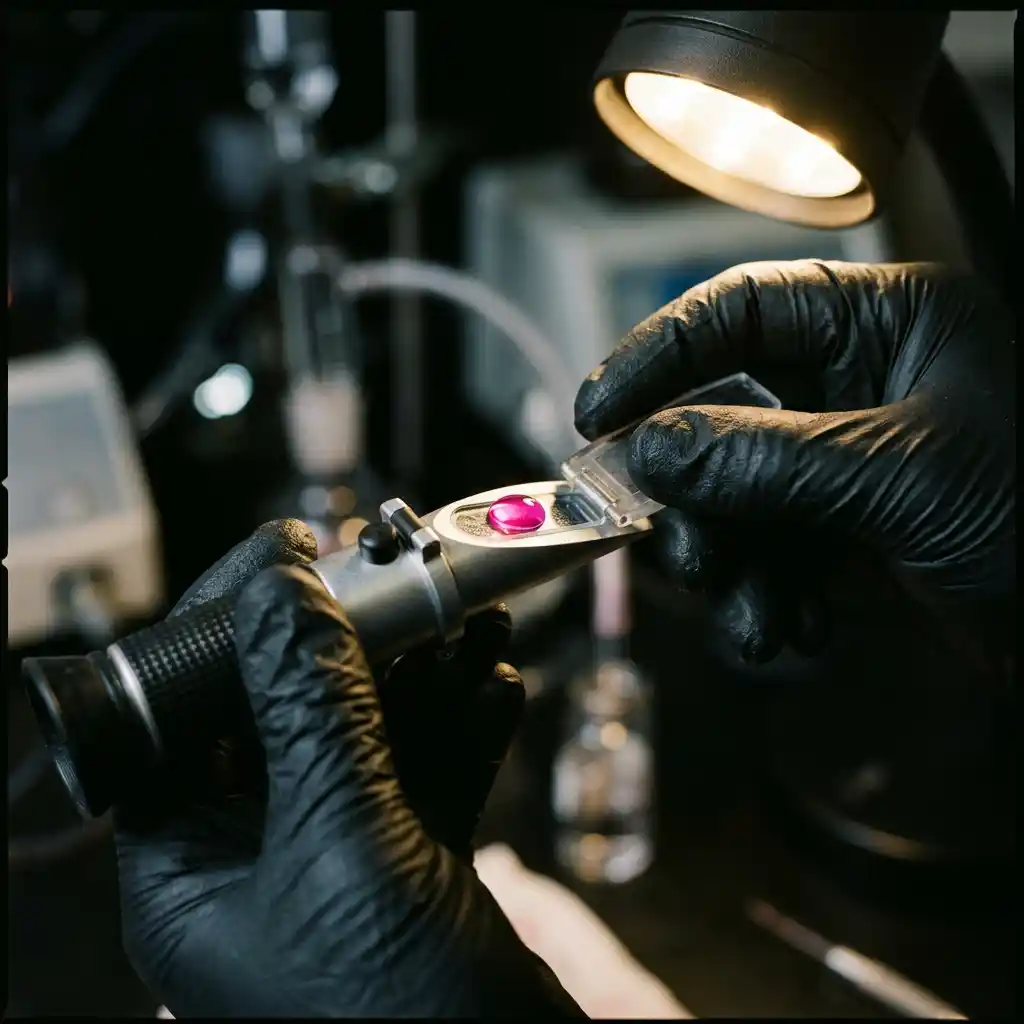
A pink, purple, or similarly colored coolant is not automatically correct for every Audi. Dyes are not a universal technical specification. Different products can look alike while using different additive chemistry, approvals, concentrations, or service applications. A bottle label, service record, part information, and exact vehicle requirement provide better evidence than color.
Coolant protects against freezing, raises boiling protection when correctly pressurized, manages corrosion, and transfers heat through the system. Its performance depends on the correct product, water quality where mixing is required, concentration, system cleanliness, pressure integrity, and circulation. Adding an unknown fluid can reduce confidence in all of those factors.
For fluid selection across the vehicle, see our Audi fluids and specifications guide.
One Audi may use several connected or separate thermal loops
The expansion tank is only the visible access point on some systems. The actual coolant path may include components that operate at different temperatures or are controlled by pumps and valves.
Block, head, pump, and thermostat
The primary circuit manages engine temperature. Design varies by engine family and can include electronically controlled pumps, mapped thermostats, or more than one pump.
Radiator, heater, oil, and turbo cooling
Radiators, heater cores, turbocharger lines, oil coolers, and other heat exchangers can create external leaks, internal cross-contamination, or flow restrictions.
Valves, sensors, fans, and pumps
A temperature problem may involve a valve that does not move, a sensor that reports implausibly, a fan-control issue, trapped air, wiring, or circulation under specific conditions.
Battery and power electronics
Hybrid and e-tron thermal management can use additional circuits with high-voltage safety requirements. These systems are not serviced as though they were a simple engine radiator loop.
Drain and refill, controlled exchange, or repair first
The best method is the one that solves the identified need while protecting the system. More fluid movement is not automatically a better service.
| Service route | When it may fit | What it includes | What it cannot prove or repair |
|---|---|---|---|
| Drain and refill | Known compatible coolant, normal operation, no active leak, and a routine maintenance reason. | Controlled draining of accessible fluid, correct approved refill, applicable bleeding, level setting, and checks after circulation. | It does not remove every drop from all passages, fix a leak, unblock a failed component, or diagnose overheating by itself. |
| Controlled exchange or flush | Broader renewal or suitable cleaning is justified after system condition and compatibility are assessed. | A planned exchange or rinse using a method, fluid, and sequence appropriate for the exact cooling system. | It cannot repair a pump, thermostat, fan, pressure loss, damaged cooler, combustion leak, or degraded hose. An unsuitable chemical can create risk. |
| Repair and refill | A leak, failed component, overheating cause, or contamination source is confirmed. | Repair of the supported fault, replacement of necessary seals or components, correct refill and bleeding, then operating verification. | It cannot guarantee that unrelated aged components will not fail later. The scope should separate confirmed failure from monitored condition. |
| Further diagnosis | The symptom is intermittent, the source is not visible, pressure behavior is unusual, or internal leakage is suspected. | Targeted testing such as pressure retention, cap assessment, scan data, temperature comparison, fan command, gas testing, or other model-specific checks. | Testing does not authorize replacement until the result and the vehicle configuration support a repair decision. |
How the cooling-system service is built
Routine service, contamination, and repair-first work enter this sequence at different points. Safety and vehicle identification remain constant.
Record the reason for service
We ask whether the request is scheduled maintenance, unknown history, mixed coolant, a recent component repair, repeated topping up, weak cabin heat, an intermittent warning, or overheating. Recent work matters because an incomplete fill can mimic a new fault.
Confirm the exact configuration
The VIN, engine code, model year, market, hybrid or electric system, auxiliary heater, and relevant option information guide coolant selection and access. The same model name can cover substantially different cooling layouts.
Inspect before opening
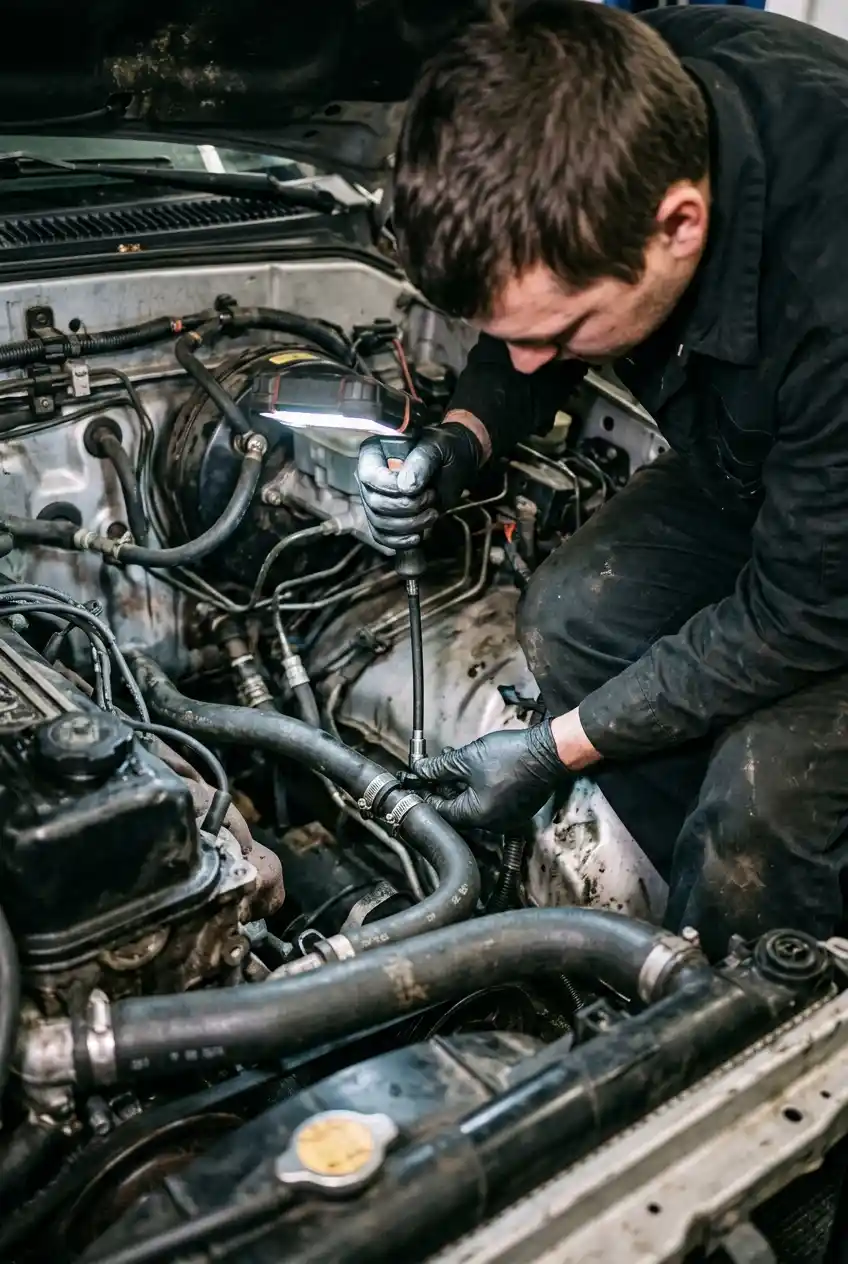
The system is handled only when its temperature and pressure make work safe. We assess cold level, reservoir condition, cap area, visible residue, hoses, junctions, radiator area, undertrays, recent repair points, and signs of oil or foreign material.
Test when a fault is possible
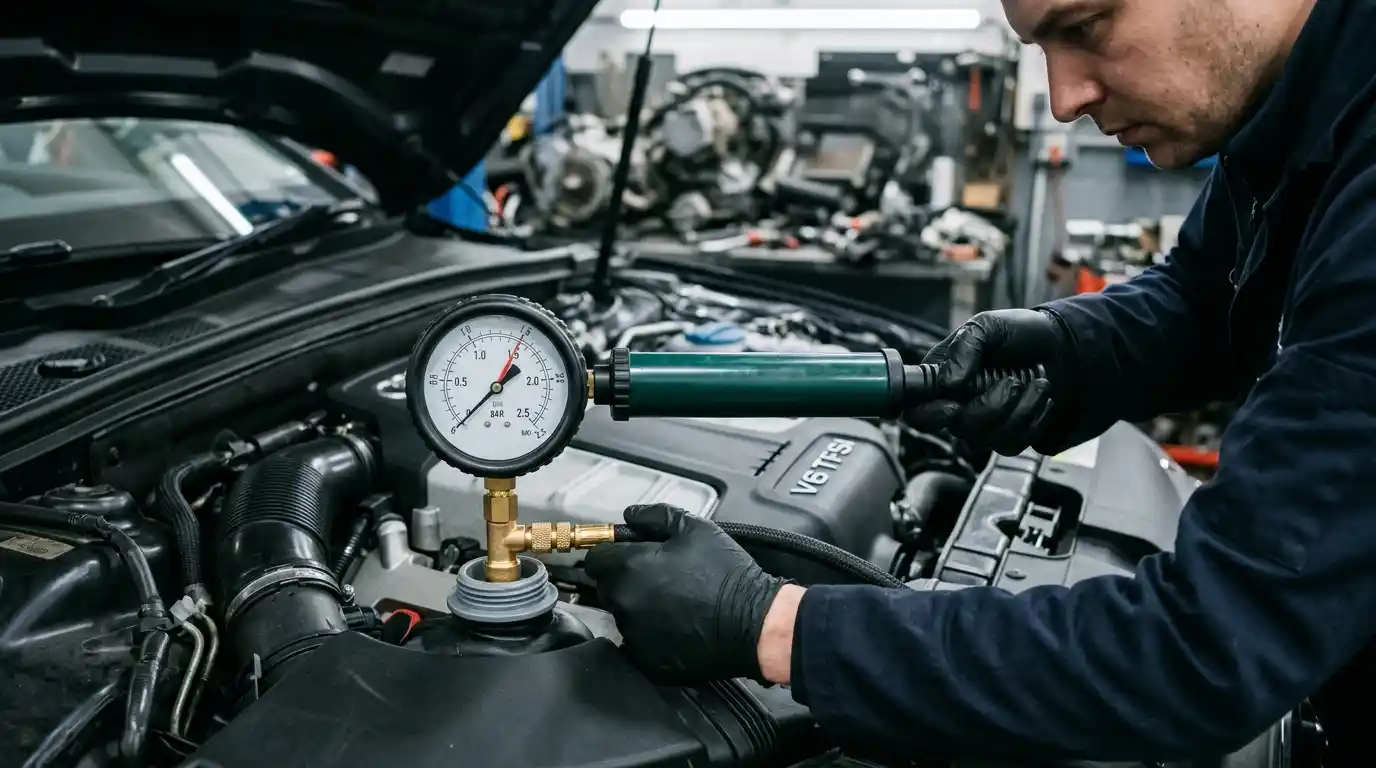
Pressure testing, cap testing, scan data, temperature plausibility, circulation behavior, fan operation, heat output, and targeted leak tracing may be used according to the complaint. A cold pressure test and hot operating behavior can reveal different evidence.
Choose the least disruptive effective method
A routine drain and refill should not be turned into aggressive cleaning without cause. Contamination may require staged rinsing after its source is repaired. The plan should state the fluid, method, parts, limitations, and how the result will be checked.
Fill and remove trapped air
The refill can require vacuum filling, designated bleed points, pump activation, heater settings, controlled warm-up, or model-specific procedures. The level is not considered final until circulation and cooling behavior have stabilized as required.
Verify and document
We recheck level, visible leakage, pressure behavior where relevant, operating temperature, cabin heat, fan response, warning status, and the original complaint. The final record should identify the coolant used and any remaining monitored condition.
A coolant flush cannot repair these faults
Fresh fluid is necessary after many cooling-system repairs, but it should not be presented as the reason the fault was fixed. The failed component, trapped air, incorrect specification, contamination source, or pressure problem still has to be identified.
For active loss, use the dedicated Audi coolant leak repair route.
When to book, stop, or arrange recovery
Never open an expansion tank or pressure cap while the system is hot. Pressurized coolant can cause serious burns. If you are uncertain about temperature or pressure, leave the system closed.
No warning, no loss, stable temperature, and known service need. Book the correct coolant maintenance after the vehicle and fluid are identified.
Normal booking
A small dried residue, uncertain history, or one low-level observation without overheating still needs inspection. Do not keep topping up without recording how much and how often.
Avoid long trips
The level drops repeatedly, cabin heat disappears while temperature rises, a warning returns, a visible leak develops, or cooling fans behave abnormally. Stop safely and call before driving farther.
Ask before moving
A red temperature warning, steam, rapid coolant loss, strong overheating smell, severe temperature rise, or coolant pouring from the vehicle can lead to major damage and unsafe roadside conditions.
Switch off safely
The job is incomplete until circulation and level are stable
A reservoir filled to a mark immediately after service does not prove that trapped air is gone or every component is leak-free. Coolant can move into passages, heater circuits, auxiliary loops, and heat exchangers as pumps and valves operate. The final level must be checked according to the applicable procedure and at a safe temperature.
Where a fault existed, the original complaint is retested. That can include pressure retention, dry inspection after warm-up, temperature comparison, cabin heat, fan command, pump operation, scan faults, and a controlled road check. Some small leaks appear only after heat expansion, system pressure, or several drive cycles, so the handover should explain any requested recheck.
- Confirm the correct coolant and recorded quantity or concentration information.
- Check that bleed points, caps, covers, undertrays, connectors, and hoses are restored.
- Verify stable temperature and cabin heat under the conditions relevant to the vehicle.
- Inspect repaired areas and visible connections for fresh residue or pressure loss.
- Explain the safe cold-level recheck and what warning requires the engine to be switched off.
Time, cost, prevention, and DIY limits
A maintenance refill on a healthy system and a contaminated multi-loop repair can differ greatly. We confirm the scope after identification and inspection rather than presenting one price or turnaround time for every Audi.
What changes the job
- Engine, model year, number of cooling loops, and hybrid or electric configuration.
- Known versus unknown fluid, concentration, compatibility, and visible contamination.
- Access to drains, bleed points, pumps, valves, radiators, heaters, and repaired parts.
- Leak diagnosis, pressure testing, temperature data, fan testing, or internal-fault checks.
- Parts availability, damaged fittings, brittle connectors, corrosion, and previous incorrect work.
- Number of controlled rinse cycles and verification required after a contamination repair.
The final written estimate depends on the exact vehicle, findings, fluid choice, required repair, and current parts availability.
What the owner can do safely
Check the coolant level only when the vehicle is parked safely and the system is cold according to the owner information. Photograph the level, warning, and visible residue without opening a hot system. Record any top-up amount and the conditions when the warning appeared.
Do not pour cold fluid into an overheated engine, mix an unidentified product, use stop-leak as routine maintenance, or open the cap to release pressure. A high-voltage thermal circuit, active overheating fault, internal contamination, or repeated coolant loss needs workshop diagnosis. Prevention means using the correct fluid, repairing leaks promptly, keeping the underbody and airflow areas intact, and documenting every cooling-system repair.
Audi coolant flush service near you in Dubai
Our Al Quoz 4 workshop can assess routine coolant renewal, unknown fluid, contamination, coolant loss, trapped air, and overheating complaints. Send the VIN or model and year, mileage, warning photo, recent repairs, top-up history, and whether the temperature changes at idle, in traffic, under load, or with the air conditioning operating.
Do not drive an overheating Audi to the workshop. Call first if there is a red temperature warning, steam, rapid loss, or unstable temperature. We can advise whether the next step is a normal booking, diagnostic inspection, or recovery.
Audi coolant flush service FAQs
These answers cover the decisions that remain after the service routes, system differences, safety guidance, and verification process above.
How often does an Audi need a coolant change?
There is no universal interval for every Audi. The requirement can depend on the exact model, production period, engine or electric platform, market, fluid specification, service history, and repairs that opened the system. We check vehicle-specific information and fluid condition rather than applying one two-year or three-year rule to the full range.
Is a coolant change the same as a coolant flush?
No. A drain and refill replaces the fluid that can be drained through the normal service points. A controlled exchange or flush renews more fluid or includes a suitable cleaning stage. The broader method is chosen only when the system condition and fluid history justify it. More aggressive service is not automatically better.
Can different coolant colors be mixed?
Color is not a reliable compatibility test. Products with similar dyes can have different approvals or additive chemistry, while compatible products can appear different. Identify the required Audi or Volkswagen approval and the existing fluid. If the contents are unknown or mixed, assess the system before adding another product.
Will a coolant flush fix overheating?
Only when the confirmed cause is something the correct service method can resolve, such as unsuitable fluid or a suitable cleaning need. Overheating more often requires investigation of coolant loss, circulation, water pump, thermostat, radiator, fan control, trapped air, sensor data, pressure, heat exchangers, or internal engine faults.
Why does the coolant level keep dropping?
A sealed system should not require frequent topping up. Loss may come from the reservoir or cap, hoses, flanges, pump, thermostat housing, radiator, heater circuit, turbo lines, coolers, seals, or an internal fault. It can also follow an incomplete bleeding process after recent work. The source should be tested instead of repeatedly hidden with top-ups.
Can stop-leak be added before a coolant flush?
Stop-leak is not routine maintenance and can complicate diagnosis or restrict small passages. A leak should be located and the appropriate repair discussed. If a sealing product was already used, tell the workshop because it can affect contamination, heater performance, radiator flow, and the amount of cleaning required.
How is air removed after Audi coolant service?
The method depends on the cooling system. It can involve vacuum filling, designated bleed points, pump or valve activation, heater settings, controlled warm-up, and later cold-level verification. Some hybrid and electric circuits have additional safety and procedural requirements. Opening random hoses or running the engine without a plan can trap more air.
Can you service hybrid and e-tron coolant circuits?
These vehicles can contain several thermal loops for the engine, battery, motors, power electronics, charging components, and cabin conditioning. The affected circuit, fluid, isolation requirements, and service procedure must be identified from the exact vehicle. High-voltage-related thermal work is not a roadside or general DIY task.
How long does an Audi coolant flush take?
Time varies with the number of circuits, drain access, fluid condition, contamination, diagnostic testing, repairs, bleeding procedure, pump or valve activation, warm-up, cooling time, and post-service recheck. A routine drain and refill on a healthy system is not comparable to decontaminating and verifying several thermal loops.
What information is needed before booking?
Send the VIN, model year, mileage, engine or e-tron version, warning photo, temperature behavior, coolant top-up history, recent cooling-system work, and clear photos of visible residue when the system is cold. Mention any product added previously. The final scope depends on inspection and current parts and fluid availability.
Book coolant maintenance or cooling-system diagnosis
Send the exact vehicle details and tell us whether this is scheduled fluid renewal, unknown coolant, repeated loss, a recent repair, or a temperature warning. We will advise the appropriate booking or recovery step for your Audi.