
Audi Engine Malfunction Warnings and Diagnosis
An EPC, check-engine, drive-system or reduced-power warning identifies a control concern, not the failed part. Preserve the exact message and operating conditions, then combine fault status, live data, voltage and mechanical checks before approving repair.
What does an Audi engine malfunction mean?
An Audi engine malfunction means that a control module detected a value or behaviour outside the expected range. Depending on model and fault, the car may show EPC, a steady or flashing engine symbol, “drive system malfunction,” “maximum engine speed” or a reduced-power message.
The warning does not automatically identify a sensor, ignition coil, injector, turbocharger or damaged engine. A code may name the circuit that detected the problem, while the root cause sits in wiring, voltage, air leakage, fuel delivery, mechanical timing or cylinder condition.
Urgency comes from the combination of the message and the way the vehicle behaves. A steady warning with normal operation is different from a flashing engine light, severe shaking, rising temperature, low oil-pressure warning or dense smoke.

Different engine messages need different first decisions
Use these routes as triage, not as a remote diagnosis. The owner’s manual and the exact vehicle behaviour remain important.
Electronic power control fault
EPC can involve throttle control, accelerator input, ignition and misfire, engine-speed or air sensors, brake-switch input, wiring, voltage and related control systems. Reduced power is a protective response, not a diagnosis.
- Do not repeatedly floor the accelerator to “test” limp mode
- Record whether EPC appears alone or with engine and stability warnings
- Note throttle response, idle stability and restart behaviour
Steady malfunction indicator
A steady engine symbol can represent emissions, mixture, sensor, air, fuel, ignition or control faults. Some conditions are minor at first; others become damaging if misfire, overheating or fuel dilution develops.
- Check fuel-cap and recent-refuelling context only where relevant
- Do not clear the warning before fault and freeze-frame data are saved
- Book diagnosis even when the car feels normal
Active combustion fault or severe behaviour
A flashing engine warning with strong shaking, raw-fuel smell or major power loss can indicate an active misfire that risks catalytic-converter damage and unsafe drivability.
- Reduce load and stop safely
- Do not keep restarting a violently shaking engine
- Arrange inspection or recovery rather than continuing in traffic
Lubrication or temperature danger
A red oil-pressure warning, rapid temperature rise, coolant loss, heavy mechanical noise or smoke can point to conditions that damage the engine within a short time.
- Switch off safely and do not continue to “see if it clears”
- Do not open a hot cooling system
- Preserve leak, smoke and fluid evidence for inspection
Warning plus severe symptom
Flashing light, heavy shaking, knock, smoke, overheating, oil pressure or stalling. Stop and protect the engine.
Warning plus reduced power
Limit load and driving. Diagnose throttle, boost, fuel, ignition, airflow, timing and mechanical evidence.
Warning with normal behaviour
Save the evidence and book diagnosis soon. “Feels normal” does not make the stored fault irrelevant.
Five details that make intermittent diagnosis faster
Owners can preserve useful information without touching wiring or clearing codes.
Capture the display
Photograph the full message, warning colour and any related symbols.
Record when
Cold start, hot idle, acceleration, steady speed, refuelling or after recent work.
Describe what changed
Shaking, loss of boost, slow response, stalling, smoke, smell or abnormal sound.
Check safely
Note visible leaks or level warnings without opening a hot cooling system.
Bring context
VIN, mileage, service history, previous codes, parts replaced and modifications.
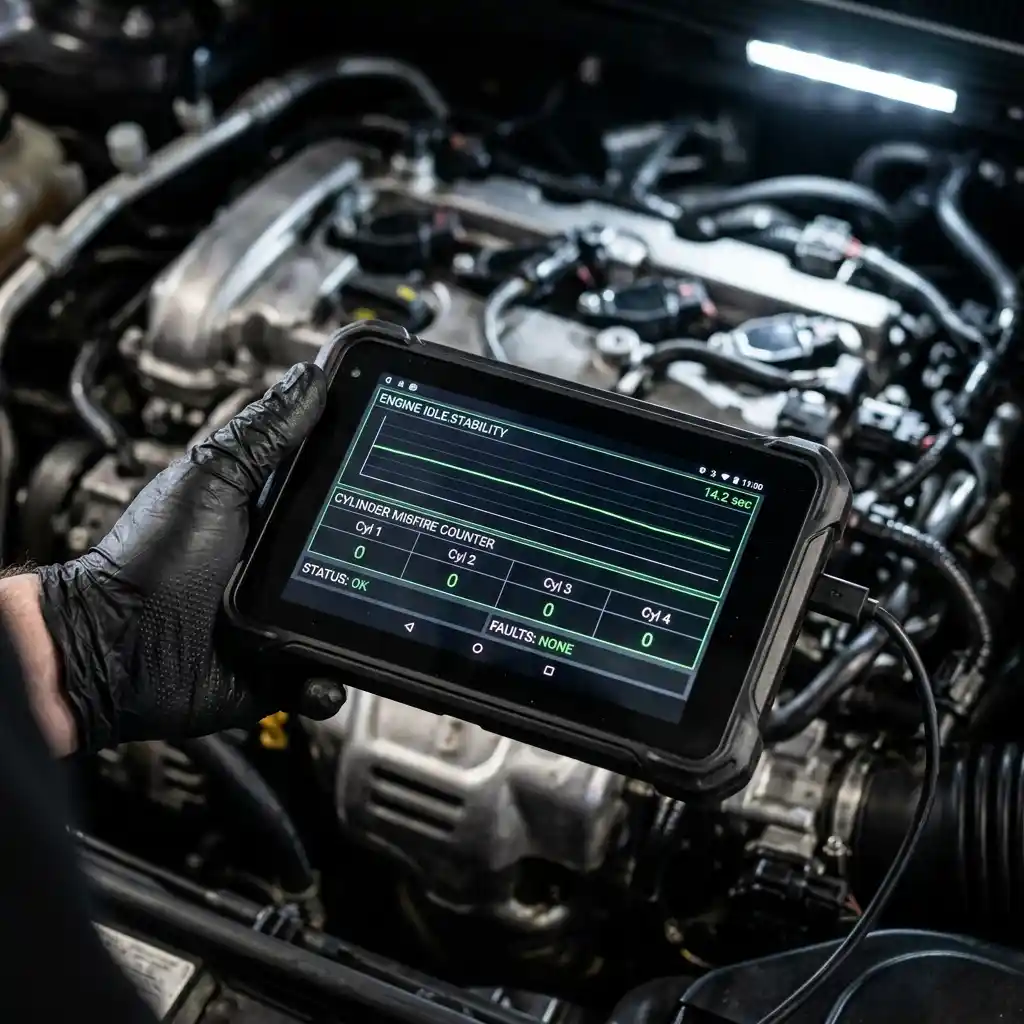

Systems behind Audi engine malfunction warnings
The same symptom can be produced by several systems, and one root cause can create faults in several controllers.
Misfire route
Spark plugs, coils, injector operation, fuel quality, mixture and cylinder sealing must be compared. Swapping a coil can be a controlled test, not a universal answer.
Load-control route
Air leaks, mass-airflow or pressure sensing, throttle operation, crankcase ventilation and intake deposits can affect calculated load and idle quality.
Pressure and metering route
Low-pressure supply, high-pressure generation, injectors, electrical control and contamination can create lean, rich, no-start or power-loss symptoms.
Requested versus actual boost
Charge-air leaks, diverter valve, wastegate control, turbo wear, sensors and protective strategies can all produce underboost or overboost faults.
Crank, cam and valve timing
Position sensors, wiring, correlation, chain or belt condition, adjusters and oil-pressure control must be distinguished before timing parts are approved.
Compression, lubrication and cooling
Low compression, valve leakage, piston or bore damage, oil pressure, overheating and coolant entry can trigger warnings that electronic parts cannot fix.
Shared electrical cause
Weak 12-volt supply, charging faults, poor grounds, connector damage or communication problems can create multiple unrelated-looking warnings.
Monitoring and aftertreatment
Oxygen sensors, catalyst efficiency, evaporative leaks and market-specific diesel systems can illuminate the engine warning without immediate drivability change.
Configuration evidence
Recent module, battery, throttle, engine or tuning work can change adaptation or expose compatibility issues. Software should not be blamed without supporting data.
When the fault appears only hot, cold or under load
Intermittent engine malfunctions are often lost when the vehicle reaches the workshop in a different state. The diagnostic plan should reproduce the original conditions without creating unnecessary risk.
A warning that appears only during a cold start can direct attention to initial fuel control, air leakage, timing correlation, ignition demand or mechanical sealing. A fault that appears only after heat soak may involve temperature-sensitive sensors, fuel pressure, wiring, turbocharger control or vapor and mixture behaviour. A concern only under acceleration requires load, boost, ignition, fuel and mechanical data rather than extended idling.
Recent work is equally important. A disconnected intake seal, pinched harness, incorrect plug, weak ground or adaptation problem can appear after battery, engine, cooling or body work. The aim is to compare requested and actual values at the moment the fault becomes active, then confirm the circuit or mechanical cause.

How an Audi engine malfunction is diagnosed
The diagnostic route narrows the system while protecting against unnecessary parts and erased evidence.
Verify the warning
Confirm the exact message, current behaviour and whether the fault can be reproduced safely.
Check the basics
Inspect fluid warnings, visible damage, intake connections, battery condition and recent work.
Scan the network
Read engine and related controllers, fault status, frequency, mileage and freeze-frame values.
Test the system
Use live data, circuit tests, smoke, pressure, fuel, ignition or mechanical tests guided by evidence.
Confirm the cause
Prove the failed part or mechanical condition and identify any dependency or resulting damage.
Verify the repair
Recreate the original conditions, check warning status and confirm live values and drivability.
| Diagnostic evidence | What it tells you | What it does not prove alone |
|---|---|---|
| Fault code description | The controller, circuit or monitored condition that detected a problem | The exact failed part or whether the cause is mechanical |
| Freeze-frame data | Load, speed, temperature and operating state when a fault was stored | That the condition is still active now |
| Live misfire counts | Which cylinder and operating condition shows combustion instability | Whether ignition, fuel, air or compression is responsible |
| Fuel-trim or mixture values | How the engine controller is correcting mixture | Whether the cause is a leak, sensor, fuel pressure or injector |
| Compression or leak-down | Cylinder pumping and leakage path information | The full internal condition without timing and visual evidence |
This malfunction page owns diagnosis
- Meaning and urgency of engine warnings
- Symptom combinations and evidence capture
- Fault-code and live-data interpretation
- Testing that separates cause groups
- Repair route after the cause is confirmed
Major mechanical work belongs elsewhere
When testing confirms overheating damage, low compression, timing contact, oil-starvation damage or internal wear, continue to the dedicated Audi engine repair and rebuild page. This separation prevents a warning guide from competing with the page that owns engine repair.
Audi engine malfunction FAQs
Can I drive with an Audi engine malfunction warning?
It depends on the warning and behaviour. Stop for flashing warnings with severe misfire, oil-pressure warnings, overheating, smoke, heavy noise or stalling. If the warning is steady and the car behaves normally, limit use and arrange diagnosis promptly.
What does the EPC light mean on an Audi?
EPC indicates an electronic power-control concern. Causes can involve throttle, accelerator input, ignition, sensors, brake-switch input, wiring, voltage or related systems. It is a system warning, not a named failed part.
Why does the EPC light appear with loss of power?
The engine controller may limit torque when it detects an unreliable or damaging condition. The protective mode can be triggered by several air, fuel, ignition, throttle, boost, timing or mechanical faults.
Does a check-engine code tell me which part to replace?
Usually not by itself. A code identifies the circuit or condition that detected a problem. Status, freeze-frame data, live values, wiring and mechanical tests are used to confirm the cause.
Why did the warning disappear after restarting?
The fault may be intermittent or the controller may have left a protective mode after conditions changed. Stored history and freeze-frame data can remain valuable, so diagnosis should happen before codes are cleared.
Can a weak battery cause an Audi engine malfunction warning?
Low or unstable voltage can disturb sensors, actuators and communication across several modules. Battery and charging tests are especially relevant when multiple warnings appear together.
Can an intake leak cause EPC or a check-engine light?
Yes. Unmetered air can affect mixture, idle and throttle calculations. Smoke testing, fuel-trim data and physical inspection can help confirm the leak route.
When does an engine malfunction require internal engine testing?
Consider compression, leak-down, oil-pressure, cooling-system or borescope testing when misfire persists despite control checks, mechanical noise is present, fluids are mixing, overheating occurred or cylinder data suggests a sealing problem.
Should I clear the engine warning before bringing the car in?
No. Clearing codes can erase status and freeze-frame evidence that helps reproduce the fault. Record the message and leave the diagnostic memory intact unless a safety procedure requires otherwise.
Arrange Audi engine malfunction diagnosis in Dubai
Send the model, year, mileage, warning photo and what the car was doing when it appeared.