
Audi crankshaft sensor replacement in Dubai
A no-start, sudden stall or crankshaft-related fault code does not automatically prove the sensor has failed. We match the complaint with engine-speed data, circuit evidence and the exact Audi configuration before approving replacement.
Direct answer An Audi crankshaft sensor fault can indicate a missing or unreliable engine-speed and position signal, but it does not automatically prove the sensor needs replacement. Similar symptoms can come from its wiring, connector, power supply, starter speed, timing relationship or another engine-management fault, so diagnosis comes before ordering the part.
Start with what the Audi does
The exact behaviour, temperature and recent repair history help determine whether the first test should follow the sensor signal, its circuit, starting speed or mechanical timing.
The ECU may not be receiving usable engine-speed or position information, but fuel, ignition, voltage and timing evidence still need separation.
An intermittent signal or circuit fault is possible. Record whether the engine cuts immediately, at idle, under load or after a bump.
Heat can expose an intermittent sensor or connection, but the fault should be reproduced and measured instead of assumed.
A check-engine or EPC warning and a stored code define a test route. They do not identify the failed part on their own.
One sensor supports several decisions
The crankshaft sensor tells the engine controller where the crankshaft is and how quickly it is turning.
During starting, the ECU uses position and speed information as part of the logic that coordinates injection and ignition. While the engine is running, the changing signal remains important for engine-speed calculation and timing control. This is why some diagnostic descriptions refer to it as an engine-speed sensor, although the exact component name and application must still be confirmed. A missing, distorted or intermittent signal can create a no-start, extended cranking, sudden stalling or a warning.
The sensor does not work alone. Its signal depends on the correct sensor specification, mounting relationship, connector, circuit and the physical target it reads. The ECU also compares crankshaft behaviour with other engine information. That is why a correlation code, low cranking speed or damaged wiring cannot be treated as automatic proof that the sensor itself is defective.
- Position identifies where the crankshaft is in its rotation
- Speed data shows whether and how fast the engine is turning
- Signal quality must remain stable through cranking, heat and vibration
- Correlation evidence may widen the test beyond the electrical sensor

Similar symptoms have different causes
The repair stays tied to measured evidence so that a sensor is not replaced for a wiring, voltage, timing or starting-system problem.
Follow the signal without disturbing it
Intermittent faults are easiest to lose when parts are unplugged or fault memory is cleared before the original condition is recorded.
Record the pattern
Confirm whether the concern is a no-start, extended crank, hot stall, warning or intermittent cut-out, and note recent battery or engine work.
Preserve scan context
Read relevant modules, code status and event data before clearing anything. Check whether engine-speed data exists during the complaint.
Test the circuit
Inspect the connector and harness, then check the required supply, ground and signal arrangement for the exact sensor type.
Approve the scope
Separate sensor replacement from connector repair, wiring work, starting-system correction or justified mechanical timing inspection.
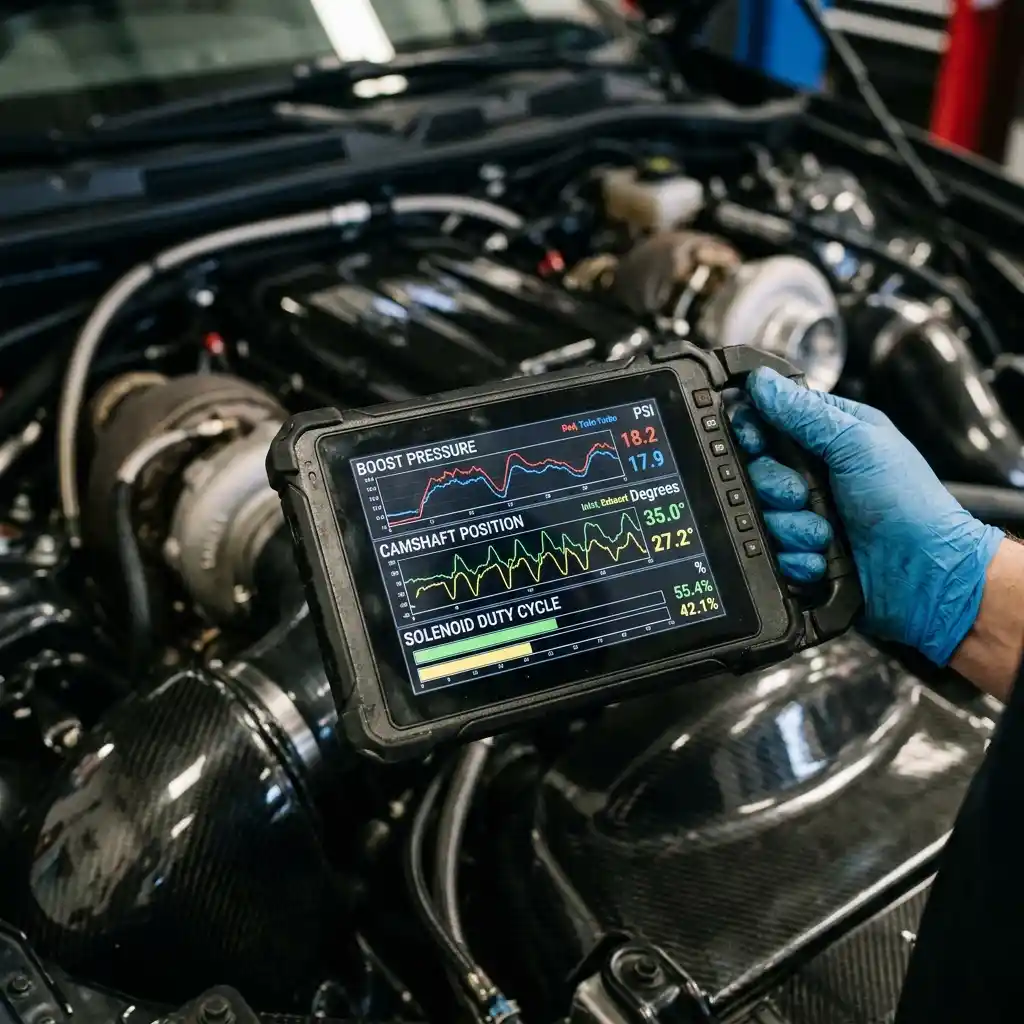
Audi crankshaft sensor replacement decisions
A crankshaft-sensor complaint can end with a small circuit repair, a sensor replacement or a wider engine investigation.
If a terminal is loose, a wire is damaged or contamination has reached the connector, installing a new sensor cannot correct the complete fault. When the circuit is sound but the sensor output becomes absent or distorted under the conditions that reproduce the complaint, replacement may be the dependable direction.
Correlation evidence needs more care. It may involve the crankshaft signal, camshaft signal, a physical target, mechanical timing or previous work. That diagnosis belongs outside a simple parts decision. If the evidence points to a wider internal concern, the dedicated Audi engine repair service explains how the mechanical scope is separated.
Install, reconnect and prove the result
Access and procedures vary by engine, so the VIN, engine code and physical part are matched before installation.
Confirm the configuration
Identify the model, year, engine and sensor application. Similar-looking sensors may use different connectors or signal characteristics.
Create safe access
Remove only the components required by the engine layout while protecting nearby wiring, hoses, clips and sealing surfaces.
Inspect before fitting
Compare the old and replacement parts and check the connector, terminals, mounting point, fastener and visible target area.
Install the correct part
Fit and secure the component according to the exact application, route the harness correctly and restore all removed items.
Complete required procedures
Clear relevant fault memory and perform applicable checks or learned-value procedures only where the vehicle requires them.
Repeat the original condition
Verify cranking, starting, signal stability and warning status under the condition that first produced the complaint.
The engine decides the access
The model badge alone does not identify the sensor, its position or the labour required to reach it.
Generation changes
An A4, A6, Q5 or Q7 can span several platforms and powertrains. The same model name can therefore lead to different sensor locations and procedures.
Packaging and signal type
Petrol and diesel engines, cylinder layouts and hybrid-supported variants can change access, connector routing and diagnostic values.
Previous work matters
Recent battery, starter, gearbox, timing or engine work may change where the inspection begins without deciding the outcome in advance.
Send the VIN or complete vehicle details before ordering a sensor. A generic part description is not enough for a dependable match.
What changes the installed cost
There is no honest single price for every Audi crankshaft sensor job. Diagnosis, part specification, access and the actual failed layer shape the quotation.
A cleared code is not enough
The final check must answer whether the original no-start, stalling or intermittent signal problem has actually been resolved.
We recheck the relevant engine-speed and synchronisation information, inspect the connector and harness in their final routed position, and confirm that related faults do not return. Where the original issue was temperature-dependent, verification should reflect that pattern as far as practical. A car that starts once while cold has not automatically passed a hot-stall complaint.
If the sensor signal is stable but the engine still behaves incorrectly, the diagnosis continues rather than treating the new part as proof that the job is complete. Wider warning context can also be reviewed through the Audi engine malfunction diagnosis page.
- Stable engine-speed data during cranking
- Reliable starting under the relevant condition
- No repeat cut-out during appropriate verification
- Harness remains secure and clear of heat or movement risks
- Relevant fault memory is rescanned after testing

Audi crankshaft sensor FAQs
What does an Audi crankshaft position sensor do?
It provides the engine controller with crankshaft position and rotational-speed information. That evidence supports starting, injection and ignition timing decisions, although the exact control strategy varies by engine.
What are common signs of a crankshaft sensor problem?
A no-start, extended cranking, intermittent stalling, a fault that appears when hot, unexpected loss of engine-speed data or a related warning can justify testing. None of these symptoms proves sensor failure by itself.
Can I drive if the Audi keeps stalling?
Repeated or unpredictable stalling can remove power at an unsafe moment and may leave the engine unable to restart. Stop where it is safe and call the workshop before continuing normal driving.
Does a crankshaft fault code always mean replacement?
No. A code can also be caused by a connector, wiring, supply, signal-target, low-cranking or correlation problem. Code status, live data and circuit evidence should be checked before a part is approved.
Can damaged wiring create the same symptoms?
Yes. A loose terminal, corrosion, contamination, heat damage or a broken conductor can interrupt or distort the signal. Replacing the sensor alone will not repair a fault elsewhere in its circuit.
Why can the problem appear only when hot?
Heat can change the electrical behaviour of an intermittent sensor, terminal or wire. It can also affect other engine conditions, so the symptom should be reproduced and measured rather than attributed to one part from history alone.
How is the crankshaft sensor checked?
The process can include scan data during cranking, code and event context, connector and harness inspection, circuit tests and signal comparison. The exact tests depend on the sensor type and Audi engine configuration.
What changes the replacement cost?
The exact sensor, access route, diagnostic time, connector or wiring condition, related timing evidence and the verification required all affect the installed scope. Vehicle details are needed before a useful quotation can be prepared.
Send the symptom before ordering a sensor
Share the Audi model, year, engine if known, exact warning, whether it cranks, starts or stalls, whether heat changes the fault, and any recent battery or engine work. We will arrange the right first diagnostic route.