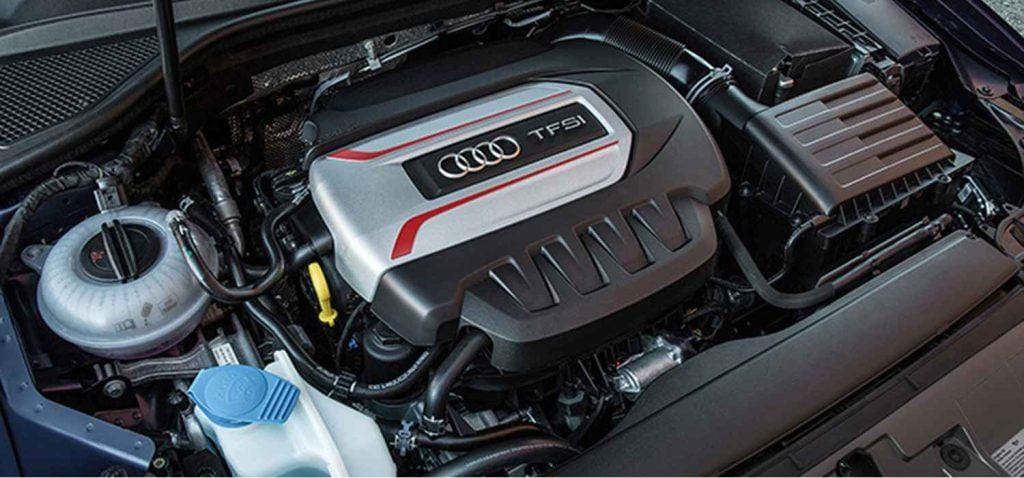
Audi Coolant Warning Causes and Correct Fluid Guide
An Audi coolant warning can describe three very different situations. The level may have fallen because of a leak. The engine may actually be too hot because coolant is not circulating. Or the reservoir may look full while a level sensor, trapped air, pressure problem or another part of the cooling system is at fault.
Do not treat all three by pouring in coolant and continuing to drive. First read the exact warning, stop safely, let the vehicle cool and determine whether the problem is low level, high temperature or an incorrect signal. Repeated top-ups are evidence of a fault, not maintenance.
Never open a hot expansion tank
The cooling system can remain pressurized after the engine is switched off. Hot coolant and steam can cause severe burns. If the warning says to stop the engine, the temperature is rising, steam is visible or coolant is escaping quickly, switch off safely and arrange recovery. Do not keep driving to “see if it clears.” Call +971 56 464 6081 if you need to confirm recovery rather than driving the car in.
Match the warning to the situation
| What you see | What to do and why |
|---|---|
| Low message and the cold level is below MIN | Photograph the level and inspect for an obvious leak. External loss, internal loss, incorrect previous fill or air after recent work must be separated before another top-up. |
| Rising temperature, steam or reduced power | Stop safely and arrange recovery. Loss of coolant, poor circulation, a pump or thermostat fault, fan failure, restriction or trapped air can overheat the engine rapidly. |
| Warning with the level apparently normal | Do not assume a false alarm. Check again when fully cold, then test the level circuit and actual cooling performance. |
| Level drops again after topping up | Record how much and how quickly. Pressure-test and inspect for unresolved external or internal loss instead of creating a top-up routine. |
| Oily, sludged or contaminated coolant | Do not add cleaner or another coolant. Identify wrong fluid, oil contamination, a seal or heat-exchanger fault, or residue from previous work first. |
Level changes slightly between hot and cold are normal because coolant expands. Compare only on level ground and under the conditions stated in the owner’s manual. A single cold reading just below the mark needs context, but a continuing downward trend needs diagnosis.
The leak often leaves a trail instead of a puddle
A small hot leak can evaporate before it reaches the ground. Look for dried pink, white or chalky residue, a sweet smell after parking, staining around hose joints, or dampness hidden by an undertray. Cabin-window misting and a sweet smell inside can suggest a heater-circuit leak. White exhaust vapor after a fully warm engine, repeated coolant loss, rough starting or abnormal cooling-system pressure can justify tests for internal leakage, but none of those signs alone proves a head-gasket failure.
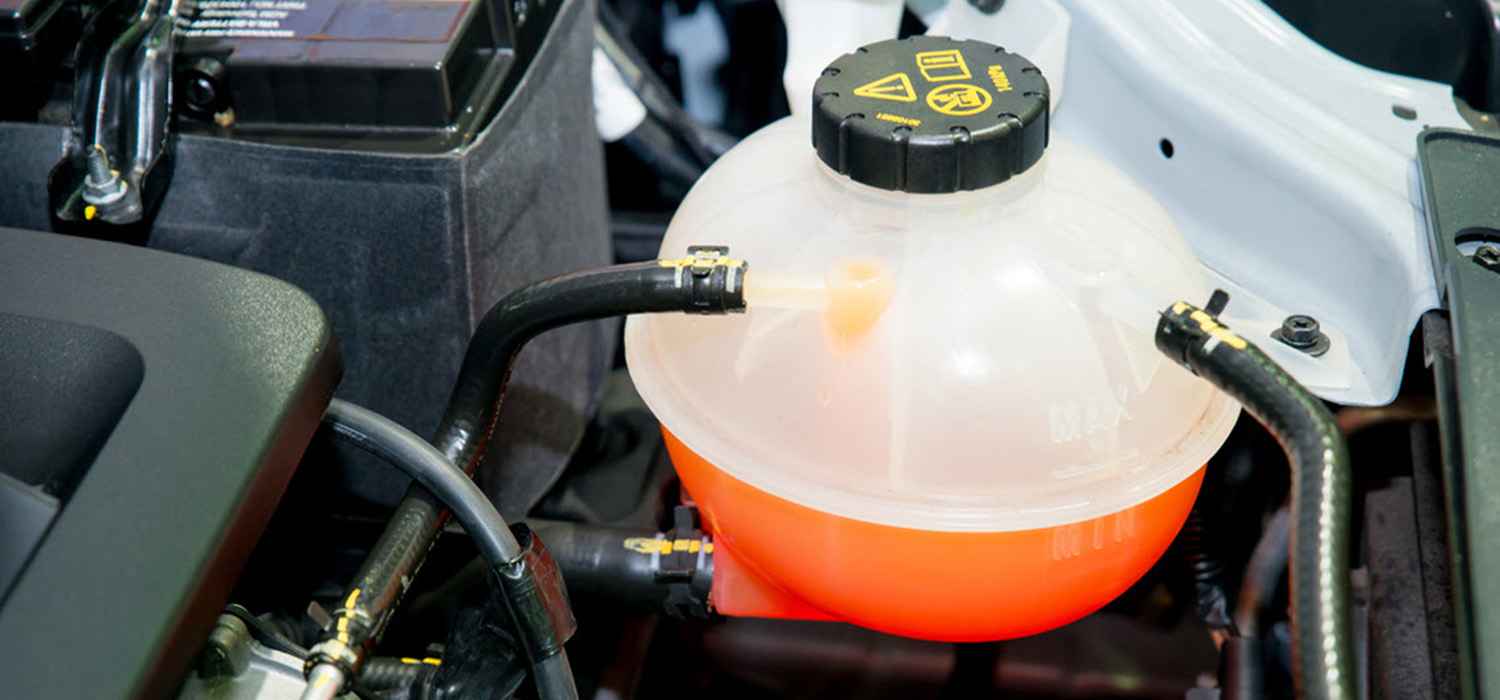
The location of residue changes the test plan:
- Front of the engine or beneath a pump and thermostat module can point toward the housing, pump, seal, hose connection or nearby pipe. Audi issued model-specific service guidance for some 2.0 TFSI applications that instructs technicians to pressure-test, locate the leak precisely and replace only the component that actually leaks.
- Near the radiator or front corners can involve the radiator, end tank, hose coupling, auxiliary cooler or damage from impact.
- At the expansion tank can involve the tank seam, cap, return line, sensor or an overpressure condition elsewhere. Replacing a stained tank without finding why it vented may not solve the problem.
- Inside the engine valley or under covers needs engine-specific inspection. Complex V6 and V8 cooling layouts can hide coolant before it reaches the floor.
- At a turbocharger or auxiliary circuit may require a separate pressure or circulation test. Do not assume every leak belongs to the main radiator circuit.
For a confirmed external leak, the Audi coolant leak repair service covers pressure testing and component repair. The evidence should identify the source rather than merely show that the reservoir is low.
Coolant color is not a specification
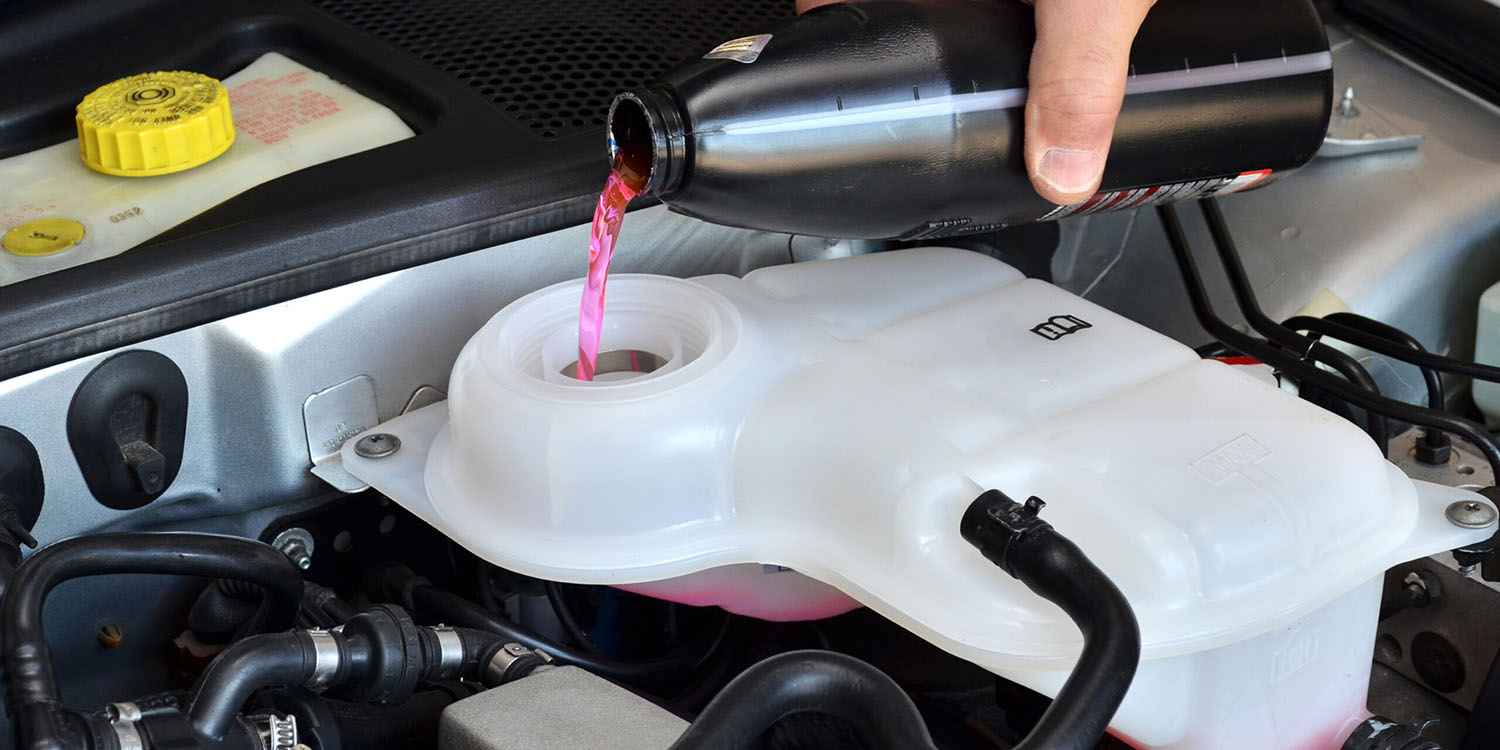
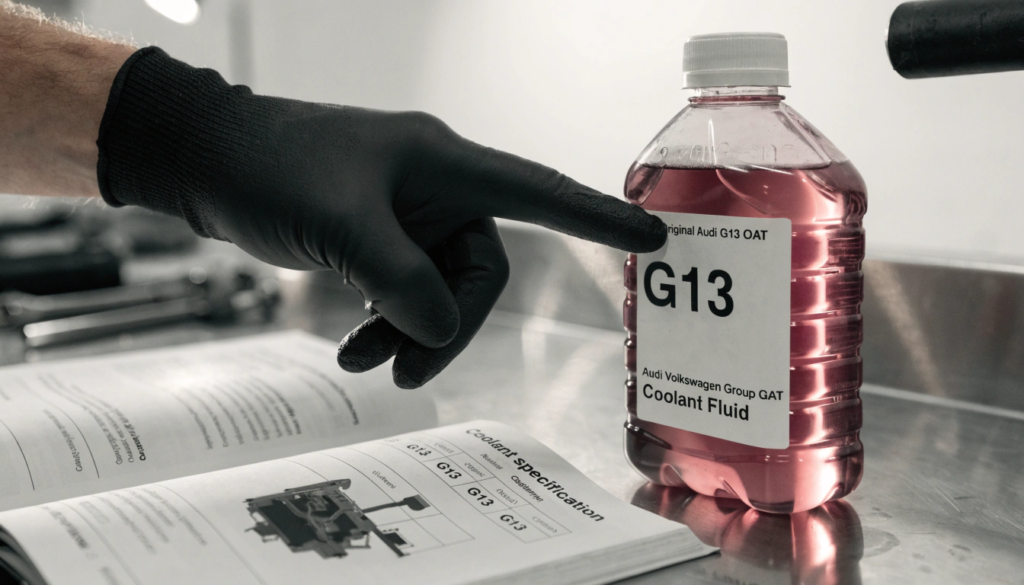
“Pink Audi coolant” is not a safe purchasing instruction. Lighting, age, previous mixing and contamination can change appearance, and different products can look similar. Match the fluid to the vehicle identification number, model year, engine and current Audi service information.
Audi service guidance for the US market states that G12evo was introduced as factory-fill and service coolant from model year 2019, while G13 is listed for many 2018-and-earlier vehicles. The same bulletin says only G12evo can be used in the Audi e-tron covered by that guidance. A Dubai workshop also sees GCC vehicles and imports from other markets, so the VIN and existing fill still have to be checked. Do not apply a US model-year table blindly to every imported car.
| Question | Why it matters |
|---|---|
| Which specification does this VIN require | Additive chemistry and compatibility matter more than color or brand claim. |
| Is the product concentrate or premixed | Adding water to a ready-to-use product changes the protection ratio. |
| What is already in the system | Unknown or contaminated fluid may require sampling and a repair procedure rather than a blind top-up. |
| Was the cooling system recently opened | The correct vacuum fill or bleeding process may be required for the exact engine and its auxiliary circuits. |
| Why did the level fall | Correct coolant does not compensate for a leak, failed cap or circulation fault. |
Do not mix in tap water or universal coolant by habit
Mineral content and incompatible additives can reduce corrosion protection or leave deposits. In a genuine roadside emergency, follow the exact owner-manual instruction for the vehicle, then have the concentration and leak checked as soon as possible.
There is no honest universal Audi flush interval
The original draft premise claimed that missing a routine flush inevitably damages the radiator and water pump. That is too broad. Audi and Volkswagen service literature describes modern approved coolants as long-life or lifetime when used exclusively in the correct system. Actual maintenance instructions still depend on the vehicle and market.
For a vehicle approaching this stage of ownership, the Audi 90,000 KM maintenance-history review helps confirm whether earlier coolant, transmission, plug and filter work was completed before anything is repeated.
A coolant replacement or full cleaning procedure makes sense when there is a defined reason, such as:
- the wrong or unknown coolant was added;
- oil, sealant, scale or debris contaminated the system;
- a component repair requires draining the circuit;
- overheating degraded the fluid or introduced contamination;
- a heater core or circuit is restricted and the approved repair procedure specifies cleaning;
- the measured concentration is wrong for the required protection;
- the model-specific maintenance schedule or official repair information calls for replacement.
Even mixing approved coolant generations has nuances. Audi literature notes that some combinations can turn brown and that the color change alone can be normal. It also provides specific compatibility and refractometer instructions. That is another reason not to diagnose coolant from appearance or internet charts alone.
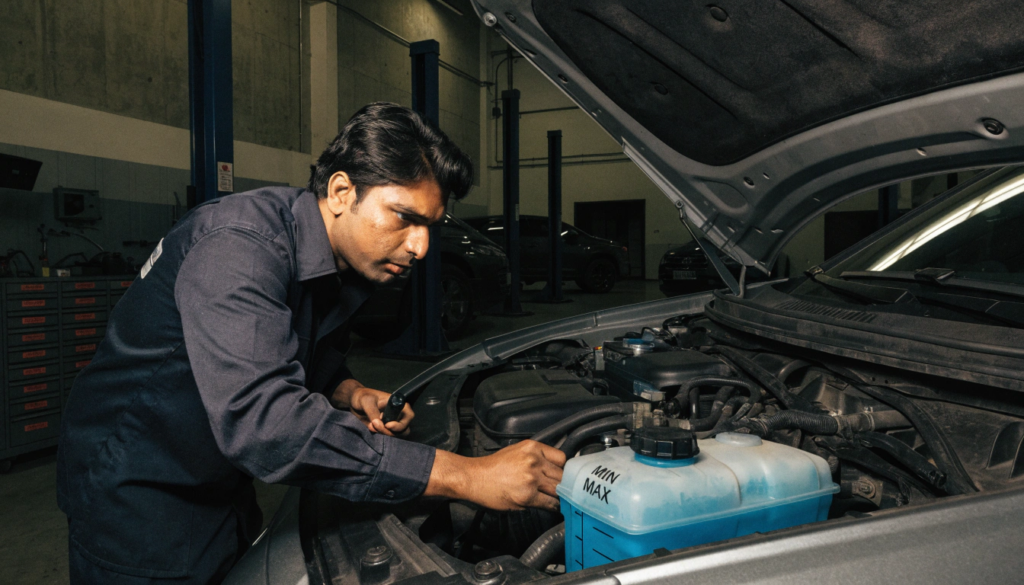
When replacement is justified, a proper Audi coolant service should use the required fluid, concentration, filling equipment and bleeding method. A generic drain from one hose may leave a large amount in auxiliary circuits.
Shortcuts can create a second cooling problem
Leak-sealing additives can circulate beyond the leak and restrict small passages in a heater core, radiator or auxiliary cooler. They may also coat the evidence needed to find the original source. A product advertised as a quick seal is not a substitute for identifying the failed joint, housing or heat exchanger.
A stronger expansion-tank cap is not an upgrade. The cap is part of the system’s pressure control. Fitting an unverified cap or modifying it can raise pressure where hoses, plastic housings and radiators were not designed to carry it. Test the cap against the correct specification.
Adding coolant to a hot engine risks burns and can expose hot components to a sudden temperature change. Wait until the system is safe and follow the owner guidance. If the reservoir is empty after a major loss, a top-up may not restore circulation because air can remain trapped in the pump or a high point.
Bleeding by guesswork is risky on cars with electric pumps, valves, several heat exchangers or separate temperature circuits. Some systems require a vacuum fill, a guided bleed routine or commanded pump operation. A heater that suddenly blows cold, gurgling behind the dashboard or an unstable level after repair can be clues that air remains, but the correct procedure depends on the engine and cooling layout.
Pressure testing is the beginning, not the whole diagnosis
A cold pressure test can reveal a hose, pump, housing, radiator or reservoir leak. It should use the vehicle’s specified test pressure and must not be used to force a leak dramatically. Some faults appear only hot, only while the pump is commanded, only after shutdown, or only when a vacuum-operated pump changes state.

A complete diagnosis may combine:
- a cold and hot visual inspection with the undertray removed where appropriate;
- cooling-system and cap pressure tests;
- UV dye only when compatible and genuinely useful;
- live temperature comparison across engine, radiator and auxiliary circuits;
- command tests for electric pumps, valves and fans;
- vacuum checks on engines with switchable coolant pumps;
- combustion-gas, cylinder leakage or borescope tests when internal loss is supported by evidence;
- a vacuum fill and model-specific bleeding routine after repair.
Audi’s EA839 3.0 TFSI guidance provides a good example of why engine knowledge matters. A “switch off the engine and check coolant” message with a particular diagnostic entry can point toward the switchable mechanical coolant pump, even when the guided tester does not automatically suggest the correct test plan. That does not make every 3.0 TFSI warning a failed pump. It means the code, symptom and engine version must agree.
Dubai heat exposes a weak cooling system
High ambient temperature, long idling with air conditioning and repeated heat soak reduce the margin available to a weak cooling system. Heat does not create a cracked connector or leaking seal by itself, but it can make a small defect appear sooner. A car that behaves normally at highway speed but warms in traffic deserves fan, airflow and low-speed circulation checks. A car that overheats under load needs a different investigation.
Do not “solve” hot-weather operation by using straight concentrate or plain water. The correct mixture balances heat transfer, corrosion protection, boiling protection and freeze protection. The required ratio comes from Audi service information for that vehicle.
What must be proven after the repair
A replaced part is not the finish line. The system must hold pressure, reach and control temperature correctly, circulate through every relevant circuit and remain free of air. The heater should work, fans and electric pumps should respond as commanded, and the level should remain stable through a full cold-hot-cold cycle.
If contamination was present, the source must be corrected before cleaning. If coolant entered a vacuum line, connector or electrical component, those paths require inspection too. Photographing the original leak and the clean, dry repair area creates far better evidence than a reservoir top-up.
Keep a cold-level record for several heat cycles after repair. The correct result is a stable level, controlled temperature, working heater and fans, no trapped air, and a clean pressure test, not merely a warning that has been cleared.
Owner questions that change the diagnosis
Can I drive with a low coolant warning if the temperature looks normal?
Not without checking the exact warning and cold level. A small leak can become a rapid loss, and the gauge may not show local hot spots immediately.
Why is there no puddle even though the level drops?
Coolant may evaporate on a hot component, remain in the undertray, leak only under pressure or enter another circuit. Pressure testing and a clean inspection area help reveal the path.
Does brown coolant mean it has turned to rust?
Not always. Audi notes that certain approved coolant mixtures can become brown. Contamination, particles, oil and corrosion still need to be ruled out rather than judged from color alone.
Should I replace the water pump whenever the thermostat housing leaks?
Not automatically. Audi service guidance for some 2.0 TFSI assemblies specifically says to locate the leak and replace only the leaking component. The exact design and access cost still affect the repair decision.
Can an e-tron have a coolant problem without an engine?
Yes. Electric vehicles use thermal-management circuits for the battery, drive components and cabin systems. The architecture and safety procedure are different from a combustion engine.
After the repair, check the cold level over several heat cycles and compare it with the original mark. A stable level, controlled temperature, working cabin heat and no returning pressure loss are stronger proof than a freshly cleaned engine bay.