A used Audi A7 can be a sensible UAE purchase when its identity, history, condition and diagnostic evidence agree. Do not buy from the badge, mileage or a smooth five-minute drive alone. Confirm the VIN and specification, inspect the car genuinely cold, scan every control system, test the engine, transmission, quattro, suspension, brakes, tires, MMI and driver-assistance functions, then price immediate repairs and overdue maintenance before negotiating.
Make the cold start part of the appointment
Ask the seller not to start, move or warm the A7 before you arrive. A warm engine can reduce startup rattle, smoke, rough idle, weak-battery behavior, fluid leakage evidence and delayed engagement. Check the temperature display and use safe exterior observations to confirm that the engine is genuinely cold.
Buy the Evidence, Not the Seller’s Description
Statements such as “GCC,” “full service history,” “accident-free,” “recent major service” and “no warning lights” need proof. A good seller should be willing to provide the VIN, registration details, invoices and enough time for an independent inspection.
Use three questions for every claim:
- What document or measurement proves it?
- Does the physical car agree with that evidence?
- What would it cost or risk if the claim is incomplete?
A dashboard without warnings proves only what is displayed at that moment. Recently cleared faults, incomplete readiness checks, low-voltage history and intermittent failures may not appear during a short viewing.
Identify Which Audi A7 Is for Sale
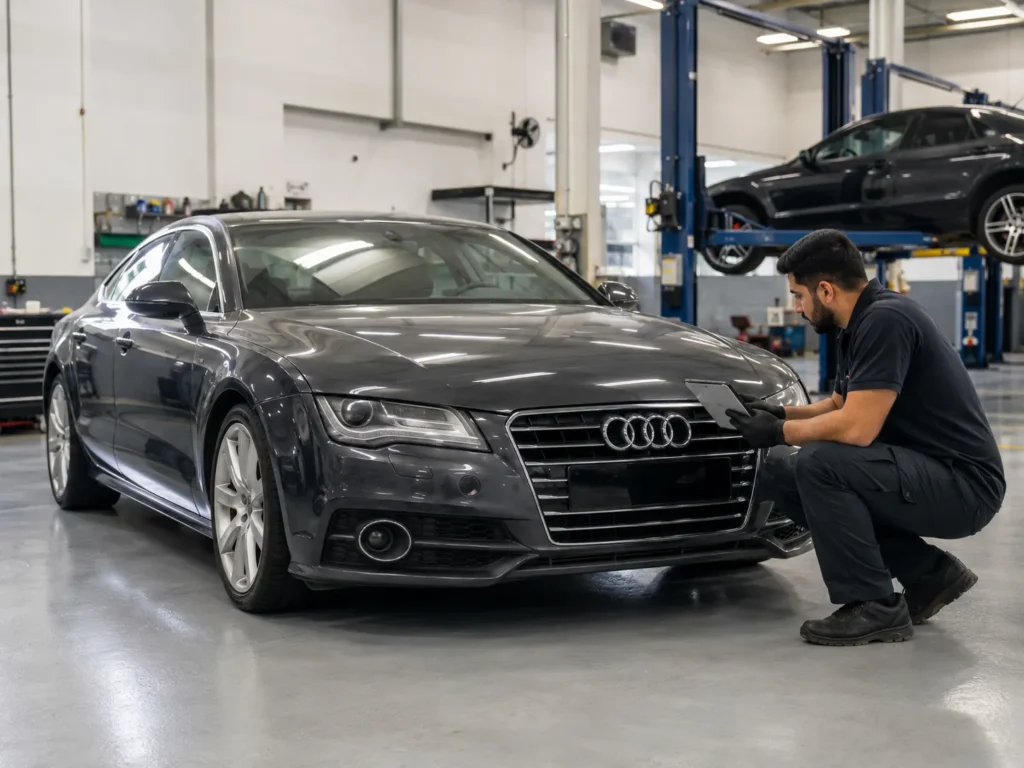
The A7 name covers different generations, petrol, diesel and electrified powertrains, front-wheel drive and quattro, several transmission designs, steel springs and adaptive air suspension, and different MMI, lighting, braking and driver-assistance packages. S7 and RS7 models introduce further mechanical and cost differences.
Compare the VIN on the registration card with the physical VIN locations and service records. Confirm production date, model year, engine, transmission, drivetrain, original market and option equipment. A GCC car and an import may differ in specification, history, software and parts availability. Imported does not automatically mean bad, but its condition and documentation must justify the purchase.
Do not rely on exterior badges, an online listing decoder or the seller’s description alone. Badges and cosmetic parts can be changed.
Check the Car Before Traveling to See It
Ask for clear copies or photographs of the registration details, VIN, service invoices and current odometer. Request images of all four sides, wheels, tire labels, engine bay, luggage area and any disclosed repair. Ask directly whether the car has been tuned, wrapped, lowered, converted, flooded, written off, imported after damage or repaired following an accident.
Useful pre-visit questions include:
- Why is the car being sold?
- How long has the seller owned it?
- Who maintained it and are the invoices available?
- Which fluids, filters, plugs, brakes, tires and battery were last replaced?
- Does it consume oil or coolant between services?
- Do any warnings, noises or faults appear intermittently?
- Has the windscreen, bumper, suspension or steering been repaired?
- Are all keys and the locking-wheel tool present?
Vague answers are not automatic rejection, but they increase the amount of verification needed.
Turn Common Seller Claims Into Proof
| Seller claim | Evidence to request | Physical check | Buying response |
|---|---|---|---|
| Full service history | Dated invoices with mileage, fluids and parts | Condition, leaks, reminders and scan data | Treat missing items as unknown, not completed |
| No accident | History records and repair invoices | Paint, fasteners, welds, gaps, glass and calibration | Assess repair quality and structure, not only the label |
| Recently serviced | Itemized invoice and correct approvals | Oil level, filters, leaks and service display | Price any work not specifically documented |
| New battery | Battery invoice and specification | Charge, health, registration and charging test | Find the cause if discharge or warnings remain |
| Perfect tires | Brand, model, size and date information | Axle match, repairs, wear, pressure and structure | Budget a compatible set if specification is mixed |
Inspect the A7 While It Is Cold and Stationary
Fluids and Leaks
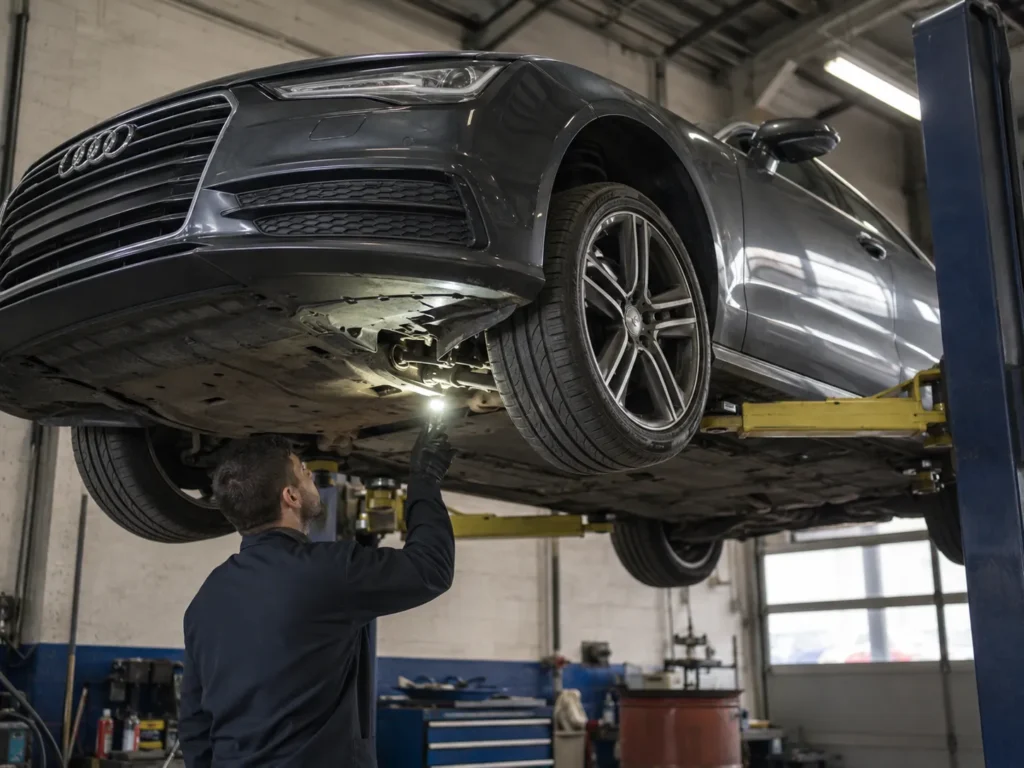
Follow the correct vehicle procedure for fluid checks. Inspect visible areas for fresh oil, dried coolant residue, damaged wiring, missing covers and signs of recent cleaning. A spotless engine bay is not proof of a leak, but cleaning can remove evidence.
Look beneath the vehicle and around undertray edges. Fluid may collect above the undertray instead of reaching the ground. Never open a hot cooling system or place hands near belts, fans or hot parts.
Tires, Wheels and Brakes
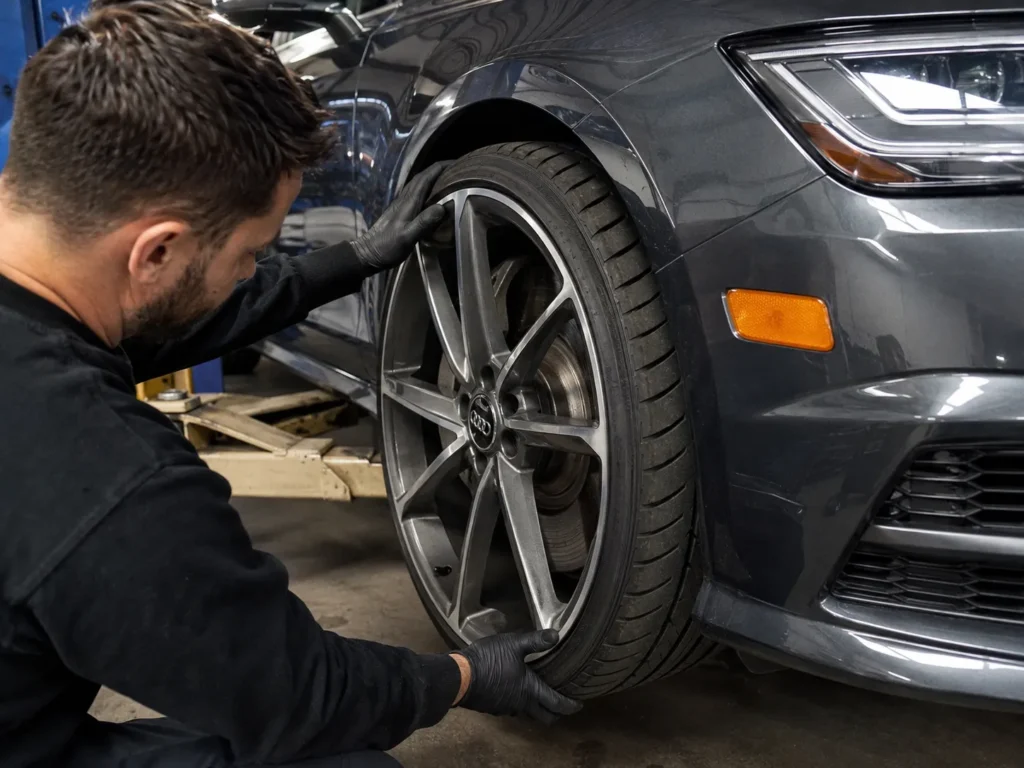
Read all four tire labels. Confirm approved size, load and speed specification, manufacturing dates, repairs, sidewall condition and wear. Mismatched rolling circumference can affect quattro behavior and complicate vibration diagnosis. Inspect wheels for impact repair, cracks, excessive weights and incorrect fitment.
Measure brake friction material and disc condition. “Recent brakes” can mean pads only, work on one axle or low-quality parts. Check caliper movement, hoses and the electronic parking brake. Uneven tire or brake wear can reveal alignment, suspension or caliper trouble.
Body, Glass and Understructure
View paint and panel gaps in good light. Look at fasteners, seam sealer, weld areas, lamps, glass dates, door and hatch operation, inner structures and underbody. Paintwork is not automatically a reason to reject the car. Poor structural repair, corrosion, water entry, incorrect parts or unresolved calibration are more important than a refinished cosmetic panel.
Inspect the windscreen and front bumper carefully because cameras and radar sensors may require correct mounting and calibration after repair. Check that warnings do not appear and that fitted functions operate, but do not assume operation alone proves calibration accuracy.
Listen to the First Start
Before starting, switch on the ignition and observe the warning-light check. Confirm that expected warnings illuminate and then clear appropriately after startup. A missing warning icon deserves investigation.
During the first start, note cranking speed, startup noise, smoke, idle quality, warning messages and odors. A brief sound needs its duration and source recorded. Rough running may involve ignition, fuel, air leakage, compression or timing. Do not accept a quick coil replacement as the only possible explanation.
Watch temperature behavior as the car warms. Check for coolant smell, fan operation, unstable idle and AC performance. An A7 that cools while moving but warms at idle may need airflow, fan, refrigerant or compressor diagnosis.
Check Transmission and Quattro Behavior
Identify the installed transmission before deciding what is normal. With the brakes applied, note engagement into Drive and Reverse when cold. During the road test, look for delay, flare, harshness, shudder, warning messages or a change after the drivetrain becomes hot.
Engine torque, mounts, tires and driveline components can imitate transmission faults. A scan, leak inspection and model-specific data review are needed before a repair cost can be trusted.
During slow tight turns, listen and feel for binding, clicking or vibration. Confirm that tire specifications and wear are compatible before blaming the quattro system.
Inspect Steel or Air Suspension Correctly
If the car has air suspension, inspect its height before startup and after it has been parked. Note whether one corner sits low and whether the compressor runs for an extended period. Test air springs, lines, fittings, valves, level sensors and control data. A tired compressor may be the consequence of a leak rather than the original cause.
On either suspension type, inspect dampers, bushes, arms, joints, links, bearings and mountings. A quiet drive on a smooth road is not enough. Use varied low-speed surfaces and listen with the cabin fan and audio reduced.
Test Every Paid Feature
The A7’s equipment can add substantial value and repair exposure. Test every function shown in the listing, including:
- MMI display, audio, navigation, phone connection and vehicle menus
- front and rear cameras, parking sensors and parking assistance
- adaptive cruise, lane functions and other fitted driver aids
- matrix or adaptive lighting where equipped
- climate control in all zones and at different fan speeds
- powered seats, memory, heating and ventilation where fitted
- hatch, soft-close doors, keyless entry and both keys
- sunroof, windows, mirrors, blinds and interior lighting
Separate a display fault from a network or input fault. A camera-unavailable message does not automatically mean the camera itself failed.
Use a Five-Stage Road Test
- Low-speed control check for steering weight, brake response, parking sensors, tight turns and suspension noise.
- Normal acceleration for engine response, shift quality, hesitation and vibration.
- Steady road speed for tire roar, wheel vibration, bearing noise and steering position.
- Controlled braking for pull, pedal behavior, vibration and noise without creating an unsafe maneuver.
- Hot restart and final idle for warning messages, fluid odor, cooling behavior, engagement and leaks.
The route should be long enough to warm the powertrain and should include safe low-speed turns, a steady-speed section and normal braking. The seller or owner should authorize the test and insurance requirements must be respected.
A Full Diagnostic Scan Is Part of the Inspection
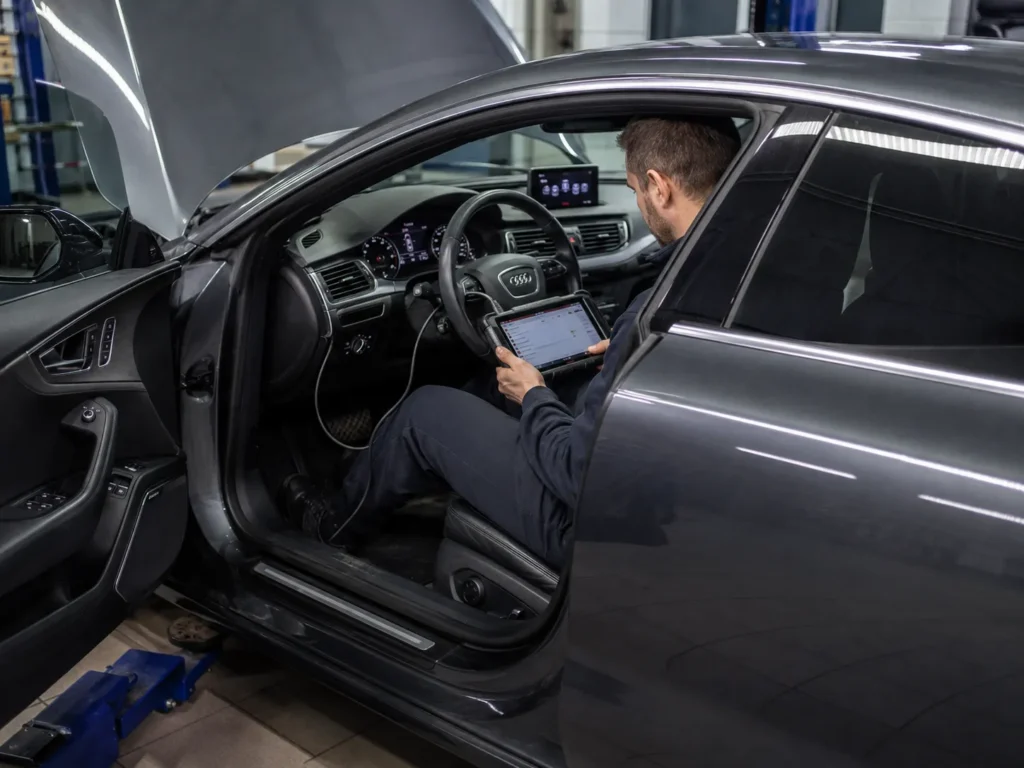
Scan all installed control units, not only the engine. Record current, intermittent and stored faults, freeze-frame information, communication status and readiness where relevant. Low-voltage faults, mileage records in control units and recently cleared data may need interpretation.
A code is evidence, not a parts order. The published guide to Audi diagnostics with ODIS, VCDS and fault codes explains why status, conditions and physical tests matter before replacement.
After the scan, test the systems related to the codes. Clear nothing until the original report is saved. A second scan after the road test can reveal faults that returned under operating conditions.
Check Whether Recent Work Actually Solved the Complaint
A new part does not prove that the original fault was diagnosed correctly. If the seller mentions a recent battery, turbocharger, transmission, suspension or cooling repair, ask what symptom led to the work, which tests confirmed the cause and how the result was verified. Compare the invoice date and mileage with the current scan and physical condition.
Repeated replacements of the same part, several fault-clearing visits or a repair completed immediately before sale deserve closer attention. The explanation may be reasonable, but the inspection should reproduce the original condition and confirm that the related measurements are now normal. A warranty on the part is useful only when the underlying fault and installation are both correct.
Separate RTA Passing From a Pre-Purchase Inspection
A current registration test or passing result is useful, but it does not answer every ownership question. A model-specific pre-purchase inspection looks for intermittent faults, maintenance gaps, fluid leaks, equipment operation, diagnostic history, accident-repair quality and likely first-year work.
Use both for their intended purpose. Do not treat one as a substitute for the other.
Build the First-Year Cost Before Negotiating
Ask the inspection report to divide findings into four groups:
- Unsafe or urgent work needed before normal use
- Active repair supported by diagnostic evidence
- Overdue or undocumented maintenance
- Normal wear and future planning
Include tires, brakes, battery, fluids, filters, plugs, suspension, AC, leaks, programming and calibration where relevant. Do not accept one round estimate without parts, labor, fluids and verification details.
The Audi A7 maintenance cost guide shows how to distinguish genuinely due work from condition-based items and active faults.
Green-light purchase
Identity, history, physical condition and scan evidence agree. Known work is limited, priced and acceptable against the purchase price.
Renegotiate or investigate
The car is fundamentally suitable, but maintenance gaps, tires, brakes, leakage or a testable fault need a written cost before a decision.
Walk away
The identity is unclear, the seller blocks an independent inspection, structural repair is unsafe, water or fire damage is unresolved, warnings were concealed, or the combined risk exceeds the value of the car.
Arrange a Used Audi A7 Inspection in Dubai
Send the listing, VIN, model year, mileage and seller location before the visit. We can check the A7 cold, inspect the mechanical and electrical systems, perform a full scan and separate immediate repair cost from overdue maintenance and normal wear.
Send the Used Audi A7 Listing for Review
Frequently Asked Questions
Is a used Audi A7 reliable in the UAE?
Reliability depends on the exact powertrain, maintenance history, condition, previous repairs and present test results. A documented and correctly maintained car is a different risk from one with missing history and unresolved warnings.
Should I buy a GCC or imported Audi A7?
Judge the individual car. Confirm original specification, history, accident repair, software, cooling and parts compatibility. Imported status alone does not prove good or bad condition.
What should I check first on a used A7?
Confirm the VIN and documents, arrange a genuine cold start, inspect body and understructure, check fluids, tires and brakes, test every fitted function and complete a full scan and road test.
Does a clean dashboard mean there are no faults?
No. Intermittent, stored or recently cleared faults may not illuminate a warning during the viewing. Scan all control units and interpret the results with physical tests.
How can I check Audi A7 air suspension?
Inspect height after parking, measure each corner, note compressor operation and test for leaks, valve or sensor faults. Repeatedly raising the car can hide the symptom and stress the compressor.
Is RTA passing enough before buying an Audi A7?
No. It serves a different purpose. A pre-purchase inspection adds model-specific mechanical, diagnostic, maintenance, equipment and repair-quality checks.
Should I reject an A7 with repainting?
Not automatically. Determine why it was painted and inspect repair quality, structure, corrosion protection, glass, sensors and calibration. Unsafe structural repair matters more than a properly refinished cosmetic panel.
How long should the A7 road test be?
Long enough to check cold behavior, warm the powertrain, test normal acceleration, steady road speed, braking, low-speed turns and a hot restart. A short drive around the block is not enough.