

Audi Thermostat Replacement in Dubai
Audi thermostat replacement begins with temperature evidence, not a guess. We distinguish a thermostat that is stuck open, stuck closed, leaking, responding incorrectly, or being blamed for another cooling fault, then renew the confirmed assembly and verify refill, bleeding, warm-up, fan behavior, and leak integrity.
Confirm whether the thermostat is causing the temperature problem
The thermostat regulates coolant flow so the engine can warm efficiently and remain within its intended operating range. A conventional wax-element thermostat responds to temperature mechanically. Some Audi applications also use an electrically influenced or mapped thermostat arrangement, and the thermostat may be integrated with a housing, sensors, valves, or water-pump module.
A thermostat stuck open can allow coolant to circulate too early, creating slow warm-up, weak heater performance in some conditions, unstable temperature, or efficiency-related faults. A thermostat stuck closed can restrict circulation and contribute to rapid overheating. A housing can leak even when temperature control is normal. Electrical control or plausibility faults can point toward wiring, a sensor, commanded operation, or another cooling-system condition.
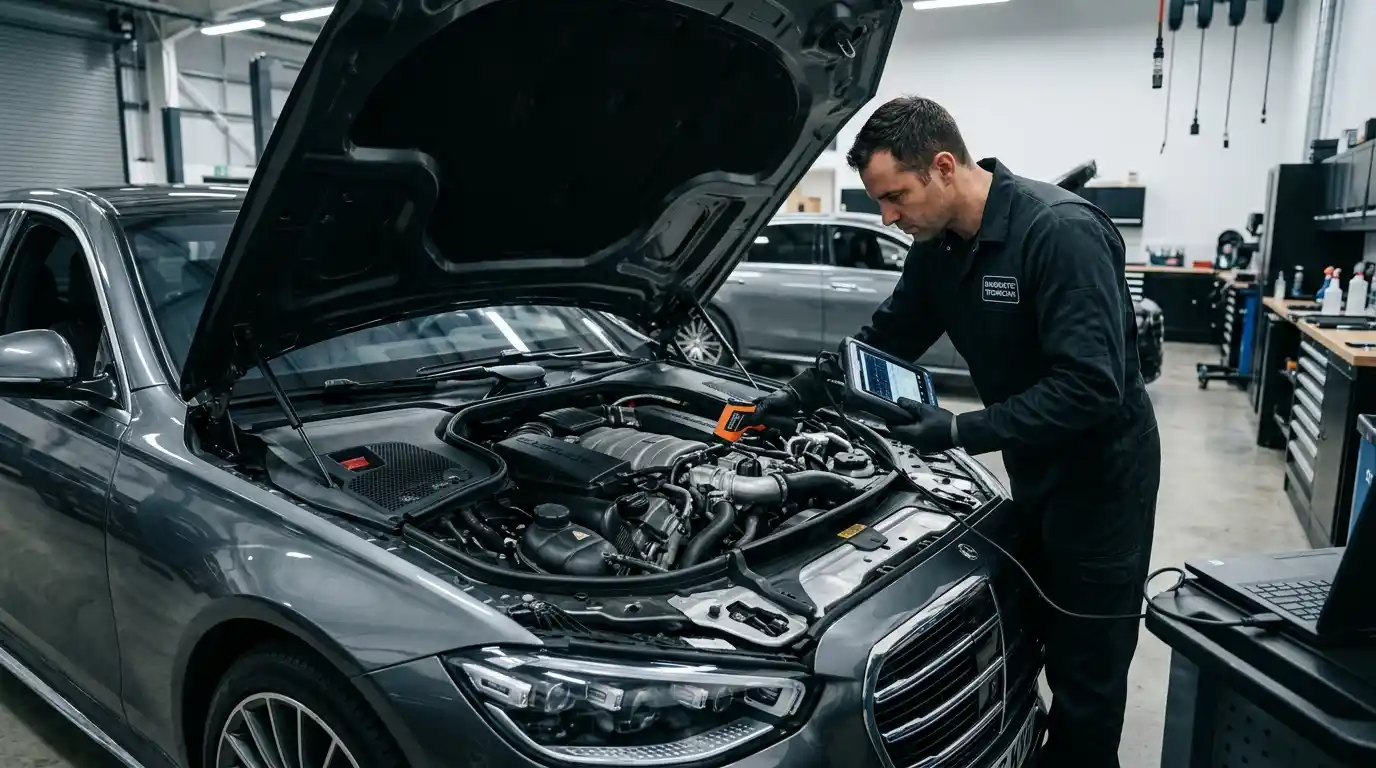
We compare the complaint, warning message, scan data, cold-start temperature plausibility, warm-up curve, hose or circuit behavior, pressure integrity, coolant level, fan operation, pump performance, and related systems. The purpose is to approve the exact failed component and avoid replacing a thermostat when a leak, water pump, fan, sensor, blocked passage, trapped air, radiator, or engine condition is responsible.
Stuck open and stuck closed do not look the same
Symptoms depend on ambient temperature, driving load, speed, heater use, coolant level, engine design, and control strategy. These patterns guide testing but do not replace it.
Slow or incomplete warm-up
The actual coolant temperature may rise unusually slowly, drop during steady driving, or fail to reach the expected regulated range. Cabin heat and fuel-management behavior can be affected. A sensor that reads incorrectly can imitate the same pattern, so temperature plausibility is checked first.
Stable regulation under load
A healthy system warms from a credible cold baseline and then manages temperature as load, vehicle speed, fan operation, and coolant circuits change. The exact target and behavior vary by engine and strategy; one universal dashboard number is not a diagnosis.
Rapid rise or overheating
Restricted flow from a closed thermostat is one possibility, but low coolant, a leak, failed pump, blocked radiator, fan fault, trapped air, combustion-gas intrusion, or another restriction can create the same urgent result. Stop driving when temperature rises abnormally.
What the vehicle tells us and what must be verified
| What you notice | Thermostat possibility | Important alternatives | Useful evidence |
|---|---|---|---|
| Temperature takes too long to rise | A valve may remain open or begin opening too early. | Coolant-temperature sensor bias, very light load, heater demand, coding or strategy, or gauge interpretation. | Cold-start curve Compare ambient, engine, and coolant values before start, then record the warm-up under known conditions. |
| Temperature drops at road speed | Excess radiator flow through an open thermostat can overcool the engine. | Sensor or wiring fault, fan command issue, unusual operating conditions, or incomplete previous repair. | Load comparison Observe actual data at idle and steady driving instead of relying on the gauge alone. |
| Temperature rises rapidly | A closed or restricted thermostat can limit circulation. | Low coolant, pump failure, trapped air, blockage, fan fault, radiator restriction, or internal engine fault. | Stop and test Inspect level only when safe, pressure-test cold, examine circulation evidence, and scan the system. |
| Coolant leak near the housing | Housing, seal, flange, or integrated assembly may be leaking. | Water pump, hose connection, pipe, oil-cooler area, reservoir cap, nearby flange, or coolant tracking from above. | Clean source Trace residue to its highest fresh point and repeat pressure checks cold and after a controlled heat cycle. |
| Cooling-system or thermostat code | Control or temperature behavior may be outside the expected model. | Sensor, wiring, connector, low coolant, pump flow, fan strategy, previous software, or intermittent conditions. | Code context Record status, frequency, freeze-frame data, related controllers, and actual values before clearing faults. |
| Weak cabin heat | An open thermostat can reduce available heat under some conditions. | Low coolant, air pocket, heater-core restriction, blend-door fault, HVAC control, auxiliary pump, or climate setting. | Circuit split Compare coolant temperature, heater circuit behavior, HVAC commands, and outlet temperature. |
A fault code does not authorize the part
Diagnosis connects the vehicle’s thermal behavior to a physical or controlled fault. Tests are chosen for the exact engine and symptom rather than performed as a generic package.
Cold-start plausibility
After an appropriate cold soak, coolant and other temperature sensors should begin from values that make sense relative to the environment. An implausible starting point can distort the entire warm-up interpretation.
Warm-up and regulation data
Actual temperature, engine load, speed, fan request, heater demand, thermostat control where available, and relevant circuit values are observed through a controlled operating cycle.
Leak and pressure inspection
Coolant level, concentration or specification evidence, reservoir, cap, housing, pump, hoses, pipes, radiator, and traces are checked. Pressure behavior can reveal a leak that is hidden when cold or dry.
Flow and heat distribution
Temperature changes across relevant hoses and components help distinguish early radiator flow, restricted circulation, trapped air, pump weakness, fan problems, and normal strategy. Hot components are approached with suitable safety controls.
Cooling-system faults often overlap
A thermostat can be installed correctly and the original problem can remain if another fault was missed. Low coolant can expose sensors or interrupt circulation. A weak or damaged water pump can reduce flow. A fan can fail to respond when stationary. A blocked heat exchanger or hose can alter temperature distribution. Combustion gases can pressurize the system. Trapped air after previous work can create unstable heat and false conclusions.
For active leakage, see our Audi coolant leak repair process. A coolant flush is maintenance or contamination work, not a cure for a failed thermostat.
How the confirmed repair is completed
Access varies widely. The thermostat may be a separate component, part of a plastic or metal housing, or combined with a pump or valve module. Intake parts, covers, belts, pipes, connectors, undertrays, or other items may require controlled removal. The exact work scope follows vehicle-specific information and the installed design.

Do not gamble with an overheating warning
Engine damage risk depends on actual temperature, coolant containment, flow, load, and duration. If behavior is unclear, call before driving.
Slow warm-up only
If the car remains stable with no coolant loss, overheating, warning escalation, steam, or severe running problem, arrange inspection and avoid assuming the gauge confirms the cause.
Recurring cooling warning
Repeated plausibility codes, changing heat, fan concerns, or a small coolant loss require timely testing before the condition becomes a roadside event.
Temperature rising
Reduce load, stop in a safe place, switch the engine off as appropriate, and do not open a hot pressurized reservoir. Call for guidance.
Steam, major loss, or severe heat
Do not continue driving with steam, coolant discharge, a critical temperature warning, heavy misfire, or repeated overheating. Recovery is safer than testing the limit.
The vehicle badge does not identify the cooling layout
Across Audi generations, petrol, diesel, mild-hybrid, plug-in-hybrid, and performance powertrains can use different thermostat positions, numbers of coolant circuits, electric pumps, valves, heat exchangers, sensors, fan strategies, and bleeding procedures. A part ordered only from “A4” or “Q7” can be wrong even when it looks similar.
Turbochargers, charge-air cooling, gearbox cooling, exhaust-temperature management, cabin heating, battery thermal systems, and after-run circulation can add circuits and valves. S and RS vehicles may have higher heat rejection and extra cooling equipment. Plug-in and battery-electric models have thermal systems that are not treated as a conventional engine-thermostat job.
We use VIN, production date, engine and drivetrain information, option data where applicable, installed part markings, and the actual circuit layout. Previous repairs, mixed coolant, aftermarket components, software changes, and modified cooling hardware are recorded before interpreting the system.
What changes the quotation
- Exact engine, thermostat design, housing, pump integration, and part availability
- Access and components that require removal and reinstallation
- Coolant loss, contamination, mixed or unknown fluid, and required system cleaning
- Hoses, pipes, connectors, sensors, seals, fasteners, and mating-surface condition
- Broken plastic, corrosion, damaged threads, or evidence of previous sealant misuse
- Additional leak, pump, fan, radiator, heater, or internal-engine diagnosis
- Refill equipment, bleeding functions, warm-up testing, and extended leak verification
A written estimate is confirmed after inspection and exact parts identification. We do not publish a single repair time because access and integrated assemblies differ substantially.
Replacement is not the same as a coolant flush
Thermostat replacement normally requires draining some coolant and restoring the system with the correct fluid and bleed procedure. That supporting work does not mean every vehicle needs an aggressive flushing process. A flush may be considered for incompatible coolant, contamination, neglected fluid condition, or a separate maintenance objective after the cause is understood.
Conversely, flushing cannot restore a thermostat that is mechanically stuck, repair a leaking housing, make a failed pump circulate, or seal an internal engine fault. Maintenance and repair scopes should be written separately so the customer understands what each action is intended to accomplish.
Our Audi coolant flush service explains fluid selection, contamination decisions, refill, and bleeding in more detail.
The final warm-up must answer the original complaint
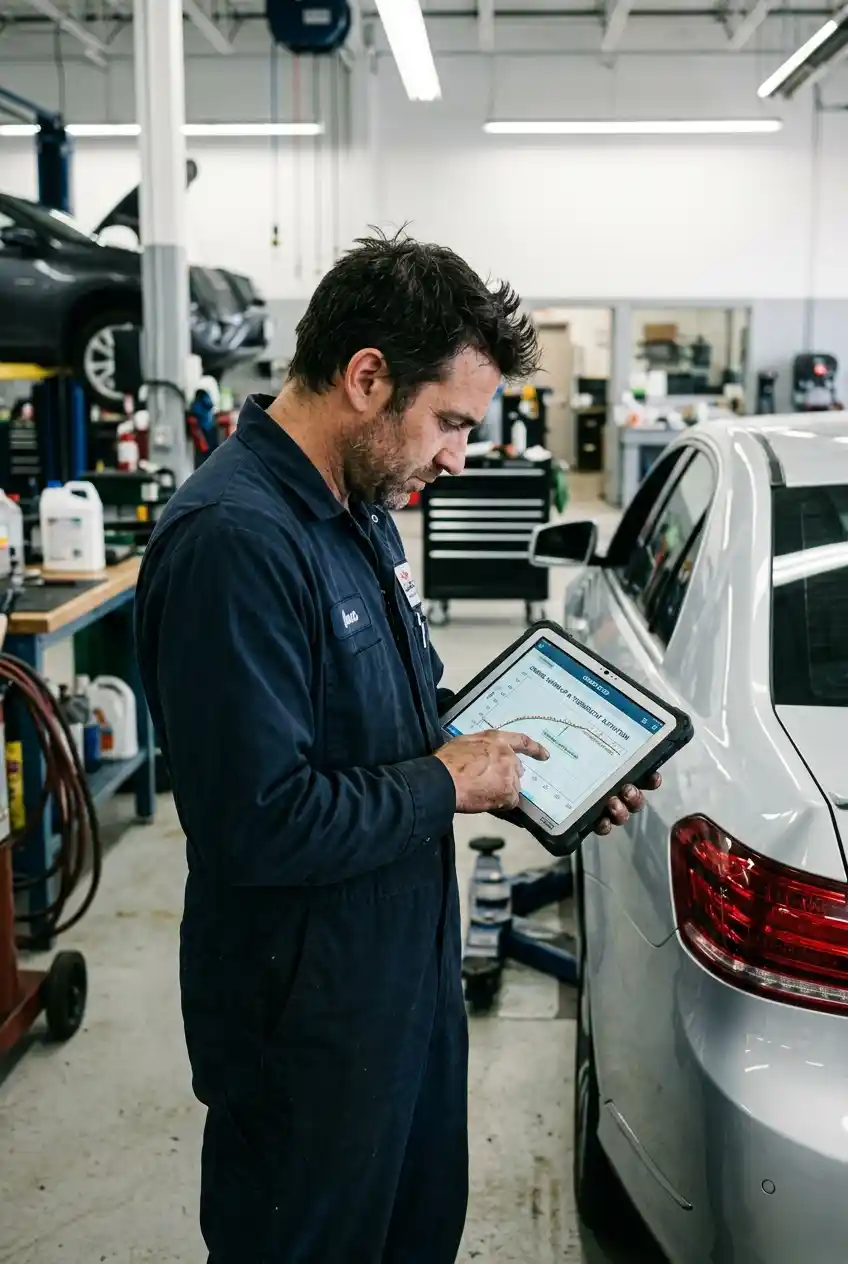
A dry housing at idle is not enough. We verify the coolant level and pressure integrity, inspect disturbed connections, clear or retain fault history appropriately, and run the engine through a controlled warm-up. Actual data should begin from a credible baseline, rise in a manner consistent with the vehicle and conditions, and show stable regulation as relevant circuits and fans respond.
When the original complaint occurred only at road speed, with the AC operating, in traffic, under load, after a hot soak, or on repeated cold starts, the verification plan must reproduce that condition safely where practical. Heater operation, fan behavior, leaks after cool-down, and the next cold coolant-level check can all matter.
- No active leakage at the thermostat, housing, pump, hoses, pipes, or disturbed connections
- Correct coolant specification and final level after the required bleed and cool-down
- Credible sensor values and a normal warm-up pattern for the exact configuration
- Stable temperature behavior under the conditions that caused the complaint
- Cooling fans and controlled components responding when requested
- No returning relevant fault code or warning after the verification cycle
Audi thermostat replacement FAQs
What are the signs of a stuck-open Audi thermostat?
Possible signs include unusually slow warm-up, actual coolant temperature falling during steady driving, weak heater output in some conditions, or a temperature-regulation fault. A biased sensor, wiring problem, light operating load, control strategy, or another cooling issue can look similar, so actual cold-start and warm-up data should be checked.
What are the signs of a stuck-closed thermostat?
A closed or restricted thermostat can contribute to a rapid temperature rise and overheating, but the same urgent pattern can result from low coolant, leakage, a failed water pump, trapped air, a blocked passage or radiator, fan failure, or an internal engine fault. Stop driving if temperature rises abnormally.
Can I drive my Audi with a thermostat fault?
Do not drive if the vehicle is overheating, losing coolant, steaming, misfiring heavily, or showing a critical warning. A stable slow-warm-up complaint may allow a planned inspection, but the cause and actual temperature still need confirmation. Call before moving the car when the condition is uncertain.
Does a thermostat fault always set a code?
No. A mechanical fault or leak may develop without an immediate dedicated code, and a code can describe temperature behavior rather than prove the thermostat itself has failed. Scan status, freeze-frame information, sensor plausibility, warm-up data, and physical cooling-system evidence must be interpreted together.
Is the thermostat separate from the water pump?
That depends on the exact engine and generation. Some use a separate thermostat and housing, while others package the thermostat with a pump, valve, or larger module. The VIN, engine information, installed assembly, and repair data determine whether one component or a complete assembly is serviceable.
Does thermostat replacement include new coolant?
The repair normally requires restoring coolant lost during access, using the correct specification and mixture, and following the applicable refill and bleeding procedure. The amount and whether broader coolant cleaning is needed depend on the system, fluid condition, contamination, previous mixture, and approved repair scope.
Why must the cooling system be bled after replacement?
Air trapped in a cooling circuit can interrupt flow, reduce heater performance, create unstable temperature readings, and contribute to overheating. The required filling and bleeding method varies by vehicle and may include vacuum filling, controlled operation, auxiliary-pump functions, heater settings, or model-specific procedures.
How long does Audi thermostat replacement take?
Time depends on thermostat location, access, engine layout, pump or housing integration, parts availability, seized or damaged components, leak diagnosis, coolant condition, refill and bleeding requirements, and the verification cycle. The schedule is confirmed after the exact vehicle and repair scope are identified.
What should I send when requesting a quotation?
Send the VIN, model year, mileage, exact warning text, when the problem occurs, whether the temperature is too low or too high, coolant-loss history, heater behavior, recent cooling work, and photos of any leak. Do not open a hot coolant reservoir to obtain a picture.
Book an Audi cooling-system assessment in Al Quoz 4
Send the VIN, exact warning, temperature behavior, coolant-loss history, and when the symptom appears. If the car is overheating or discharging coolant, call for recovery guidance instead of driving it to the workshop.