
Audi RS7 Repair and Service in Dubai
An RS7 diagnosis is strongest when it preserves the order of events: supply voltage, startup, warming, load, chassis response, heat soak and restart. That sequence helps separate one initiating fault from the warnings and protective actions that follow it.
Write an event log before clearing the dashboard
Compare the related Audi S7 repair page and Audi RS6 repair page. For warning-led triage, preserve the first event and use the dashboard warning guide.
Check battery and charging behavior before pricing several modules. Save fault status and environmental data. A low-voltage history can create secondary events, while a recurring system fault still requires its own test.
Stop when the event log shows immediate risk
Park safely, switch off and request transport when lubrication is in question, coolant heat is uncontrolled, combustion is violently uneven, fluids are escaping, tires are compromised, the body sits abnormally low, or the driver cannot rely on braking, steering or gear engagement. Visible exhaust smoke, a gasoline smell or deep internal impact noise also rules out further testing on the road.
Contact the workshop before moving an RS7 that has limited output together with an electrical, ride-control, gearbox or heat alert. When a technician approves a brief transfer, keep engine demand and braking gentle, watch every new message and end the journey immediately if control becomes less consistent. Do not keep restarting to regain normal mode.
Confirm the RS7 configuration before the test route
Power and supply
Engine, gearbox, 12-volt and applicable 48-volt systems, software state and modification history.
Chassis and control
Air suspension or DRC, steering, sport differential, assistance sensors, brakes, wheels and tires.
Body and cabin
Sportback tailgate, frameless glass, water paths, lighting, cameras, climate and fitted comfort equipment.
Audi’s official RS7 facts describe later performance equipment. Match that information to this car’s chassis number, option record and physical suspension and brake configuration.
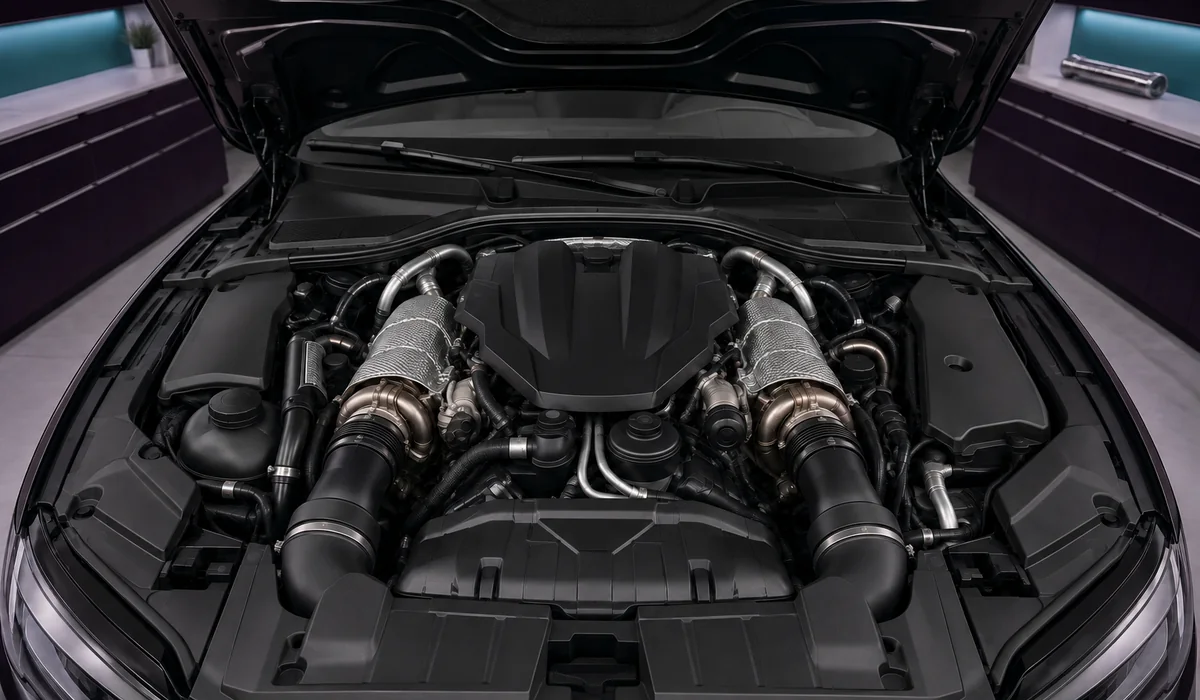
Test V8 power loss without creating a second heat event
Record whether reduced power appears after traffic, parking, steady speed or moderate acceleration. Compare ignition, fueling, air, boost, temperature and requested torque as the system allows. A boost or cylinder code does not automatically identify the failed component.
Inspect oil and coolant evidence with the correct procedures, never opening a hot system. Describe exhaust smoke by appearance, moment of onset, operating demand and any measured change in oil or coolant. A smell after hard use needs its first source at exhaust, fluid, brake, tire or wiring.
Use the smallest safe load that reproduces the concern and watch recovery. Repeated maximum acceleration can obscure the initiating condition.
Keep transmission behavior inside the whole driveline
Test selection of drive and reverse before warm-up, then repeat low-speed turns, upshifts, downshifts and coast-down after the driveline reaches operating temperature. Compare commanded engine torque with transmission response, mount movement, joint condition, sport-differential data and tire uniformity. A disturbance during a shift can originate elsewhere in the driveline.
Confirm fluid and service history for the exact transmission and driven-axle units. Preserve adaptation and software data before reset. After repair, repeat low-speed and original safe-load conditions, not only one smooth highway shift.

Separate air suspension, DRC and steering evidence
Identify the installed chassis. For air suspension, observe stance before startup and after the route, command available heights, and inspect leakage, compressor, valve, sensor and wiring behavior. For DRC, inspect dampers, hydraulic condition, mounts and geometry using the correct procedure.
Rear-steering and driver-assistance faults require stable voltage, secure sensor mounting, correct geometry and valid calibration. Link any recent windscreen, bumper, wheel or chassis work to the affected sensor path. Support the vehicle with approved mechanical equipment; an air-suspension position is not a safety support.
Measure the contact patches and Sportback load
Create an RS7 wheel sheet for all four corners with tire model, date code, inflation, tread depth, repair history and rim runout. Classify vibration by whether it follows vehicle velocity, engine speed, braking force or steering input. Check joints and baseline geometry before adjusting alignment.
Identify the installed brake-disc construction before measuring it with the applicable method. Document disc condition, pad thickness, caliper operation, hub runout, flexible lines and fluid history. Mileage alone cannot establish remaining brake capacity.
Test tailgate, load-area restraints, drainage and rear electronic equipment. Prior rear body work can affect water paths, sensors and wiring as well as appearance.

Make maintenance and repair approvals auditable
| Approval | Evidence required | Handover proof |
|---|---|---|
| Routine service | VIN, exact specification, time, mileage and history. | Product, quantity, part and reset record. |
| Wear renewal | Brake, tire, battery or chassis measurement. | Before-and-after value and review plan. |
| Fault repair | Reproduced event and failed test. | Final scan and repeated event sequence. |
| Conditional access | Defined hidden-damage possibility. | Separate owner approval before expansion. |
Identify parts route, labor access, fluids, fasteners, coding, alignment and calibration. If an intermittent event cannot be reproduced at handover, state the limitation and define the next capture plan.
Record modifications without assuming guilt
List software, intake, exhaust, cooling, fueling, suspension, wheel and brake changes. Preserve current faults and calibration identity before flashing or resetting. A modification can change heat, load, compatibility and warranty questions, but it does not prove every warning.
Confirm UAE legal use, insurer and warranty consequences with the relevant providers. Some testing may require a known reference configuration and a separately approved return toward standard.
Inspect a used RS7 before its systems normalize
Arrange the first inspection before startup, ideally following a full resting period. Verify VIN, records, keys, GCC or import status, accident work and modification history. Inspect stance, fluids safely, underbody, cooling openings, tires, brakes and load area, then scan.
Build the purchase drive from tight maneuvering, a stable cruise, one bounded load increase, progressive stopping and a restart after heat soak. Compare the post-drive module report with the initial scan. Launch operation adds stress without establishing overall condition.
Budget known maintenance. Request further testing or leave when engine, gearbox, structural, 48-volt or chassis risk remains open-ended.
Interpret 48-volt and cylinder-on-demand events carefully
Later RS7 configurations use electrical and engine-management strategies that can change sound, vibration and warning behavior. Document the conventional battery baseline and the higher-voltage support system separately, followed by controller wake timing, calibration identity and the precise operating demand that triggers the change. Physical 48-volt work requires qualified safety procedures.
Do not label a light-load transition as a failed cylinder or mount without data. Equally, a new vibration, warning or repeated fault should not be dismissed as normal control behavior. Compare the event with scan and operating evidence.
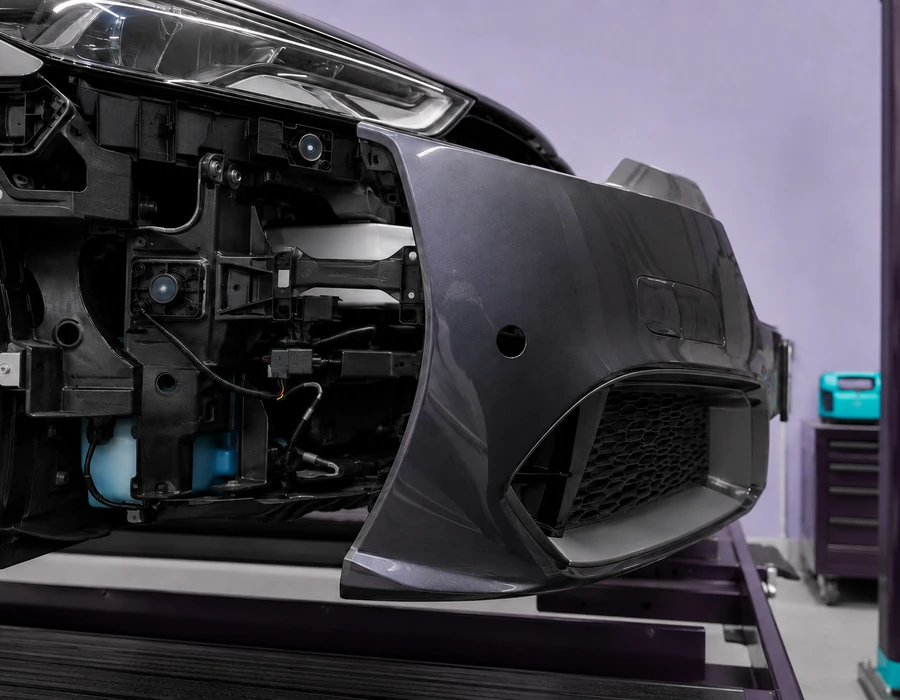
Map cosmetic repair to hidden sensing hardware
Inspect repaired windscreen, bumpers, lamps, wheel arches and suspension areas for disturbed brackets, ducts, wiring and sensors. Connect body or wheel work to current radar, camera, parking, steering and geometry checks. Request calibration records where applicable.
Frameless door glass, seals and tailgate drainage deserve function and water-path tests. Moisture around rear electronics needs source tracing before modules or trim are priced.
Plan parts, downtime and conditional access
The RS7 estimate should identify part source, labor access, approved fluids, single-use hardware, programming, wheel alignment and any required calibration. Show availability, VIN-restricted ordering, exchange-unit conditions and outsourced operations separately from hands-on workshop time.
If hidden damage can only be seen after disassembly, define the access point and obtain approval before the job expands. Do not use open-ended authorization on a complex performance vehicle.
Use storage and battery history in the diagnosis
After long parking, record pressure loss, battery state, startup messages, stance and first-drive vibration. Flat spotting or low voltage can alter the initial event, but they do not automatically explain faults that return after the baseline is corrected.
Inspect for leakage, pest or heat damage before a long journey. Preserve the initial scan and timestamps before clearing historic events.
Close the event log at handover
The final report should connect the original sequence to the failed test, repair, parts and fluids, adaptations or calibrations and repeated verification. Check the same startup, temperature, road speed, height or steering input as safely as possible.
If the event was intermittent and does not return, state what was tested, what remains uncertain and what the owner should capture next. A cleared dashboard is not a substitute for that conclusion.
Separate fuel, ignition and air evidence during a difficult start
A long crank, rough restart or fuel smell needs immediate condition notes. Record cold or hot state, time since shutdown, fuel level, recent refueling, cranking speed and exhaust appearance. Compare pressure, injector, ignition, air and vapor-control evidence as the test route supports.
Do not keep cranking when fuel odor, smoke, severe misfire or heavy knocking appears. Switch off and recover the vehicle. A battery that turns the engine slowly can affect the event, but it does not prove the fuel system is healthy.
Measure braking heat without assuming the friction pair
After a safe controlled stop, compare temperatures with tire pressure, wheel and hub condition, caliper operation, suspension movement and the installed steel or ceramic package. Disc or rotor feedback can overlap with hub error, wheel damage and tire variation.
Do not reproduce repeated high-energy stops on public roads. A pulling vehicle, soft pedal, red warning or severe grinding requires immediate assessment and may require recovery.
Prepare the RS7 evidence package before arrival
Send the chassis number, current odometer reading, photographs of each message, the first system that changed, ambient temperature, parking duration and any recent repair. Include battery replacement, jump-start, wheel, glass, body and software history because these can change the initial test order.
For a noise or vibration, record it safely without placing a phone near moving belts, fans, hot exhaust or rotating wheels. Note whether it follows engine rpm, vehicle speed, surface, braking or steering. Do not provoke the event with unsafe acceleration.
Agree on the first-stage output: saved scan, supply baseline, reproduced condition, measurements and a defined next approval. This prevents the visit from turning into open-ended parts substitution.
RS7 service questions
Can low voltage create several RS7 warnings?
It can contribute. Stabilize supply and identify which faults return before pricing several modules.
How should an RS7 that settles on one side be tested?
Compare resting height, commanded leveling, leakage, valve response, sensor data, electrical supply and physical suspension condition before selecting a component.
What is the next step after RS7 power is limited?
Share the warning sequence before moving the car. Use recovery when lubrication, uncontrolled heat, violent misfire or unreliable vehicle control is part of the event.