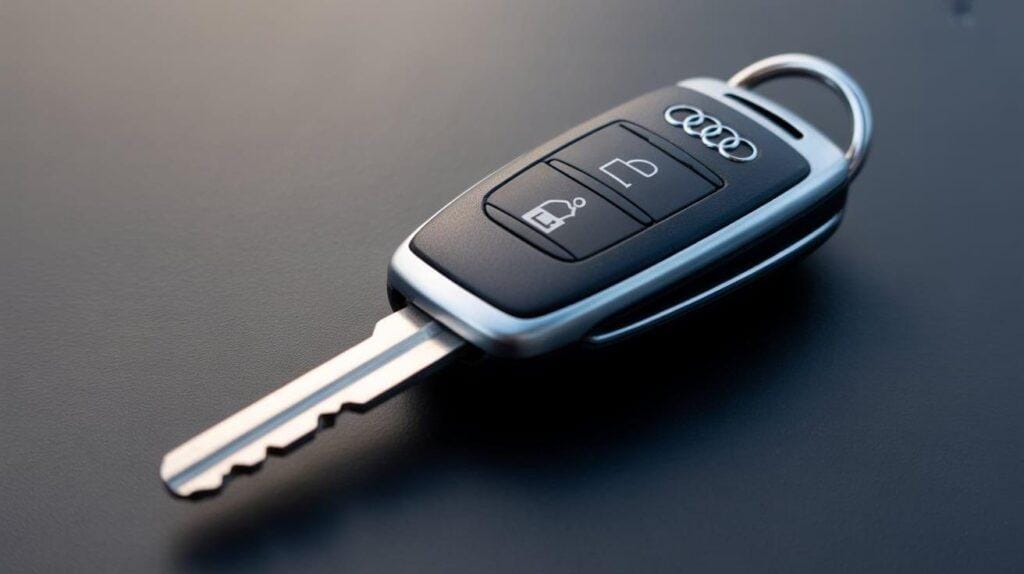
Your Audi key fob can stop unlocking the doors, lose range, show a “key not detected” warning, or work only after several button presses. The cause is often a weak coin-cell battery, but not always. Damaged contacts, lost remote synchronization, water exposure, a weak vehicle battery, or a fault in the car’s keyless entry system can produce very similar symptoms.
This guide helps you separate a simple key-fob problem from a vehicle-side fault before you replace parts or book programming. Audi key designs and emergency-start procedures vary by model and year, so use your Audi owner’s manual for the exact battery type, opening method, and backup key position.
First Check Whether the Problem Is the Key or the Car
Start with the spare key, if you have one. This single test usually narrows the diagnosis faster than repeatedly changing batteries.
- The spare key works normally: the main fob likely has a battery, contact, button, circuit-board, or synchronization problem.
- Neither key works: check the Audi’s 12-volt battery, central locking system, receiver antennas, relevant faults, and local signal interference.
- The buttons do not work, but the engine starts: the remote-locking side of the fob may be faulty while the immobilizer authorization still works.
- The car displays “key not detected”: the fob battery may be weak, but the issue can also involve the key chip, interior antenna, receiver, or vehicle voltage.
- Only touch-to-unlock fails: the keyless-entry door-handle sensor or an exterior antenna may be the problem, especially when the lock and unlock buttons still work.
8 Common Reasons an Audi Key Fob Stops Working
1. The Key Fob Battery Is Weak or Installed Incorrectly
A weak battery commonly causes shorter operating range, delayed response, and repeated button presses. A newly installed battery can also fail to solve the problem when the wrong type was used, the polarity is reversed, the cell is old, or a protective film was left in place.
Confirm the correct battery specification for your exact key. Install it in the direction shown inside the housing, then test the fob near the car and again from a normal distance.
2. The Battery Contacts Are Bent, Loose, or Corroded
The coin cell must sit firmly against its metal terminals. A drop, previous repair, moisture, or rough battery replacement can bend the contacts and interrupt power even when the battery is new. Look for loose terminals, white or green corrosion, dirt, or a battery that moves inside the holder.
Do not force thin contacts back into place if they are cracked or detached from the circuit board. That requires careful electronic repair.
3. The Buttons or Circuit Board Are Damaged
If one button fails while the others still work, the rubber membrane, switch, or soldered contact beneath that button may be worn. If every button stopped after the key was dropped, the circuit board or battery holder may have cracked.
A damaged housing should also be addressed. Gaps around the case let dust and moisture reach the electronics and can turn a minor button issue into permanent board damage.
4. The Remote Locking Function Has Lost Synchronization
Some Audi keys may need the remote-locking function restored after battery work, long storage, or a communication interruption. This is different from programming a new immobilizer key. A normal battery replacement usually does not erase the key’s secure start authorization.
Synchronization steps vary by model and model year. Avoid generic online sequences that may not apply to your Audi. Follow the vehicle manual or have the key checked with Audi-compatible diagnostic equipment.
5. The Audi’s 12-Volt Battery Is Weak
A key-fob complaint can begin with the car, not the remote. Low vehicle voltage can affect central locking, key detection, interior antennas, and control modules. This becomes more likely when both keys fail, the car cranks slowly, lights flicker, warning messages appear, or the vehicle has been parked for a long time.
Test the vehicle battery and charging system before replacing both keys or programming new ones.
6. Radio Interference Is Blocking the Signal
Temporary interference can reduce remote range in some parking areas. Move a short distance from the original location and test again. Keep the fob away from metal cases, other electronic access cards, power banks, and devices pressed directly against it.
If the key works normally elsewhere, the fob may be healthy. If its range is poor in every location, the battery, transmitter, or vehicle receiver needs further testing.
7. The Key Fob Has Water, Heat, or Impact Damage
Water exposure, repeated drops, and leaving the key in direct sunlight can damage the battery, housing, switches, and circuit board. In Dubai, avoid storing the fob on the dashboard or inside a parked vehicle where cabin temperatures become extreme.
After water exposure, remove the battery if the housing can be opened safely. Do not press the buttons repeatedly, charge the key, or apply direct heat. Internal cleaning and corrosion assessment should be completed as soon as possible.
8. The Fault Is in the Car’s Receiver or Keyless Entry System
When both keys behave the same way, or the remote buttons work but keyless entry does not, the vehicle may have a receiver, antenna, door-handle sensor, wiring, control-module, or software fault. A scan can reveal stored central-locking, access-start, or undervoltage errors that are not visible on the dashboard.
This is why replacing or programming a key without testing the car can waste money and leave the original fault unresolved.
Audi Key Fob Not Working After a Battery Change
When the remote fails immediately after a battery replacement, check these points in order:
- Confirm the battery number matches the old cell or the owner’s manual.
- Check that the positive and negative sides face the correct direction.
- Make sure the battery is fully seated and the cover closes without forcing it.
- Inspect the metal contacts for bending, looseness, dirt, or corrosion.
- Test a second new battery from a reliable pack.
- Try the spare key to determine whether the vehicle is responding normally.
- Follow only the model-specific synchronization guidance in the Audi manual.
If the car starts with the same key but the lock and unlock buttons remain dead, the immobilizer portion may still be authorized while the remote section has a power, switch, transmitter, or synchronization fault.
What Each Audi Key Fob Symptom Usually Means
| Symptom | Likely Area to Check | Best Next Step |
|---|---|---|
| Remote works only very close to the car | Weak battery, poor battery contact, or interference | Fit the correct fresh battery and retest in another location |
| One button does not respond | Worn button membrane or internal switch | Inspect and repair the fob rather than programming it |
| Buttons fail but the engine starts | Remote transmitter, contacts, or synchronization | Test signal output and remote locking synchronization |
| “Key not detected” appears | Weak fob battery, key chip, antenna, receiver, or low vehicle voltage | Use the backup start position and diagnose both key and vehicle |
| Both keys stop working | Vehicle battery, receiver, central locking, antenna, or interference | Test the Audi before replacing two keys |
| Buttons work but touch entry does not | Door-handle sensor or keyless-entry antenna | Scan and test the vehicle-side access system |
| Failure started after a drop or water exposure | Housing, battery holder, switches, or circuit board | Stop repeated testing and inspect the internals promptly |
Can You Start an Audi With a Weak Key Fob Battery?
Many Audi models provide a backup recognition position for the key when the fob battery is weak. Depending on the vehicle, the key may need to be held against a marked area, near the steering column, or in another specified location while the start button is pressed.
The location and procedure are model-specific. Check the owner’s manual rather than guessing. If the backup method works, replace the fob battery soon. If it does not work and the spare key also fails, the vehicle battery or access-start system needs diagnosis.
When the Key Needs Repair, Programming, or Replacement
These services solve different problems:
- Key fob repair: suitable for damaged buttons, loose battery contacts, cracked housings, minor corrosion, and repairable circuit-board faults.
- Key programming: required for a new or duplicate key, some replacement modules, and specific pairing faults confirmed through diagnosis.
- Key replacement: needed when the circuit board, transponder, or housing is beyond reliable repair, or when all keys are lost.
For physical or electronic remote damage, see our Audi key fob repair service. When a new, duplicate, or replacement key must be securely matched to the vehicle, use our Audi key programming service.
How to Protect an Audi Key Fob in Dubai
- Do not leave the key on the dashboard or inside a parked car.
- Keep it dry and avoid storing it with leaking bottles or wet clothing.
- Use a fitted protective case that does not press the buttons continuously.
- Replace the battery when range drops instead of waiting for complete failure.
- Keep the spare key in a cool, dry place and test it every few months.
- Do not attach a heavy keychain that strains a folding blade or housing.
Book an Audi Key and Access-System Diagnosis in Dubai
If a new battery did not solve the problem, bring both keys when possible. Testing the main key, spare key, vehicle battery, signal output, stored faults, and keyless-entry antennas helps identify the real cause before repair, programming, or replacement is recommended.
Call or WhatsApp to arrange an Audi key fob inspection in Dubai.
Frequently Asked Questions
Why is my Audi key fob still not working after a new battery?
The battery may be the wrong type, reversed, poorly seated, or unable to contact the terminals. The fob may also have damaged buttons, a cracked battery holder, lost remote synchronization, or a circuit-board fault.
Does an Audi key fob need programming after every battery change?
Usually, no. Replacing the coin-cell battery normally does not erase the immobilizer authorization. Some models may need the remote-locking function synchronized, so follow the exact procedure in the owner’s manual.
Can a weak key fob battery cause a “key not detected” message?
Yes, but it is not the only cause. The same warning can result from a damaged key, weak vehicle battery, interior antenna fault, receiver problem, or interference.
Why does my spare Audi key work but the main key does not?
This strongly suggests a fault inside the main fob, such as a weak battery, poor contact, damaged button, transmitter issue, or lost remote synchronization.
Why did both Audi key fobs stop working at the same time?
Two keys rarely fail in exactly the same moment. Check the vehicle’s 12-volt battery, central locking system, receiver antennas, stored faults, and the location for temporary interference.
Can a water-damaged Audi key fob be repaired?
Sometimes. The chance of repair depends on how quickly the battery is removed, the level of corrosion, and whether the circuit board or transponder was damaged. Prompt inspection improves the chance of recovery.
How do I know whether the fault is in the Audi rather than the key?
Vehicle-side diagnosis is more likely when both keys fail, only touch entry fails, the car has low-voltage symptoms, or a scan shows access-start, central-locking, antenna, or receiver faults.