

Home/Audi hybrid battery replacement
Audi hybrid battery replacement in Dubai
Reduced electric range or a hybrid-system warning does not prove that the complete traction battery has failed. We first identify the Audi powertrain, preserve the fault evidence and test the high-voltage battery, cooling, insulation, control and support systems before repair or replacement is approved.
Supports control units, locking, lighting and system startup. It needs a separate condition and supply test.
Assists selected vehicle functions on equipped Audis. Its diagnosis is not the same as a plug-in hybrid battery.
Stores energy for electric propulsion. Battery, cooling, isolation and power-management evidence shape the repair.
Belongs to a separate vehicle and service scope with model-specific charging, thermal and drive-system diagnosis.
A warning is not a battery verdict
Audi hybrid battery replacement means removing a confirmed faulty high-voltage traction battery and installing a compatible unit using the isolation, handling, identification and commissioning procedure required for that exact vehicle. It should not begin with a guess based on one dashboard message, one range estimate or one scan value.
A plug-in hybrid combines a combustion powertrain with a high-voltage electric drive and a separate low-voltage network. Reduced electric operation can therefore begin outside the battery pack. A weak 12V supply, cooling-system fault, charging restriction, temperature limit, sensor problem, connector issue, software state or stored control fault can change how the vehicle charges or uses electric assistance.
The first useful decision is not “repair or replace.” It is “which battery and which system are producing the evidence?” The VIN, model year, installed powertrain, exact warning and conditions that reproduce the concern establish the correct test path.
Audi hybrid battery replacement Dubai bookings should include the exact warning. A clear cluster or MMI photo, the current state of charge and a description of when the concern began can preserve evidence that disappears after codes are cleared.

Similar symptoms have different causes
Timing and repeatability matter. Record what the car was doing, its charge level, ambient conditions and whether the symptom followed charging, parking, service, impact or water exposure.

May involve the high-voltage battery, interlock, isolation, cooling, control, power electronics or low-voltage support. Preserve the exact message.
Displayed and usable range can change with temperature, climate demand, speed, recent consumption, charging history and battery condition. A single estimate is not a capacity test.
Battery temperature, charging equipment, inlet communication, onboard charging components, thermal limits and stored faults need separation before the battery is blamed.
The control strategy can increase combustion-engine operation because of temperature, requested power, battery state, climate demand or a recorded hybrid-system limitation.
Low-voltage supply, authorization, interlock, isolation and high-voltage control faults can all prevent ready mode. Repeated reset attempts can erase useful context.
Fan noise alone does not identify a failed battery. Temperature data, cooling flow, air paths, pumps, valves, sensors and operating conditions should be reviewed together.
A protective limit may follow temperature, battery state, power-electronics or drivetrain evidence. The reason for the limit matters more than the sensation alone.
Clearing a code does not repair its cause. The returning fault, freeze-frame information and live behavior should be compared before any component is ordered.
A red high-voltage or electrical-system warning appears.
There is smoke, a burning smell, unusual heat or visible damage.
Orange cables or the battery enclosure may have been struck.
The vehicle has meaningful water or flood exposure.
The Audi cannot enter or remain in ready mode safely.
Steering, braking support or another essential function changes.
Do not open a high-voltage battery enclosure, touch orange cabling or attempt isolation outside an appropriate service environment. After collision, water exposure or underbody impact, describe the event and arrange safe recovery guidance before moving the vehicle.
Six stages protect the repair decision
A scan starts the investigation. It does not replace system identification, physical inspection, measurement or verification under the conditions that produced the complaint.
Identify the vehicle
Confirm VIN, model year, powertrain, battery type, relevant build information and the fitted charging architecture.
Preserve warning data
Record the exact message, fault memory, event conditions and recent work before clearing or disconnecting anything.
Check 12V support
Test the low-voltage supply because unstable startup voltage can disrupt communication and high-voltage system activation.
Review battery data
Assess supported state, voltage deviation, temperature behavior and load or charge evidence in the context of the complete battery.
Inspect supporting systems
Consider cooling, connectors, enclosure condition, high-voltage interlock, insulation evidence, charging and related control paths.
Approve the route
Explain whether the evidence supports a support-system repair, further testing, internal work where serviceable or full compatible replacement.
Dubai use changes the evidence
Heat and driving pattern matter, but they do not justify replacing a traction battery without measurement. They help the workshop reproduce the concern and interpret battery and cooling data correctly.
High ambient temperature can increase cooling demand and influence charging or electric-drive limits. The useful question is whether battery temperatures, coolant behavior and recorded limits agree with the operating conditions. Heat alone is not proof of internal battery failure.
A vehicle parked for extended periods may return with a weak 12V support battery, low traction-battery state or stored communication faults. Record how long the Audi was parked, whether it was connected to charging equipment and whether the first warning appeared before or after startup.
Home charging, public AC charging and rapid charging expose different parts of the charging path. If the concern occurs only at one location or with one cable, compare a known-compatible source before assuming the battery pack is defective.
Battery, cooling, body, underbody, software or electrical work can change the diagnostic path. Provide invoices or part numbers when available. This history helps separate a new internal fault from an installation, connection, configuration or support-system concern.
Audi hybrid battery replacement decisions
High-voltage battery work is not one universal job. Construction, safe serviceability, parts support, damage type and the evidence available for the exact Audi determine the responsible route.
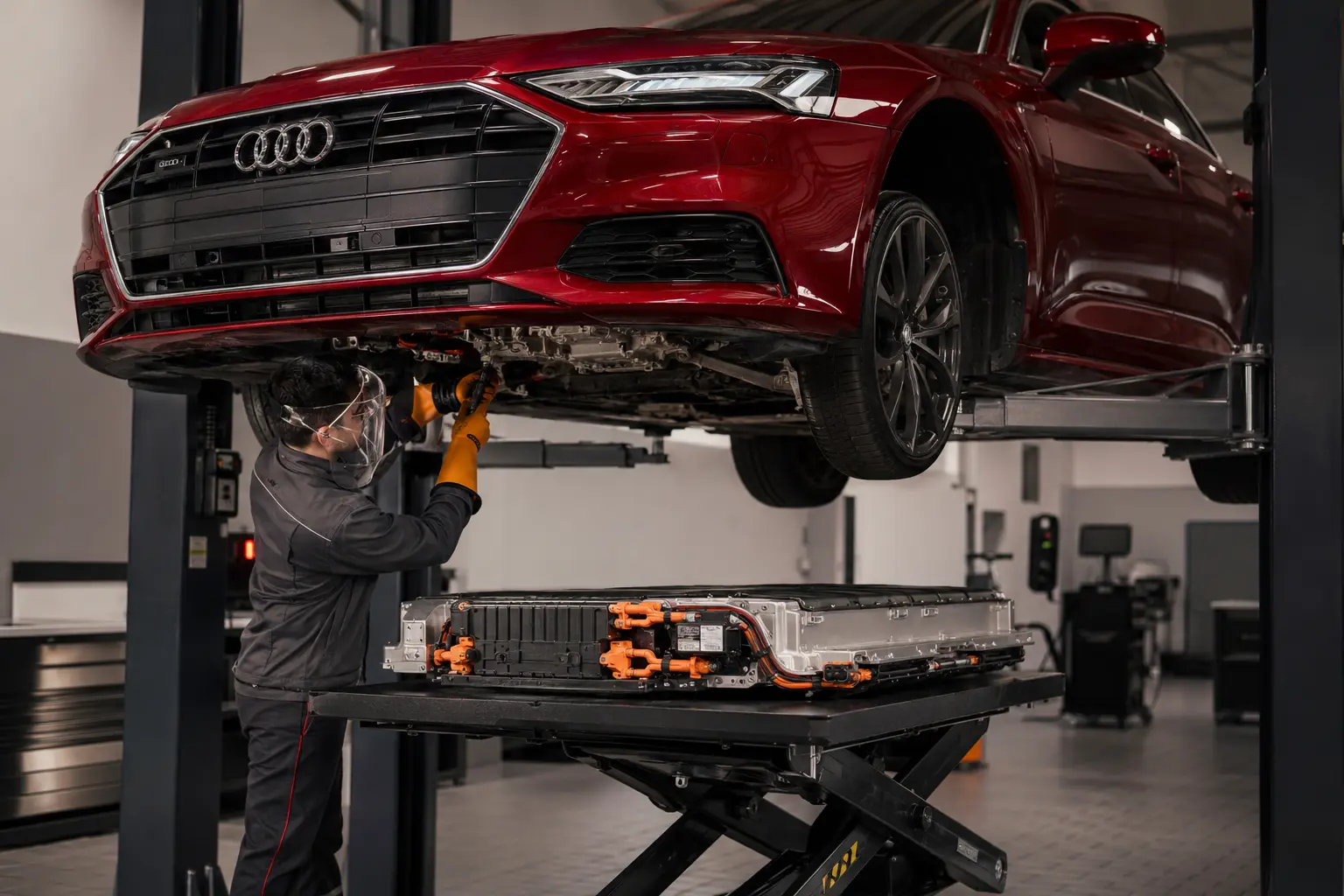
Replacement begins after the fault is proven
The approved unit must be supported, isolated, matched and commissioned for the exact vehicle. The physical installation is only one part of the completed repair.
Support-system repair
A low-voltage, charging, communication or external control fault may need correction without internal traction-battery work.
Cooling or sensor work
A pump, valve, temperature input, wiring or coolant concern can limit battery operation and must be proven separately.
Internal battery repair
Module or internal work is considered only when the battery design, condition, parts support and safe procedure allow a testable repair.
Complete replacement
Replacement may be justified by confirmed internal damage, unsuitable repairability, safety evidence or a failed battery that cannot meet the required function.
Further investigation
Conflicting or incomplete evidence may require controlled charging, repeat measurement or specialist assessment before a costly decision.

Condition changes the available route
Targeted repair
A limited repair may be considered when testing identifies a serviceable failed area and the remaining battery, enclosure, insulation, cooling and connections support a safe, verifiable result.
- Failure is localized by evidence
- The design supports the procedure
- Compatible parts are available
- The completed battery can be tested
Complete replacement
A complete compatible battery may be more appropriate when damage is extensive, safety or isolation evidence is unfavorable, service information does not support an internal route or the pack cannot be restored to dependable operation.
- Exact part compatibility is confirmed
- Access and handling are planned
- Coding or commissioning is included
- Old-unit handling is defined
Used or remanufactured units need proof. A battery is not suitable merely because its case or connector looks similar. Part number, hardware generation, software, capacity, cooling, mounting, vehicle configuration, provenance and any supplied warranty must be checked before approval.
Capacity claims need verified compatibility. A different-capacity or “upgraded” battery should never be promised from marketing language alone. It is considered only when verified Audi-compatible documentation, hardware, software, packaging, cooling and applicable legal requirements support that configuration.
Scope shapes the installed cost
There is no responsible universal price for hybrid-battery work. A written quotation should identify what was tested, what component is proposed and what completion work is included.
Model, model year, VIN, powertrain, battery part number and vehicle configuration define the starting point.
Intermittent faults, charging comparisons, controlled testing or collision and water evidence can expand the assessment.
Battery location, vehicle preparation, lifting, isolation, removal equipment and transport requirements affect the job.
Supporting-system correction, serviceable internal work and complete replacement are materially different scopes.
New, remanufactured or other approved options require compatibility, source, condition and warranty details.
Coolant service, programming, adaptation, commissioning, charging checks and road verification may be relevant.
Ask for an estimate tied to the exact Audi and measured findings. This page does not advertise a generic “free check,” a fixed battery life or an unverified warranty.
From warning photo to handover
Prepare the booking
Send the VIN, model, year, mileage, warning photo, charging behavior and recent impact, water or repair history.
Assess immediate safety
Decide whether the Audi can arrive normally or whether its condition requires recovery and controlled handling.
Identify the system
Confirm which low-voltage, mild-hybrid, plug-in hybrid or battery-electric architecture is installed.
Test the complaint
Preserve faults, inspect relevant components and compare battery, thermal, isolation, charging and support evidence.
Explain the findings
Separate confirmed faults, contributing conditions and remaining uncertainties before any parts route is approved.
Complete approved work
Follow the applicable access, isolation, component, coolant, connection and high-voltage handling procedure.
Commission when required
Perform supported coding, adaptation, setup or commissioning for the exact vehicle and installed component.
Verify and record
Recheck the original warning and relevant system behavior, then explain the completed scope and remaining observations.
Prove the original concern changed
Successful installation is not established by the absence of one warning immediately after codes are cleared. The completed checks must relate back to the original complaint.
Vehicle-side verification cannot guarantee the condition, compatibility or availability of every third-party charging station.
Use the page for the proven system
This page focuses on Audi plug-in hybrid and applicable high-voltage hybrid traction-battery decisions. These connected services cover different intents.
Audi hybrid battery FAQs
Does reduced electric range prove the hybrid battery has failed?
No. Temperature, climate use, speed, recent consumption, tire condition, state of charge, charging history, software limits and battery condition can all change displayed or usable range. Battery and system data must be compared with repeatable behavior before replacement is recommended.
Can one damaged module be repaired?
Sometimes, but not as a universal rule. The battery construction, failure type, enclosure condition, isolation evidence, available service information, compatible parts and ability to test the completed battery determine whether internal work is appropriate.
How long does an Audi hybrid battery last?
There is no single replacement age. Battery design, use, temperature exposure, charging history, cooling performance, faults and the exact vehicle all influence capacity and service life. Vehicle-specific warranty terms should be checked from the applicable official documentation.
Can a weak 12V battery cause hybrid warnings?
Yes. Low or unstable 12V supply can interfere with control-unit startup, communication and high-voltage system activation. The 12V battery and support path should be tested without assuming they explain every high-voltage fault.
Can an Audi hybrid battery be upgraded?
An upgrade should not be promised from physical size or advertised capacity alone. A different battery can be considered only when verified compatibility covers hardware, software, cooling, mounting, charging, vehicle configuration and applicable technical and legal requirements.
Is a used hybrid battery safe to install?
Its suitability must be established. Part number, generation, history, storage, damage, measured condition, isolation, cooling, configuration and source all matter. A used unit should not be treated as compatible only because its connectors appear to match.
Can I drive with a high-voltage warning?
Follow the vehicle warning and seek advice. Stop and arrange recovery for a red warning, smoke, heat, burning smell, visible high-voltage damage, water exposure, loss of essential functions or a vehicle that cannot remain in normal ready operation.
What information should I send before booking?
Send the Audi model, model year, VIN when available, mileage, exact warning photo, state of charge, charging or driving symptom, when it occurs and any recent repair, collision, underbody impact or water exposure.
Send the VIN and warning photo
Tell us whether the concern happens while charging, after parking, when entering ready mode or during electric driving. That detail helps AMF Auto Services prepare the correct high-voltage and support-system assessment.