
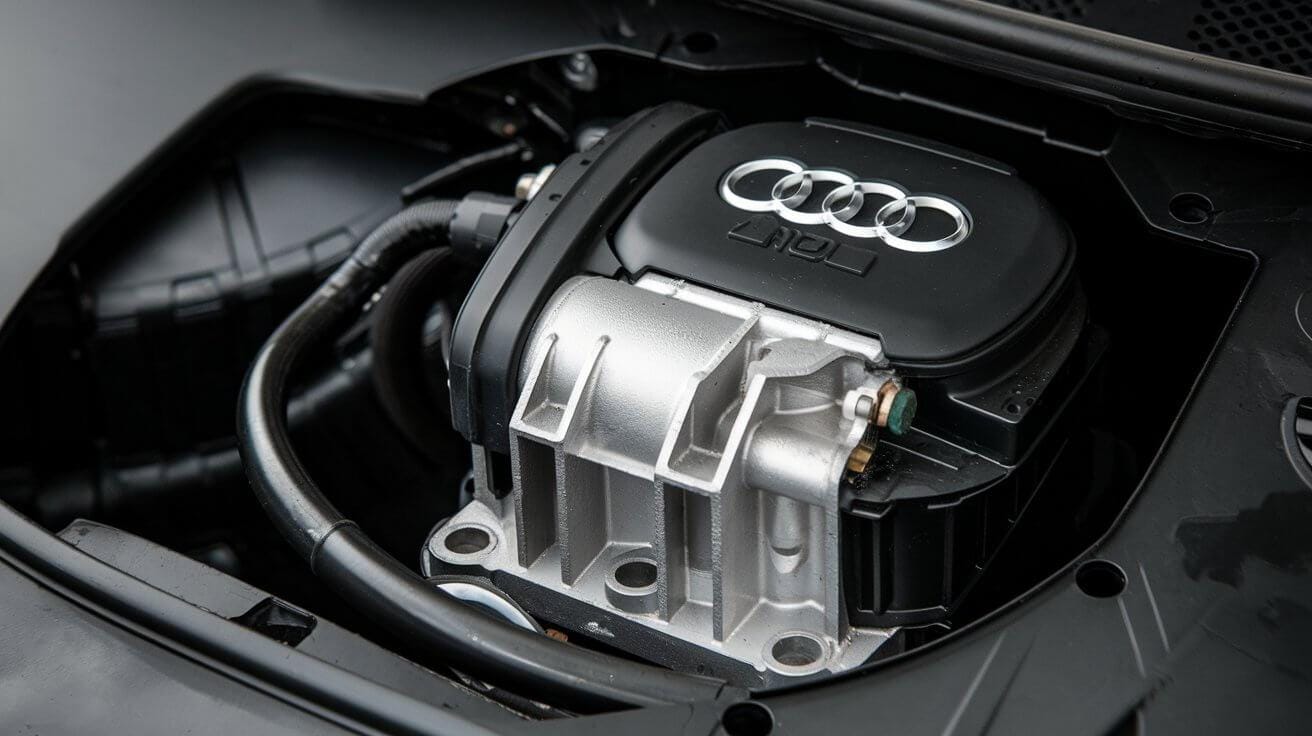
An Audi can lose fuel pressure on the low-pressure supply side, the high-pressure injection side, or somewhere else that only looks like a pump fault. The symptoms overlap, but the tests and parts are different. Replacing the in-tank pump because the engine hesitates, or replacing the high-pressure pump because a rail-pressure code appears, can waste money if electrical supply, sensors, filters, injectors or control commands are not checked first.
A weak in-tank pump usually affects the fuel reaching the engine. A weak high-pressure pump affects the pressure created for direct injection. Hard starting, stalling and power loss can occur with either one. The correct diagnosis compares requested pressure with actual pressure, checks pump power and control, and confirms whether the pressure loss occurs before or after the engine-driven pump.
| System | Main job | Typical components | What testing should prove |
|---|---|---|---|
| Low-pressure side | Moves fuel from the tank toward the engine | In-tank pump, pump control module, wiring, filter or delivery unit, low-pressure sensor where fitted | The engine receives stable supply pressure and volume under cranking and load |
| High-pressure side | Raises pressure for direct injection | Cam-driven high-pressure pump, metering valve, rail, rail-pressure sensor, injectors | Actual rail pressure follows the engine-control unit’s requested pressure |
Audi training material shows both circuits in direct-injection engines, including a transfer pump and control module on the supply side and a mechanically driven pump on the high-pressure side. The exact layout, number of pumps and pressure strategy vary by engine and model, so the VIN and engine code matter.
These signs can support a low-side diagnosis, but none confirms the pump by itself.
A low rail-pressure fault does not automatically mean the high-pressure pump is bad. The high-pressure pump cannot create the required rail pressure if the in-tank side is not supplying it correctly.
| Driver complaint | Possible fuel-side explanation | Common lookalikes | Best next evidence |
|---|---|---|---|
| Cranks but will not start | No low-side delivery or insufficient rail pressure | Battery voltage, immobilizer, crank sensor, ignition fault | Full scan, engine-speed data, low and high pressure during cranking |
| Hesitates during acceleration | Pressure cannot follow demand | Boost leak, ignition misfire, transmission intervention | Requested versus actual pressure and misfire data on a controlled road test |
| Starts then stalls | Supply interruption or pressure collapse | Air-metering fault, throttle issue, immobilizer authorization | Pressure trace, pump command and electrical voltage-drop test |
| Fuel smell or visible leak | Damaged line, seal, pump housing or injector connection | Evaporative-emissions leak | Stop driving and inspect the complete fuel path |
| Check-engine light with no drivability issue | Intermittent pressure deviation or sensor plausibility fault | Stored historic fault or wiring issue | Fault status, freeze-frame data and repeatable conditions |
A fault-code scan is only the beginning. Our expanded Audi diagnostics workflow explains how fault status, freeze-frame data and measured values should be turned into a test plan.
Replacement is supported when testing proves that the pump cannot meet the required output despite correct supply, command and surrounding-system condition. It may also be necessary when the pump leaks, is internally damaged or has contaminated the fuel system.
| Finding | Likely action | Why |
|---|---|---|
| No pump operation because of wiring, connector or fuse fault | Repair the electrical fault | A good pump cannot run without correct power and control |
| Sensor reading is implausible but mechanical pressure is correct | Test sensor and circuit | The pump may be meeting demand while the control unit receives incorrect feedback |
| Pump receives correct voltage and command but output is low | Replace the proven failed pump or delivery unit | Electrical and control causes have been excluded |
| High-pressure pump output is low because low-side pressure collapses | Repair the supply-side fault first | The high-pressure pump is being starved |
| Metal contamination in rail or injectors | Plan a system-level repair | Replacing only one component can leave damaging material behind |
For the commercial repair and replacement options after diagnosis, see our Audi fuel pump replacement service.
A useful estimate should identify the failed circuit and the confirmed part. Cost depends on the Audi model, engine, whether the in-tank delivery unit or engine-driven high-pressure pump is involved, access time, control-module or wiring repairs, seals and lines, fuel contamination, injector testing and whether coding or adaptation is required. A fixed price before diagnosis is unreliable because two cars with the same symptom may need completely different work.
Audi fuel pump failure is not one diagnosis. The in-tank supply circuit and the engine-driven high-pressure circuit must be tested separately, and both must be compared with the engine control unit’s requested values before parts are approved.
Call +971 56 464 6081 or WhatsApp us with the Audi model, year, engine and exact starting or power-loss symptom.
Yes. A mechanical or intermittent electrical fault may develop before the control unit stores a useful code. Measured pressure and electrical tests are still required.
No. Low supply pressure, sensor faults, injector leakage, metering-valve problems and wiring can all affect rail pressure.
Yes. Low cranking speed and voltage can prevent correct pressure build-up and create misleading communication or sensor faults.
Possible causes include slow pressure build-up, pressure bleed-down, injector leakage, a weak battery or an engine-speed signal issue. The pressure trace during cranking is more useful than guessing.
No. Electric pumps can be audible. A new or unusually loud sound becomes useful only when combined with pressure, current and drivability evidence.
A restriction can increase pump demand and reduce delivery. Filter design and serviceability vary by model, so the vehicle-specific fuel system must be identified first.
Not normally. Replace only the components proven faulty unless contamination or a system-level failure requires a broader repair.
Yes. Contamination can affect pumps, metering components, rail and injectors. The complete system should be inspected before deciding the repair scope.
System descriptions were checked against Audi self-study material for direct-injection fuel systems and the VIN-specific Audi Online Owner’s Manual. Specifications and warning actions must still be confirmed for the exact vehicle.