Tank replacement supported
A fresh leak, crack, damaged neck, seam failure or confirmed reservoir interface fault supports replacement with the correctly matched part.

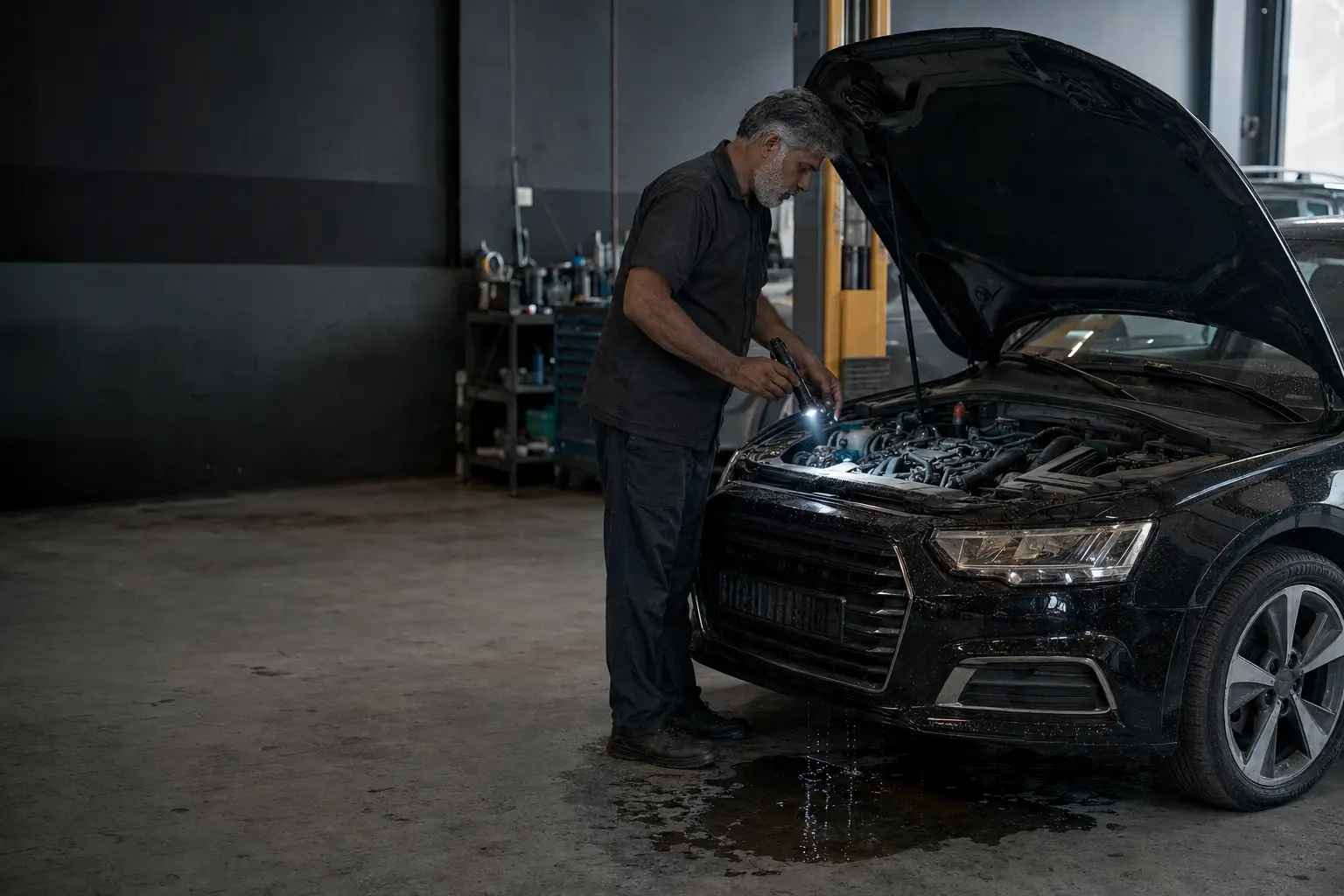
A falling coolant level does not prove that the reservoir has failed. We inspect the tank, cap, sensor area, hose connections and surrounding cooling circuit, confirm where the coolant escapes, then replace only the parts supported by evidence.
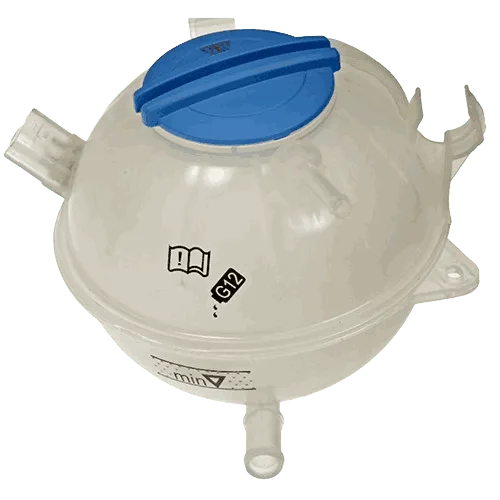
Direct answerReplace the reservoir only when the tank body or its sealing interface is confirmed as the leak source.
Do not guessCoolant can travel before it drips.
Never open hotThe circuit may be pressurised.
Send evidenceVIN, warning photo and top-up history help.
Coolant evidence changes with temperature, pressure, airflow and parking angle. A stain narrows the search, but it cannot identify a failed component on its own.
| Driver evidence | Possible direction | Required check |
|---|---|---|
| Dried pink, white or chalky residue | Coolant reached the surface and evaporated. A seam, neck, cap or connection may be involved. | Trace the highest fresh origin because gravity and airflow can move coolant away from the leak. |
| Wetness below the reservoir | The lower tank body or connection is a candidate, but leakage from above can run down the tank. | Inspect the cap, upper hose joints and nearby housings before condemning the reservoir. |
| Low-coolant message when cold | The level may be low, air may be moving after previous work, or the level signal may need attention. | Check the cold level, external loss, service history and sensor connection. |
| Sweet smell after driving | A small leak may reach a hot surface or escape as vapour. | Inspect safely after cooling. Smell alone cannot name the source. |
| Temperature rise or red warning | Cooling control may be compromised and continued driving can increase risk. | Stop safely and investigate the complete cooling circuit urgently. |
| Level falls after a recent repair | Air may remain in the circuit, a disturbed connection may leak, or another source may persist. | Review what was opened, how the system was filled and the final cold-level check. |
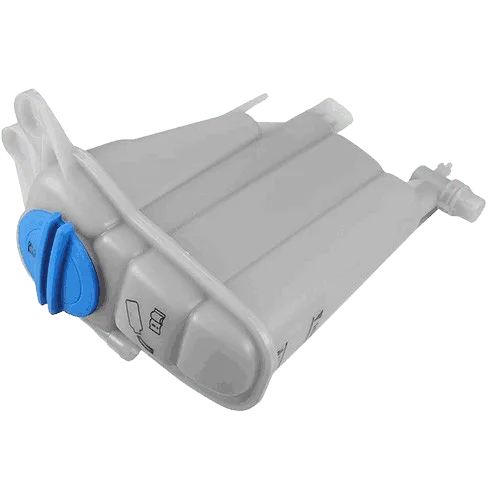
The expansion tank accommodates coolant volume changes as the system moves between cold and operating temperature. Its cap and connected passages form part of a pressure-controlled circuit. Coolant around the reservoir therefore needs to be traced to the first wet boundary, not simply the place where it collects.
Heat-cycled plastic can crack at a seam, neck, moulded feature or mounting point. Fresh evidence during a suitable test matters more than old staining.
The cap seals at the neck and controls system pressure. Seal, seat or cap-function problems may leave residue nearby without a crack in the tank body.
A hose, quick connector, seal or level-sensor area can leak independently. Replacing the reservoir alone would leave that fault untouched.
A radiator, water pump, thermostat housing, auxiliary circuit or concealed pipe can send coolant toward the reservoir area.
If evidence begins elsewhere, the correct route is broader Audi coolant leak diagnosis.
As an engine warms, coolant expands, system pressure changes and plastic, seals and joints move with temperature. A fine crack may remain dry during a short cold inspection yet leave a visible trail after a journey. Old residue can also stay visible after an active leak has moved or been repaired.
A suitable pressure test can help expose loss, but the test must respect the vehicle and its current condition. Excess pressure is not better testing. The purpose is to reproduce an appropriate condition while watching the suspected source and surrounding circuit.
A pressure drop is meaningful only when the test equipment, temperature and system state are understood. The change must still be connected to the exact leaking boundary. If no external source appears, the next diagnostic step should be explained rather than a reservoir being ordered by elimination.
We record top-up frequency, warning wording, smell, steam, temperature behaviour and recent cooling work. The VIN and engine configuration guide technical information and parts identification.
Trails and deposits can disappear during cleaning. The first record covers the reservoir, cap, sensor area, hose joints and visible parts of the wider circuit.
Controlled cleaning may be needed before an appropriate pressure or operating-condition test reveals a fresh trace.
If only the tank failed, the estimate stays focused. A brittle connector, damaged hose, incorrect cap or separate leak is recorded as a distinct finding.
Production date, engine, installed connections, sensor provision and cap specification matter. Visual similarity alone does not prove compatibility.
The applicable coolant and filling method are used. After air removal and temperature monitoring, the repaired area is checked again. A final cold-level confirmation matters after a complete heat cycle.
A useful diagnosis ends with a defined repair boundary. It does not turn every low-coolant complaint into the same parts order.
A fresh leak, crack, damaged neck, seam failure or confirmed reservoir interface fault supports replacement with the correctly matched part.
Evidence may instead identify the cap, hose, quick connector, seal or level-sensor area. The approved work should address that source.
When the reservoir area remains dry or coolant arrives from elsewhere, the water pump, thermostat housing, radiator and other circuit areas need the appropriate route.
Installing a plastic reservoir is only one part of completing the repair. Part selection, connected components, coolant handling and verification determine whether the original complaint has actually been resolved.
Model name alone is not enough. VIN, production date, engine and the installed reservoir arrangement guide part and cap selection.
Hoses, clips, seals, quick connectors and the level-sensor interface are checked for damage that should not be transferred to a new tank.
The system is allowed to cool and depressurise before opening. Coolant is contained appropriately and nearby electrical connections are protected.
Colour is not a technical specification. The product, concentration and any decision to reuse or replace coolant follow the exact vehicle and fluid condition.
Air pockets can produce unstable levels, poor circulation or another warning. The required filling and bleeding procedure varies with configuration.
The repaired boundary is rechecked for leakage. Level, temperature behaviour and relevant warning status are compared with the original complaint.
Audi A3, A4, A5, A6, A7, A8, Q3, Q5, Q7, Q8, S and RS families span different engines, production generations and thermal layouts. Tank position, hose routing, sensor provision and bleeding requirements can change even within one model name.
Some vehicles contain more than one thermal circuit. A conventional engine-coolant loop, charge-air circuit or electrified powertrain system may have its own reservoir and operating requirements. The visible tank must be identified before its level is interpreted or the circuit is opened.
Before ordering, the workshop should review the installed part, original part number where available, cap, connections and service information for the exact vehicle. This prevents visually similar reservoirs from being treated as interchangeable.
If fluid is contaminated, mixed with an unknown product or due for corrective service, review the dedicated Audi coolant flush service. A flush should not be added automatically to every tank replacement.
A stable gauge does not prove that the cooling system is sealed. Use the warning, temperature behaviour and rate of loss to make a cautious decision.
Stop if the temperature rises, a red warning appears, steam is visible, coolant escapes rapidly or the vehicle instructs you to stop. Arrange assistance rather than opening the system.
A hot circuit can remain pressurised. Opening the cap can release hot coolant and steam. Wait for professional guidance and complete cool-down.
If temperature remains stable but the cold level repeatedly falls, arrange diagnosis before a slower leak becomes a larger cooling problem.
Photograph warnings and residue safely. Note when coolant was last added and whether earlier work disturbed the system.
The installed cost cannot be defined responsibly from the phrase “low coolant” alone. The exact reservoir, cap arrangement and access vary. A separate hose, connector, sensor interface or leak elsewhere can change the approved scope.
Coolant condition also matters. A straightforward refill is different from correcting an unknown or contaminated mixture. The required bleeding route and post-repair checks depend on the fitted cooling system.
A useful estimate identifies the confirmed source, included parts, coolant work, labour boundary and verification plan. It should explain how any second leak discovered during cleaning or testing will be handled before work expands.
No fixed price should be presented before the vehicle and leak source are identified.
Audi Repair Dubai operates through AMF Auto Services at Warehouse 39, Al Quoz 4, Dubai. The workshop handles Audi diagnostics, mechanical repairs and cooling-system work with physical testing supported by diagnostic equipment where warning data or monitored values are relevant.
For the most useful first conversation, send the model, year, VIN when available, exact dashboard message and photographs of residue. This helps prepare the correct inspection without pretending that a message or photograph replaces workshop testing.
No. The warning reports a level condition, not the location of a leak. The reservoir, cap, connections, sensor area and wider cooling circuit need inspection.
Continuing can allow further coolant loss and overheating. Stop safely if temperature rises, steam appears, a red warning is shown or coolant is escaping rapidly. A slower suspected leak still needs prompt inspection.
A cap or sealing-seat problem can affect how the system holds pressure and may leave residue near the reservoir. The correct cap and tank neck should be assessed for the exact vehicle.
The circuit may still be leaking, may contain trapped air after earlier work, or may have a level-sensing concern. Repeated topping up does not replace diagnosis.
A repair may not provide a dependable result on a heat-cycled, pressurised plastic component. Replacement is normally considered when the tank body, neck or seam is confirmed defective.
No. The applicable specification depends on the exact vehicle and technical requirements. Fluid should be selected from vehicle information, not colour alone.
The VIN, production date, engine, installed connections, sensor provision, cap specification and original part information are considered. A model badge or visual similarity is not sufficient.
Checks can include the repaired boundary, connected hoses and seals, correct cold level, bleeding result, temperature behaviour and relevant warning status. The final checks should relate to the original complaint.
Air remaining after cooling-system work can alter level and circulation. The refill and bleeding method should match the vehicle, followed by an appropriate heat cycle and cold-level confirmation.
Part specification, access, cap and connection condition, coolant state, another leak source, bleeding requirements and post-repair testing all influence the work.
Tell us the Audi model, year, VIN when available, exact warning, recent top-ups and any visible residue. We can arrange the correct inspection and determine whether the expansion tank or another cooling-system component requires attention.
Warehouse 39, Al Quoz 4, Dubai · Monday to Saturday · 9:00 AM to 7:00 PM