
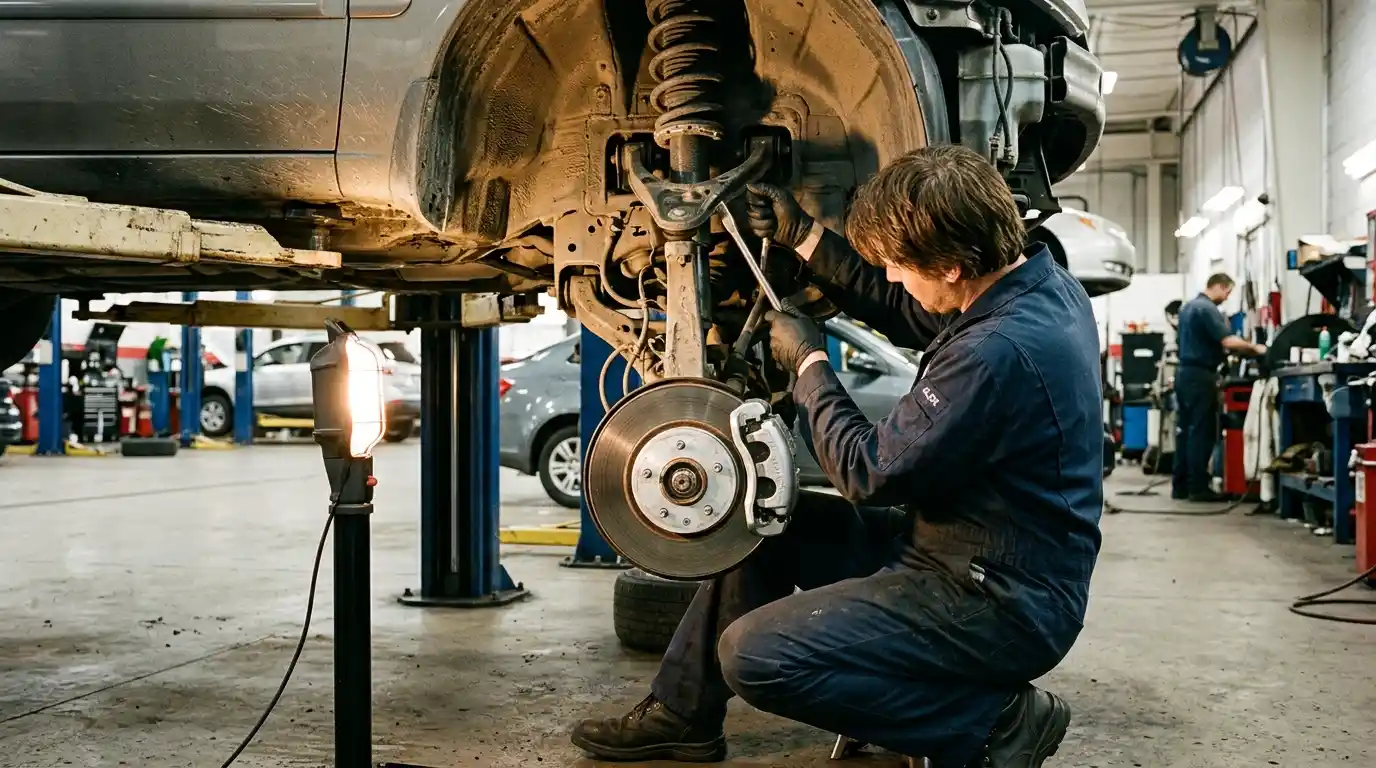
Audi Control Arm Replacement
Audi control arm replacement starts by identifying the exact link, bushing, joint, and load condition causing the complaint. We inspect the complete wheel corner, separate a damaged arm from a serviceable bushing or ball joint, install the approved scope correctly, and measure geometry when the repair can affect wheel position.
Control arm, bushing or ball joint?
We locate the worn connection before recommending parts. Several suspension links can cause similar knocks, vibration or changes in handling.

We explain the findings, the parts needed and any alignment checks before you approve the work.

Arm, bushing, and ball joint perform different jobs
The arm is the structural link between the wheel carrier and the body or subframe. It controls wheel movement along a designed path. Aluminum and steel arms require different inspection attention, and impact can deform an arm without producing an obvious fracture.
A bonded rubber bushing isolates noise and allows limited movement. Some bushings contain hydraulic fluid. Cracks in a rubber surface do not always equal failed function, while separation, excessive movement, torn rubber, fluid loss, or displacement can support replacement. Bushings must often be assessed while force is applied in the direction they control.
A ball joint allows angular movement while maintaining wheel location. Excessive play, stiffness, a torn protective boot, corrosion, or wear at the attachment can affect steering and suspension control. Some ball joints are integrated into the arm, while others are separately serviceable.
What the symptom suggests and how it is confirmed
A symptom becomes useful when its load condition is recorded. Braking, acceleration, steering angle, road surface, temperature, and wheel position can each change which joint is stressed.
| What you notice | Possible control-arm connection | Important lookalikes | Confirming evidence |
|---|---|---|---|
| Clunk over sharp bumps | A bushing can shift, a ball joint can move, or an attachment can knock as the wheel changes direction quickly. | Anti-roll-bar link, top mount, damper, spring seat, brake hardware, loose undertray, or subframe attachment. | Bump load Reproduce the sound, inspect the corner, and apply force through the suspected link. |
| Movement or thud while braking | A thrust-related bushing may allow the wheel to move rearward or change toe under braking. | Brake disc variation, caliper movement, tire fault, engine mount, wheel bearing, or another suspension bushing. | Brake load Compare both sides, observe loaded deflection, inspect the bushing, and check braking components. |
| Wandering or delayed steering response | Excess movement can let wheel alignment change dynamically even when a static reading appears acceptable. | Tire pressure or construction, steering joint, wheel bearing, rear-axle movement, ride height, alignment, or road crown. | Direction load Road-test safely, inspect tire evidence, measure geometry, and test joints in their working directions. |
| Inner or outer edge tire wear | A worn link can change camber, caster, or toe directly or under load. | Incorrect alignment, bent wheel, tire pressure, damaged spring, ride-height difference, subframe position, or previous impact. | Wear pattern Measure tire wear, ride height, joint condition, wheel runout, and complete alignment geometry. |
| Vibration during braking or acceleration | A bushing can permit movement that changes wheel position or transmits load into the body. | Brake discs, tires, wheels, driveshafts, CV joints, engine or gearbox mounts, and driveline components. | Speed and load Record whether frequency follows road speed, engine speed, braking force, or acceleration. |
| Vehicle pulls after impact | An arm may be bent or a mounting point may have shifted. | Wheel and tire damage, steering tie rod, knuckle, subframe, damper, body structure, or rear geometry. | Impact path Inspect all impact-related parts and compare alignment readings rather than replacing the visibly marked arm only. |
| Heavy knock with unstable handling | Severe joint looseness, separation, or a damaged arm can affect wheel control. | Wheel fastener, wheel bearing, tire failure, broken spring, steering joint, axle, or structural damage. | Immediate risk Do not continue the road test. Arrange safe lifting, inspection, and recovery if needed. |
Four views of the same wheel corner
No single test is enough for every bushing or joint. The complete diagnosis combines what happens on the road with the part’s condition unloaded, loaded, and compared against the opposite side.
Road-load behavior
When safe, we reproduce the complaint over the relevant surface and under the relevant load. We note whether braking, acceleration, steering direction, wheel position, vehicle load, or temperature changes the noise or movement. A car with severe looseness or instability is not road-tested.
Unloaded visual condition
With the vehicle supported correctly, we inspect arm bodies, bushings, boots, ball joints, fasteners, subframe brackets, wheel carrier connections, corrosion, impact marks, polished contact points, and signs of recent work. A surface crack is recorded but not automatically called failure.
Loaded movement test
Force is applied in the direction the link controls while the joint and mounting are observed. This can reveal separation, excessive deflection, looseness, a displaced center sleeve, hydraulic-fluid loss, or movement between the arm and its mounting that is hidden when the suspension hangs freely.
Geometry and comparison
Ride height, tire wear, wheel position, steering center, and alignment measurements help show whether the fault changes geometry. Left-to-right comparison is useful, but paired age does not mean both sides automatically require replacement. Each side needs evidence.
Bushing only, complete arm, or another repair
The words control arm replacement should not force every vehicle into a complete-arm quote. The repair decision follows the serviceability, condition, and total installed result.
Replace a serviceable bushing
This route may fit when the arm is straight and undamaged, the bushing is separately available and approved for replacement, and correct removal and pressing can be completed without harming the arm.
- Confirm orientation and installation depth.
- Inspect the bore and arm condition.
- Use the correct support during pressing.
- Plan final tightening at the required position.
Replace the complete control arm
A complete arm is considered when the arm is bent, cracked, corroded beyond service, damaged at a mounting, or fitted with a non-serviceable bushing or ball joint. Assembly replacement can also be the approved route when individual parts are not supplied.
- Match material, side, axle, and suspension code.
- Check ball joint and bushing specification.
- Renew required hardware.
- Protect adjacent sensors and boots.
Repair the actual lookalike
If the arm and its joints are serviceable, the complaint may lead to an anti-roll-bar link, damper mount, tie rod, wheel bearing, tire, wheel, brake, axle, subframe, or another link.
- Do not approve parts from noise location alone.
- Do not use alignment to hide looseness.
- Do not treat scan faults as mechanical proof.
- Retest the original load condition.
For diagnosis across springs, dampers, links, air suspension, ride height, and other chassis components, see the broader Audi suspension repair service.
Ride-height preload and hardware position can decide durability
Removing an Audi control arm can involve closely spaced multi-link joints, aluminum components, pinch connections, underbody covers, steering or level sensors, brake hoses, driveshaft clearance, and fasteners designed for a specific installation procedure. The surrounding parts must be supported without placing unintended force on joints or cables.
Some bonded rubber bushings are designed to sit near a neutral position at normal ride height. If their inner sleeve is tightened while the suspension hangs fully extended, the rubber can remain twisted when the car is lowered. This preload can restrict movement, change ride behavior, and shorten bushing life. The applicable procedure determines whether final torque is applied at simulated or actual curb position.
Torque figures, torque-angle steps, locking nuts, stretch bolts, and replacement hardware vary by platform and joint. Generic values or impact-tool tightening are not substitutes for the correct repair information. Contact surfaces, tapers, sleeves, and brackets must be clean and undamaged before final assembly.
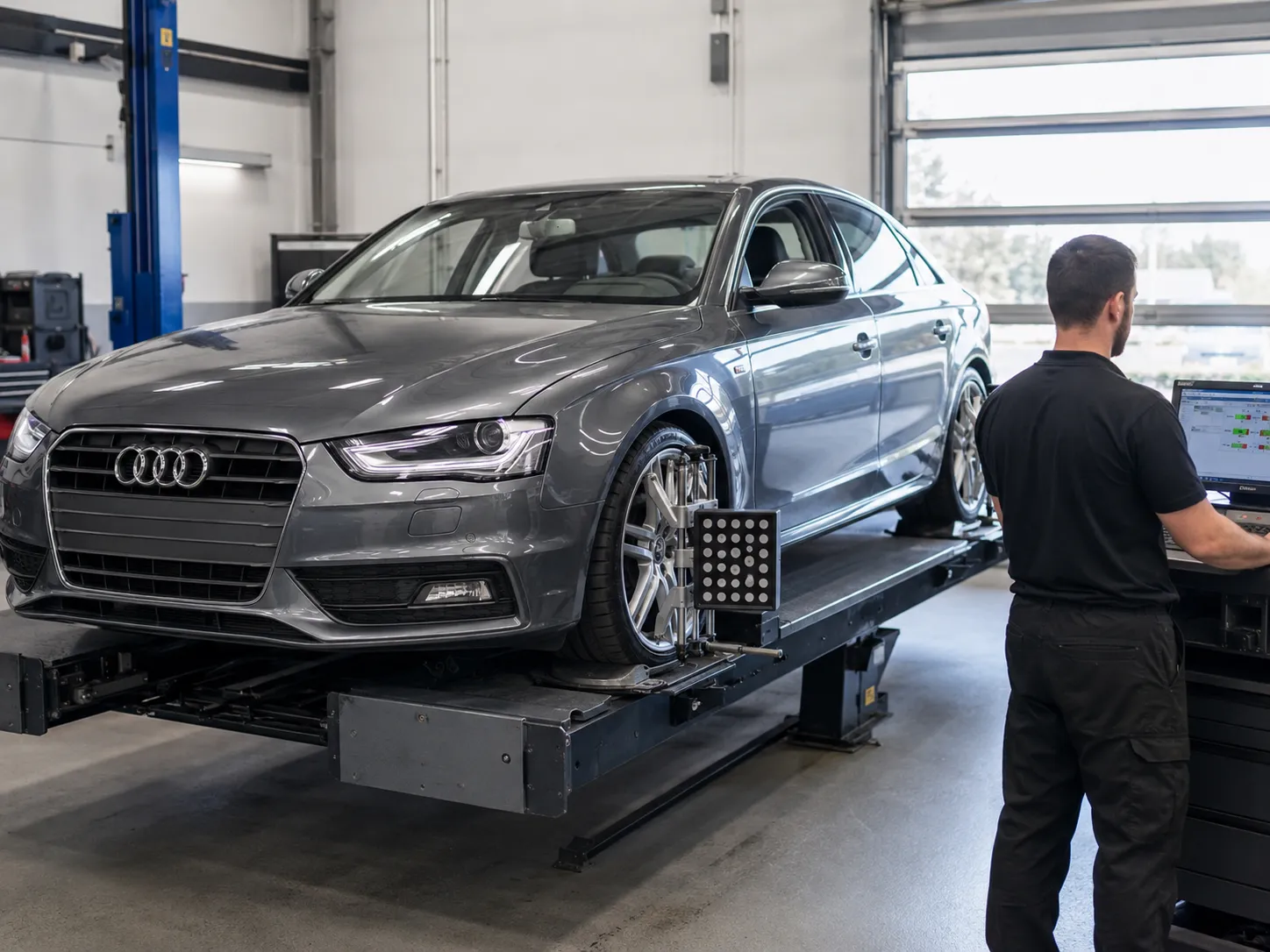
Alignment is a measurement, not a cure for worn parts
Control arms establish wheel position, so replacement can affect camber, caster, or toe directly or indirectly. Whether adjustment is required depends on the axle design, arm function, mounting position, subframe, ride height, and which fasteners were released. A separate rear link and a front thrust arm do not influence geometry in the same way.
We recommend measurement when the arm controls an alignment angle, the car pulls, the steering wheel is off-center, tire wear is uneven, impact damage exists, the subframe moved, adjustable points were disturbed, or the previous readings are unknown. Measurement can also expose a bent component or seized adjuster that prevents the target result.
Our Audi wheel alignment service explains measurement, adjustment, tire evidence, and situations where repair must come before geometry.
When the Audi can be booked and when it should not move
A description cannot confirm that a worn suspension joint is safe. Use these levels to decide how urgently the vehicle needs inspection, then call if the condition is uncertain.
Mild repeatable noise
A light clunk with no steering change, visible wheel movement, rubbing, or instability still needs inspection. Avoid delaying until tire wear or looseness increases.
Pull, wear, or braking movement
Uneven tire wear, a change under braking, wandering, or a new off-center wheel can indicate geometry or joint movement. Limit unnecessary travel and arrange diagnosis.
Heavy knock or sudden change
A strong knock after impact, new steering looseness, severe vibration, or rapidly changing tire contact requires an assessment before the car is driven farther.
Visible or severe instability
Do not drive if a wheel sits out of position, a tire rubs, a joint or arm is cracked or separating, steering control is poor, or the car changes direction unexpectedly.
The model name does not identify the fitted arm
Audi platforms can use MacPherson-type, multi-link, five-link, or other front and rear arrangements. The same model line may change layout between generations. Front-wheel drive, quattro, allroad, S, RS, SUV, air-suspension, adaptive-chassis, and electric variants can use different arms, bushings, joints, axle loads, fasteners, and geometry targets.
An aluminum arm may look similar to another version while differing in length, bushing stiffness, ball-joint connection, mounting offset, or production revision. Left and right parts are often side-specific. Front upper, front lower, guide, track, thrust, toe, and camber links do not share one job.
The VIN, production date, PR or option codes where applicable, axle, suspension package, wheel and tire configuration, and installed part markings are used together. Ordering by a generic model description can create an arm that bolts on incorrectly, changes geometry, or does not match the intended ride behavior.
What changes the scope and how repeat wear is reduced
We do not publish one control-arm price or turnaround time because the exact link, parts design, access, hardware condition, and geometry requirements vary widely.
Factors that move time and cost
- Exact arm, axle, material, side, suspension package, and part availability.
- Complete-arm replacement versus pressing a separately serviceable bushing.
- Ball-joint, wheel-carrier, subframe, sensor, hose, or neighboring-link condition.
- Seized pinch bolts, damaged threads, corrosion, distorted brackets, or previous incorrect work.
- Single-use hardware, required support, ride-height tightening, and access components.
- Alignment measurement, adjustment, seized adjusters, and further diagnosis after readings.
- Impact damage that extends to a wheel, tire, tie rod, damper, knuckle, subframe, or body mounting.
The final written estimate depends on inspection, the exact vehicle, approved parts choice, required supporting work, and current availability.
Prevention and sensible monitoring
Control arms are wear and structural components, not routine mileage replacements. Reduce avoidable load by maintaining correct tire pressures, using suitable wheels and tires, slowing for potholes and sharp road edges, and investigating a new knock or steering change before movement damages another part.
After tire impact, curb contact, or suspension work, record the event and watch for steering-center change, pull, new vibration, or tire rubbing. Keep alignment reports because comparison can reveal whether an angle moved over time. Do not rely on a fresh alignment printout if a bushing or joint remains loose.
Avoid spraying rubber bushings with products not approved for the material. Do not use a visual surface crack as automatic proof of failure, and do not ignore fluid leaking from a hydraulic bushing. Condition must be interpreted with movement and function.
The original noise or movement must be retested
Correct parts and torque are essential, but the repair is not complete until the wheel corner is rechecked. The arm must sit without contact, the bushing must not be locked in the wrong operating position, the ball-joint boot and adjacent wiring must remain intact, and fasteners must be installed according to their specified method.
When alignment is relevant, the final readings are reviewed as a complete axle set. One in-range value does not explain pull or tire wear if another angle, ride-height difference, tire condition, or rear thrust direction remains abnormal. A road check confirms steering center, stability, braking response, noise, and the complaint under the original safe load condition.
- Confirm the arm, bushing, ball joint, and required hardware are correctly seated.
- Check brake hoses, ABS wiring, level-sensor links, undertrays, boots, and wheel fasteners.
- Verify ride height and clearance with the vehicle on level ground.
- Measure and adjust geometry when the design or evidence requires it.
- Repeat the original braking, steering, bump, or acceleration condition safely.
- Explain any remaining tire, wheel, link, or geometry condition that requires monitoring.
Audi control arm replacement near you in Dubai
Our Al Quoz 4 workshop can inspect clunks, braking movement, wandering, uneven tire wear, impact-related geometry changes, and suspected control-arm faults. Send the VIN, affected corner, symptom conditions, and any useful report before parts are ordered. A video can help describe the complaint, but it cannot prove which joint has failed.
If the wheel position has changed visibly, steering feels loose, a tire rubs, or handling is unstable, do not drive to the workshop. Call for recovery guidance. For a stable vehicle with a mild repeatable complaint, we can arrange a suspension inspection and explain whether the next step is a bushing, complete arm, ball joint, another chassis repair, or geometry measurement.
Audi control arm replacement FAQs
These answers cover the practical decisions that remain after diagnosis, parts selection, installation, safety, and alignment.
Can only the Audi control-arm bushing be replaced?
On some applications, yes. The bushing must be separately serviceable, available in the correct specification, and installable without damaging an otherwise sound arm. Orientation, pressing support, depth, and final tightening position matter. Other arms are supplied as complete assemblies because the bushing or ball joint is integrated.
Does every control-arm replacement need wheel alignment?
Not every arm changes geometry in the same way, but measurement is sensible when the link controls wheel position, adjustment points or the subframe were disturbed, the car pulls, the steering wheel is off-center, tire wear exists, or impact damage is involved. Alignment cannot correct a joint that remains loose or an unrecognized bent part.
Should left and right control arms be replaced together?
Not automatically. Both sides should be inspected because they share age and operating conditions, but an impact can damage one side and a previously replaced arm may be much newer. Paired replacement can be considered when wear and function are similar, yet the recommendation should be based on evidence and the repair objective.
Can a worn control arm cause vibration?
It can contribute when a bushing allows wheel movement under braking, acceleration, or road load. Vibration can also come from brake discs, tires, wheels, driveshafts, CV joints, wheel bearings, engine or gearbox mounts, and other suspension links. The frequency and load condition help determine which system should be tested first.
Why are some control-arm bushings tightened at ride height?
Many bonded rubber bushings are designed to sit near neutral at the normal operating position. Tightening the inner sleeve while the suspension hangs can leave the rubber twisted when the vehicle is lowered. The correct position and procedure depend on the exact arm design and repair information.
Can an alignment fix a control-arm clunk?
No. Alignment measures and adjusts wheel angles through the designed adjustment points. It does not tighten a loose ball joint, restore a separated bushing, repair a bent arm, or remove contact between parts. The mechanical fault must be corrected before meaningful final geometry is approved.
What happens if a worn control arm is ignored?
Movement can increase, tire wear can accelerate, steering and braking behavior can change, and another joint or mounting can receive extra load. The risk depends on the failed part and severity. Stop driving and request recovery if wheel position changes, a joint separates, a tire rubs, or the vehicle becomes unstable.
How long does Audi control arm replacement take?
Time depends on the exact arm, axle layout, access, parts availability, seized pinch bolts, corrosion, damaged threads, bushing pressing, replacement hardware, ride-height tightening, alignment, and any additional impact damage. A separate rear link and a multi-link front upper-arm repair are not equivalent jobs.
Are control arms different on quattro, S, RS, and e-tron models?
They can be. Drivetrain, axle load, suspension package, ride height, wheel carrier, brake package, air or adaptive suspension, battery mass, and generation can affect the fitted arms and geometry. The VIN, production data, option information, and installed component must be checked before parts are approved.
What information helps with an accurate quotation?
Send the VIN, model year, mileage, front or rear location, affected side, exact symptom, recent tire or suspension work, impact history, and any photos, video, inspection report, or alignment printout. The final scope depends on physical inspection, approved parts choice, supporting hardware, and current availability.
Request an Audi suspension corner inspection
Send the VIN, affected corner, and the exact bump, braking, steering, or tire-wear symptom. We will advise whether to book an inspection in Al Quoz 4 or arrange recovery before the vehicle is moved.