Powertrain-specific checkpoint
Audi 60,000 KM Service Checklist
Sixty thousand kilometers can bring several additional items due on some Audi configurations. It does not make the same fluid or part mandatory on all of them.
An Audi 60,000 KM service should begin with the normal inspection and oil requirements for the exact vehicle, then verify whether spark plugs, engine air filter, fuel filter, S tronic fluid, quattro coupling oil, auxiliary belt or other model-specific items are due. Several Audi schedules list selected 60,000 KM work, but applicability changes by engine, gearbox, driveline and market. The visit should also inspect cooling, brakes, tires, battery, suspension and leaks. Existing shift, boost or misfire complaints require diagnosis before maintenance is approved.
Vehicle map
Identify every powertrain component before ordering materials
Record the engine code, transmission type, quattro arrangement, differential equipment, electrification and market. Similar-looking A3, Q3, A4, Q5, S and RS models can use different gearboxes and rear-drive systems.
Review invoices for the actual fluid name, part numbers and quantity. A previous “gear oil change” may have covered one differential while leaving the transmission or coupling untouched. Do not repeat or skip work based on an unclear description.
Audi’s published service information for some model years includes selected items at 60,000 KM, while other components use time or different distances. The official Audi service interval document demonstrates why model and engine columns must be read before applying the number.
Ignition and filtration
Use the removed parts as diagnostic evidence
If spark plugs are due for the fitted petrol engine, compare each removed plug for deposits, oil, heat, gap and cylinder differences. Plug replacement can restore a due maintenance baseline, but it cannot prove that a recurring misfire is repaired.
Inspect engine air filtration and housing sealing. Diesel fuel filters and other fuel-system items apply only where specified. Note contamination or water evidence and avoid substituting a filter brand or specification without compatibility confirmation.
Inspect auxiliary belts, tensioners and accessible pulleys when the schedule or condition requires it. A timing chain is not automatically replaced at 60,000 KM. Timing belts also follow engine-specific information rather than the article title.
Transmission and quattro
Service the installed driveline with the correct temperature procedure
Some S tronic units may have fluid service due around this checkpoint, while other transmissions use a different requirement. Correct work can involve a filter or pan, specified oil, controlled fill temperature, adaptations and a final leak and road check.
Transverse quattro couplings, longitudinal differentials, sport differentials and transfer systems need separate identification. Do not pour one universal gear oil into every unit. Record fluid specification and whether a screen or filter was inspected.
If the car already shifts harshly, slips, delays engagement or shows a warning, scan and road-test before the service. The Audi transmission problem guide explains why maintenance and fault repair must remain separate.
Thermal and electrical reserve
Test the systems that have completed thousands of heat cycles
Pressure-test cooling when history or residue justifies it, inspect pumps, thermostat areas, hoses, radiator edges, fans and live temperatures. Repeated coolant top-up is not a scheduled service item.

Test the 12-volt battery, charging behavior and low-voltage history. Include relevant 48-volt equipment on applicable vehicles. Air-conditioning output should be measured at idle after road heat, not judged only by initial cold air.
Check fluid leakage after the road test. Fresh undertrays can hide the source, so identify the highest wet point and document it before cleaning.
Chassis condition
Use 60,000 KM to review cumulative tire and suspension patterns
- Measure inner, center and outer tread on all four tires.
- Confirm rolling-dimension compatibility on quattro vehicles.
- Inspect wheel barrels for impact repair or distortion.
- Measure brakes and consider hub and suspension sources of vibration.
- Check arms, joints, bushes, dampers, mounts and bearings.
- Observe air-suspension height and compressor behavior where fitted.
Alignment should follow correction of damaged or worn components. A printout with green values does not make an unsafe joint or bent wheel suitable.
Sixty-thousand pricing
Expect the range to widen when driveline items become applicable
| Possible work | Dubai planning range | Reason for variation |
|---|---|---|
| Scheduled engine service | AED 800 to AED 2,200 | Engine, oil, plugs and filters |
| S tronic maintenance where due | AED 1,300 to AED 3,500 | Gearbox, filter and procedure |
| Quattro or differential fluid work | AED 650 to AED 2,200 | Installed unit and material |
| Combined scheduled scope | AED 1,800 to AED 5,500 | Number of applicable systems |
All figures are non-binding editorial estimates. The final quote should show the VIN, component codes, parts, labor, VAT, programming, calibration and exclusions. Brake, tire and fault repairs are additional unless explicitly included.
Fault before fluid
Diagnose unsafe or abnormal behavior before routine 60,000 KM work
A due transmission, coupling or engine service does not prove that maintenance will correct an active complaint. Scan and road-test a harsh shift, delayed engagement, slipping, misfire, boost loss or overheating pattern before draining fluid or clearing fault information. Fresh fluid can maintain a healthy unit, but it cannot repair a damaged clutch, failed mechatronic component, leaking charge system or cooling fault.
Do not drive through a red oil-pressure or temperature warning, meaningful brake or steering loss, rapid coolant escape, severe tire damage or a transmission condition that leaves the car unable to move predictably. Stop safely and arrange recovery when continued use could cause danger or secondary damage. An amber warning may still need prompt testing, especially when it is accompanied by poor operation.
Preserve the original operating state

Record whether the symptom occurs cold or hot, in a specific gear, during acceleration, after traffic or while turning. Save fault status and freeze-frame data before service resets. Photograph leakage before cleaning. If the problem appeared immediately after earlier work, verify fluid type, level procedure, connections and adaptations before assuming an unrelated failure.
Powertrain branches
Build the 60,000 KM scope from the hardware actually fitted
The vehicle record should branch before parts are ordered. A petrol engine may need ignition items that do not exist on a diesel or electric model. A diesel can have fuel-filtration requirements that do not apply to a petrol car. A plug-in hybrid combines combustion maintenance with high-voltage and charging checks. A battery-electric Audi removes engine oil and plugs but still needs tires, brakes, thermal systems, cabin filtration and 12-volt assessment.
Petrol and diesel engines
Confirm oil approval, filter schedule and any engine-specific plug, fuel-filter or belt requirement. Read removed plugs or filters as evidence rather than discarding them before comparison. Oil, fuel or coolant contamination can point to a fault that belongs outside the scheduled estimate.
S tronic, tiptronic and other transmission applications
Identify the gearbox code and exact service operation. Some units require a filter or pan procedure, a defined filling temperature and adaptation or road verification. Other transmissions use different maintenance. A generic label such as gearbox oil cannot establish the material or scope.
Quattro, differential and electric drive equipment
Map every housing separately. A rear coupling, center arrangement, sport differential, transfer unit and electric axle do not share one fluid. Record which unit was serviced and which was only inspected. On quattro vehicles, also confirm compatible rolling dimensions and tire condition because mismatched tires can affect driveline behavior.
Completion evidence
Prove each serviced system works after temperatures stabilize
Verify oil and fluid levels through the correct procedure, inspect for leakage and confirm that no cap, plug, line or undertray was left loose. Transmission and driveline work may require controlled temperature checks and a road test that covers engagement, shift quality and the condition originally reported.
After plug or filtration work, review misfire status and intake sealing. After cooling work, confirm pressure, filling, bleeding, warm-up behavior and the cold level on a later recheck. Chassis work should be followed by the applicable torque, ride-height or geometry verification.
The final report should state the component code, material specification, quantity, parts and next due point. It should also list any active fault that was not corrected. This keeps scheduled maintenance from being mistaken for a warranty that every engine, gearbox or driveline concern has been repaired.
Interactions at 60,000 KM
Check how wear can affect a scheduled powertrain service
By 60,000 KM, a maintenance visit can overlap with tires, brakes, mounts or cooling components that have begun to age. These findings should influence testing without being disguised as mandatory service items. A vibration, for example, can come from wheels, tires, engine mounts, driveline joints or transmission behavior. Record when it occurs before deciding which system needs work.
Tires can alter the driveline assessment
Confirm size, construction, load and speed rating, then compare rolling dimensions and tread across both axles. A damaged or mismatched tire can produce noise or stress that an owner describes as a quattro or gearbox problem. Correct unsafe tire conditions before drawing conclusions from a driveline road test.
Mounts can change shift and idle sensations
Inspect engine, gearbox and relevant differential mounts for leakage, collapse or excessive movement. A worn mount can amplify an otherwise normal engagement, while a genuine transmission fault can still exist. Use controlled observation rather than replacing mounts and fluid together without knowing which symptom each is expected to change.
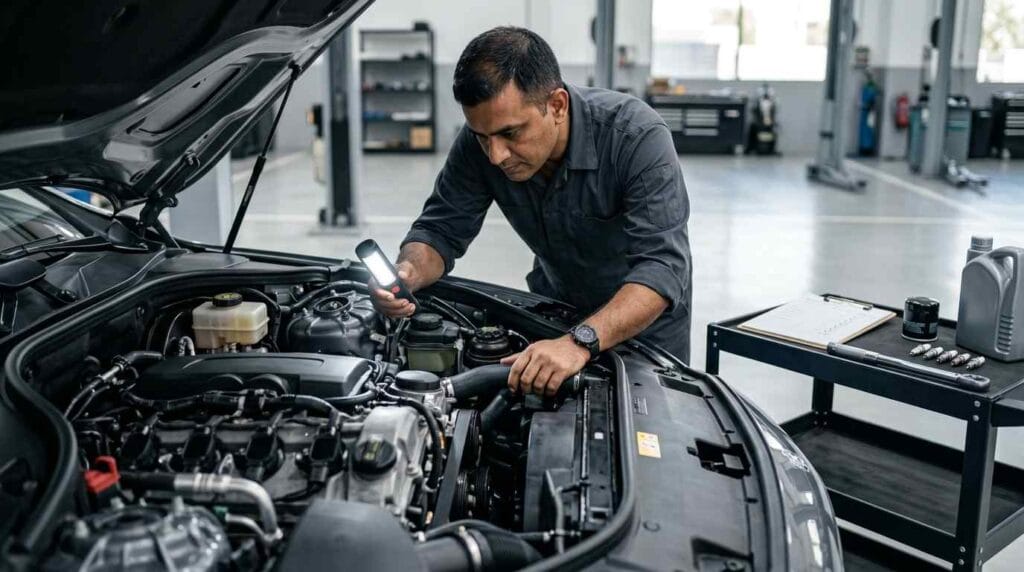
Tires, mounts, brakes and cooling are inspected alongside the powertrain – one worn part can imitate another system’s fault.

Cooling condition affects repeatable testing
Powertrain data collected with unstable engine or charge temperature can be misleading. Resolve active coolant loss, fan faults or overheating risk before applying sustained load. After cooling work, verify filling and thermal stability before completing transmission adaptations or performance checks.
Brake drag can imitate lost performance
Compare wheel temperature carefully when drag is suspected and inspect caliper, hose, bearing and parking-brake behavior as applicable. Do not use a hot wheel as a standalone diagnosis. A binding brake can increase consumption and alter acceleration even though the scheduled engine service was completed correctly.
The final report should connect each complaint with the system tested and the evidence found. This prevents a broad 60,000 KM package from receiving credit for a symptom that was never reproduced or verified.
Electrical supply can confuse several system checks
Test the 12-volt battery and charging behavior before diagnosing a cluster of intermittent warnings. Low voltage can disturb controller communication and create faults across systems that are otherwise unrelated. Save the original scan, establish whether the events are current or historic, and retest after the supply issue is corrected. Do not replace multiple modules solely because their codes appeared during one weak start.
Sixty-thousand questions
Audi 60,000 KM service questions
What is changed at an Audi 60,000 KM service?
Depending on the exact vehicle, oil, selected filters, spark plugs, transmission fluid, coupling oil or belts may be due. No single list applies to every Audi.
Is S tronic fluid always due at 60,000 KM?
No. Several units use different requirements. Identify the gearbox code and applicable schedule.
Are spark plugs changed on every Audi at 60,000 KM?
They can be due on many petrol applications, but diesel and electric vehicles differ, and model-specific information must be checked.
Does a timing chain need replacement at 60,000 KM?
Not simply because of the mileage. Timing chains are assessed from engine-specific guidance, symptoms, faults, lubrication and measured evidence.
How much is a 60,000 KM Audi service?
A combined scheduled scope may broadly range from AED 1,800 to AED 5,500, depending on applicable engine and driveline items.
Can transmission faults be fixed by a fluid service?
A due service may help maintain a healthy unit, but it does not guarantee correction of clutch, mechatronic, pressure or internal damage.