Early ownership checkpoint
Audi 10,000 KM Service Checklist
Use 10,000 KM to establish a clean maintenance baseline. Do not describe every item as a factory-required replacement without checking the VIN and elapsed time.
An Audi 10,000 KM service should confirm the correct vehicle schedule, review engine oil and filter status where applicable, inspect fluid levels and leaks, measure tires and brakes, test battery and charging condition, check cooling and air-conditioning performance, and document any warnings or damage. It is not a universal Audi replacement interval in every market. Some cars may not yet require an oil change, while severe use, elapsed time or an uncertain history may justify earlier work. Electric Audi models need a different checklist without combustion-engine oil service.
Baseline file
Confirm what the first 10,000 KM represents
Ten thousand kilometers can mean a nearly new vehicle approaching an early check, a used Audi with recently reset mileage records, or a car that has covered little distance over several years. Record the VIN, model year, engine or electric powertrain, transmission, quattro equipment, first-registration date and existing service history.
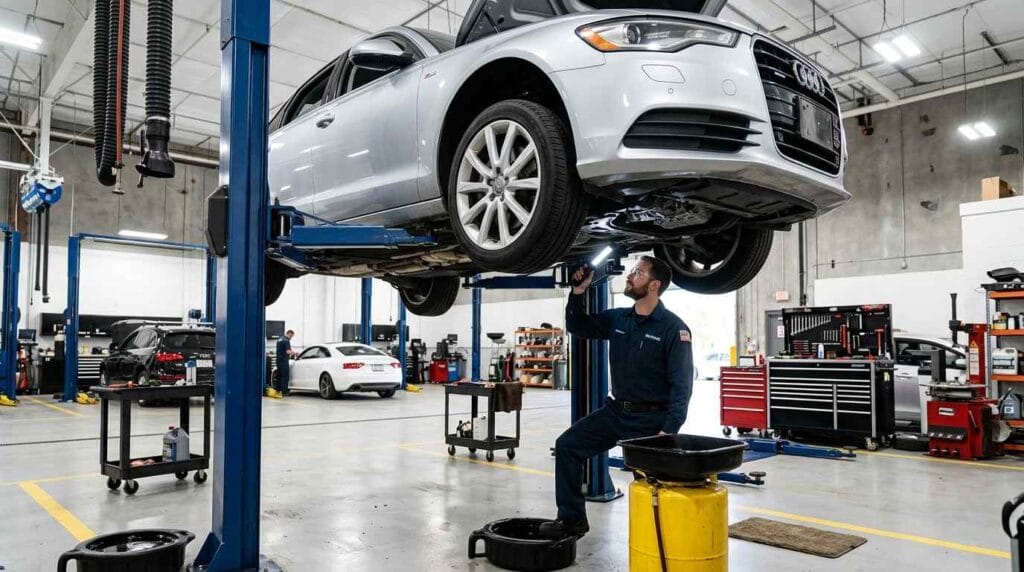
Read the service display and compare it with the applicable manufacturer schedule. Do not reset the reminder before recording what it showed. If the car was imported, verify which market schedule and specifications apply rather than carrying over assumptions from the seller.
Due by schedule
Work supported by the vehicle’s time, mileage, service display and powertrain information.
Due by condition
Tires, brakes, battery, wipers or damage that inspection shows should be corrected.
Due to a fault
Leakage, warning lights, unusual noise or poor operation needing diagnosis.
Not yet proven
Suggested replacements that lack an interval, measurement or failed test.
Engine and fluids
Inspect oil evidence before approving an early change
For a petrol or diesel Audi, check oil level through the correct vehicle procedure and inspect for leakage. Confirm the approval required by the exact engine, not only viscosity. The Audi oil interval and specification guide explains why the VIN, service display, date and operating pattern matter.
If an oil change is due or chosen as an early baseline, record the approval, quantity and filter. Investigate unusually low or high level, fuel smell, warning history or metal evidence rather than hiding the observation with fresh oil.
Check coolant, brake fluid, washer fluid and any visible hydraulic or driveline leakage. Topping up a falling level is not the same as identifying its cause.
Contact and stopping
Create measurements that later services can compare
- Record tire size, load and speed rating, production date and cold pressure.
- Measure inner, center and outer tread instead of reporting only the best point.
- Inspect sidewalls, puncture repairs, wheel barrels and impact damage.
- Measure available brake friction material and examine disc surfaces.
- Check pedal feel, warning state, parking brake and safe stopping behavior.
Early irregular tire wear can expose pressure, alignment, wheel or suspension concerns while correction is still simple. Brake wear at this mileage may reflect use or a mechanical issue, so measurements are more useful than assumptions about how the car was driven.
UAE operating condition
Test battery, cooling and cabin comfort under heat
Battery reserve can fall before a clear starting complaint appears, especially after long parking or repeated short trips. Test state and charging response, then review stored low-voltage events if several warnings appeared together.
Inspect cooling-system sealing, radiator airflow and fan operation. Test the air conditioner after the cabin and engine bay have absorbed road heat. A quick check inside a cool workshop cannot show idle cooling performance in Dubai traffic.
Check wipers, washers, exterior lighting and drainage paths. Dust loading can affect cabin and air filters before an expected distance, but replacement should follow inspection and the applicable schedule.
Electric Audi version
Replace engine items with charging and high-voltage observations
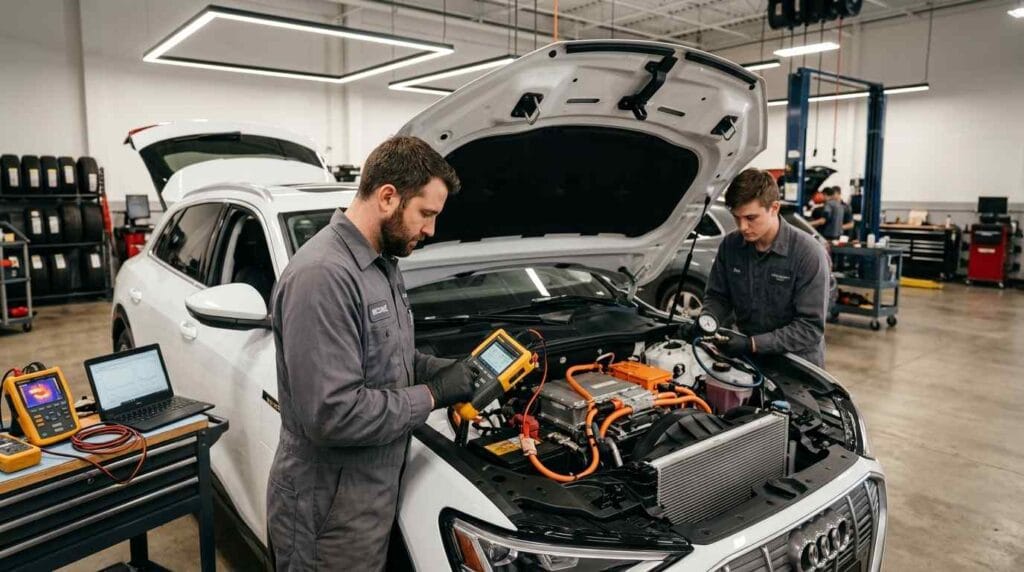
An e-tron does not receive combustion-engine oil, spark plugs or an engine air filter. Review charging-port condition, cable condition, charging warnings, thermal-system faults, tire wear, brakes, 12-volt supply and high-voltage system status instead.
Regenerative braking can reduce friction-brake use, but it does not eliminate inspection. Disc corrosion, uneven contact and sticking hardware can still develop. High-voltage components must be handled only by qualified personnel using the proper safety process.
Cost and handover
Keep the 10,000 KM estimate limited to confirmed work
| Possible scope | Dubai planning range | Qualification |
|---|---|---|
| Inspection and basic checks | AED 250 to AED 650 | Depth, model and diagnostic requirement |
| Oil and filter where due | AED 550 to AED 1,500 | Engine, approval, quantity and filter |
| Cabin or air filter work | AED 250 to AED 850 | Filter count, access and specification |
| Alignment after measured need | AED 250 to AED 650 | Wheel size, suspension and calibration considerations |
These are non-binding editorial ranges, not quotations. Final pricing requires the VIN, schedule and inspection. A written estimate should identify parts, labor, VAT, programming, calibration and exclusions. Decline any “10K package” that cannot explain why each item is included.
Driveability decision
A 10,000 KM service does not override an active warning
A nearly new Audi can still suffer impact damage, a puncture, fluid loss, charging trouble or a manufacturing fault. Do not wait for the service appointment when the dashboard displays a red oil-pressure, brake, steering, temperature or high-voltage warning. Follow the warning instruction, stop in a safe location and arrange recovery when continued operation cannot be confirmed as safe.
An amber message, slight vibration or intermittent electrical warning may allow a controlled inspection visit, but the decision depends on the exact message and current behavior. Photograph the warning before restarting. Note whether it appeared at cold start, during braking, after charging, while turning or at motorway speed. That information is more useful than clearing the display before the workshop sees it.
Separate a service observation from a fault
A low washer-fluid message, a damaged wiper blade or a due-service reminder belongs in the ordinary checklist. Coolant loss, a soft brake pedal, severe steering pull, repeated charging interruption, smoke or a tire sidewall bulge needs a separate safety or diagnostic response. The invoice should not hide either category inside a general 10,000 KM package.
If an oil-level request appears, establish the correct level using the vehicle procedure and suitable oil. Do not continue driving merely to reach 10,000 KM when the level cannot be verified. An oil-pressure warning is a different and more urgent condition.
Behavior baseline
Record how the Audi behaves before measurements begin
The first service visit is a chance to document characteristics that later become difficult to reconstruct. Ask the owner about cold start, idle quality, gear engagement, steering position, braking feel, fan noise, cabin cooling and charging behavior. A short road check should use a safe route that can reveal the complaint without aggressive driving.
Cold observations
Record starting speed, warning sequence and any brief rattle, smoke or roughness. Check the parking area for fresh fluid evidence before the car is moved. On plug-in and electric models, note charge percentage, any interrupted session and whether the vehicle was connected overnight.

Road observations
Listen for tire or wheel noise, confirm that the steering returns normally, and check for vibration during acceleration and braking. Verify that the transmission engages and shifts without an active warning. These observations are not a license to declare every sensation faulty. They create a reference that can be compared with the owner’s report and future visits.
Heat observations
After ordinary road load, recheck for odor, leakage and unusual fan operation. Test cabin cooling at idle, where Dubai traffic often exposes weak airflow or reduced refrigerant performance. A temperature reading and outlet comparison are more useful than stating that the air feels cool.
Useful handover
Leave measurements that make the next service easier
A strong 10,000 KM record does not simply say inspected. It shows tire tread by position, cold pressures, remaining brake material where measurable, battery test result, fluid findings, diagnostic warnings and any damage photographed with location. The report should also identify which items were not accessible or not tested.
Record the next due date and mileage from the applicable schedule. Keep recommendations under clear labels such as due now, safe to monitor, diagnosis required and owner choice. This prevents the next workshop from repeating healthy parts or treating a monitored observation as a confirmed failure.
At collection, verify that service reminders match the work completed, fluid caps and covers are secure, no new warning is present and the agreed road behavior remains normal. A correct baseline at 10,000 KM gives the 30,000 KM visit a genuine comparison point instead of another isolated checklist.
Before the appointment
Bring the information that makes an early service accurate
The workshop can build a better 10,000 KM scope when the owner sends the VIN, first-registration date, current odometer, service-display photo and earlier invoice before arrival. Include the market from which the vehicle was supplied and state whether it is petrol, diesel, plug-in hybrid or fully electric. Do not rely on the model badge to identify the maintenance schedule.
Keep warning photos and charging records
Photograph any message before it disappears. Note the date, outside temperature, battery or fuel level and what the car was doing. E-tron and plug-in owners should include interrupted charging sessions, cable used and charger type. Combustion-model owners should report every oil or coolant addition, even if the dashboard later returned to normal.

Do not warm the vehicle for a cold complaint
If the concern occurs at the first start, ask the workshop whether the car should arrive by recovery or remain parked for a cold inspection. Starting and moving it repeatedly can hide rattle, smoke, rough running, weak-battery behavior and fresh leakage. Safety takes priority, so never leave a car in an unsafe location merely to preserve a symptom.
Remove unnecessary load but keep useful evidence
Clear personal valuables and explain any heavy load normally carried. Keep the wheel-lock key, charging cable and relevant documents available. Do not wash an oily engine bay or underbody immediately before inspection. Cleaning can remove the path that helps locate a new leak.
At booking, ask whether the estimate covers only inspection or also approved oil, filters, diagnostic time and road testing. A clear boundary prevents the service from expanding without consent. It also gives the owner a usable total when comparing two workshops.
Early-service questions
Audi 10,000 KM service questions
Is 10,000 KM a mandatory Audi service interval?
Not universally. Audi intervals vary by market, model year, powertrain and time. Use the VIN, service display and applicable schedule.
Does every Audi need an oil change at 10,000 KM?
No. Some vehicles may be due by time, schedule or operating condition, while others may not. Electric Audi models do not have combustion-engine oil.
What should be measured at the first service?
Record tire tread and pressure, brake condition, battery performance, fluid levels, leakage and any diagnostic warnings.
Why inspect alignment so early?
A curb impact, delivery damage, incorrect pressure or suspension issue can produce uneven wear before high mileage. Align only after checking the physical cause.
How much can a 10,000 KM Audi service cost?
An inspection may be a few hundred dirhams. Oil and filter work may broadly range from AED 550 to AED 1,500 depending on the exact vehicle.
Should faults be included inside the service package?
They should be listed separately. Scheduled maintenance, measured wear and fault diagnosis are different scopes.