Audi A7 common problems are best understood by when the symptom appears, what the car is doing and which warning accompanies it. An oil-pressure warning, overheating, severe misfire, loss of braking or steering assistance, smoke, fuel smell, sudden suspension collapse or loss of drive needs an immediate stop. Less urgent complaints such as an intermittent MMI restart, mild vibration or occasional warning still need diagnosis, but the evidence should be recorded before parts are replaced.
Capture a two-minute symptom fingerprint
- Photograph the complete warning and its color.
- Note whether the engine and transmission were cold or hot.
- Record speed, gear, throttle position and road surface.
- Write down whether AC, lights or another electrical load was operating.
- Save a short video of a noise or vibration when it is safe.
- Tell the workshop what changed after a restart.
This small record often gives the technician a better starting point than a description such as “the car felt strange.”
The Audi A7 Badge Does Not Identify One Mechanical Package
An A7 can have a petrol, diesel or electrified powertrain, different transmissions, front-wheel drive or quattro, steel springs or adaptive air suspension, and different braking, steering, MMI and driver-assistance equipment. S7 and RS7 versions introduce further powertrain, cooling and chassis differences. Market specification also matters because a GCC car and an imported car may not share the same equipment, software or maintenance history.
Begin with the VIN, production date, engine code, transmission code and installed equipment. The first-generation A7, commonly associated with the 4G platform, and the later 4K generation do not follow one diagnostic path. Even within the same generation, an engine or suspension option can change the relevant fluid, component location, test plan and repair cost.
A fault reported online for one A7 should therefore be treated as a clue, not a diagnosis for every A7.
Read the Pattern Before Naming a Part
A useful symptom has several dimensions. A vibration only at idle is different from one tied to road speed. A coolant warning after an overnight park is different from a temperature rise in slow traffic. A shift complaint that appears only after a long hot drive is different from delayed engagement at the first cold start.
| Symptom event | Systems to separate | Useful evidence | Initial priority |
|---|---|---|---|
| Several warnings at startup | Battery, charging, network, individual control unit | Cranking voltage, warning order, full scan | Prompt test before module replacement |
| Power loss under acceleration | Boost, ignition, fuel, exhaust, transmission | Requested versus actual data, misfire counts, pressure | Reduce load and diagnose |
| One corner low after parking | Air spring, line, valve, sensor, compressor control | Level-ground photos, height measurements, leak test | Do not cycle the height repeatedly |
| Vibration at one road speed | Tire, wheel, hub, bearing, driveline | Speed range, road surface, runout, road force | Inspect before alignment or mount replacement |
| MMI resets after heat or startup | Voltage, network, software, module, display | Temperature, affected functions, communication scan | Record and arrange diagnosis |
Warnings That Mean the A7 Should Stop
Stop the engine for a red oil-pressure warning, even if the electronic oil-level display appears normal. Oil level and oil pressure are different measurements. Continuing to run the engine while pressure is genuinely low can create severe internal damage.
Stop for rising temperature, steam or sudden coolant loss. Do not open a hot cooling system. A leak, fan problem, circulation fault, thermostat control issue or another cause may be involved. Repeatedly adding coolant without finding the loss can hide a developing fault.
Stop for a flashing engine warning with severe shaking. A heavy misfire can send unburned fuel into the exhaust and overheat the catalytic converter. Reduce load immediately and arrange recovery if the engine does not run smoothly.
Recovery is also the safer choice for a strong fuel smell, visible fire risk, smoke that obscures visibility, a tire with structural damage, grinding brakes, unsafe steering, loss of drive, or an air-suspension fault that leaves the body close to a tire.
Engine and Cooling Symptoms
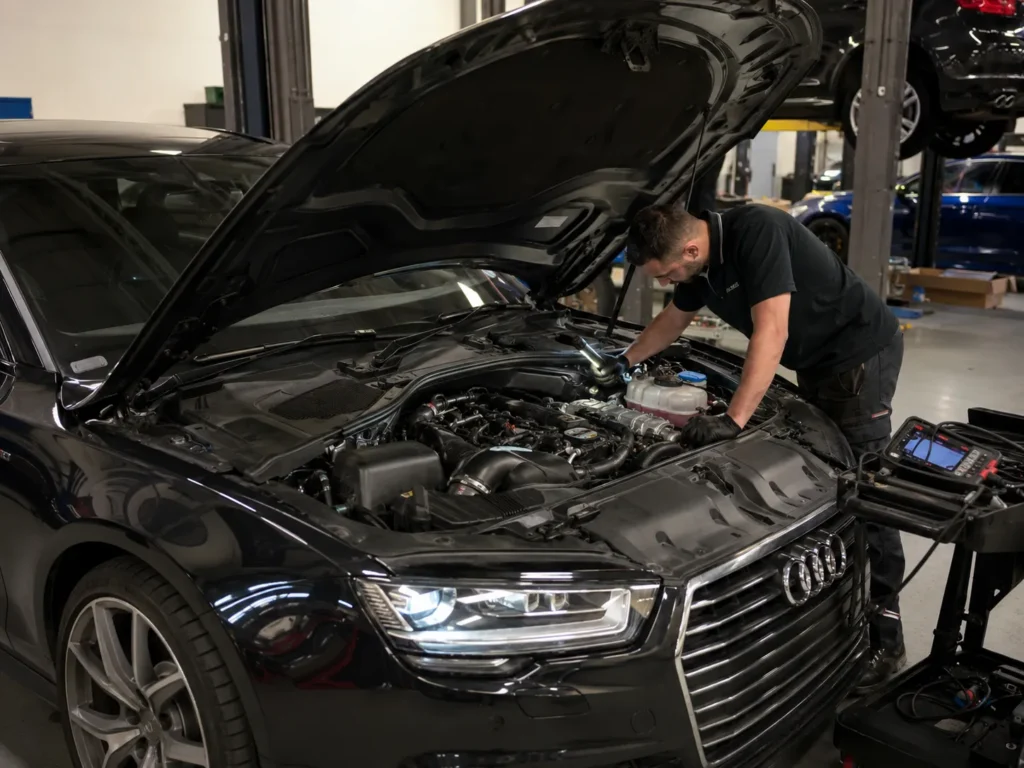
Cold-Start Rattle or Rough Running
Record the duration and whether the sound occurs after every overnight park or only occasionally. Oil level, correct oil approval, service history, stored timing data and the exact sound location all matter. Accessory-drive components, exhaust shields and mounts can imitate internal engine noise.
A rough cold start may involve ignition, fuel delivery, air leakage, deposits, compression or timing. A cylinder-specific misfire code identifies where unstable combustion was detected. It does not prove that the coil is the failed part. Controlled swapping, plug inspection, fuel-pressure data, injector testing, smoke testing and compression evidence may be needed.
Oil Smell or Oil Under the Car
Trace a leak from the highest fresh source. Airflow and the undertray can move oil away from the original seal. Clean the area and use dye when appropriate. Oil on a hot exhaust component can create an odor or smoke without proving internal engine wear.
Electronic level messages should be checked under the correct vehicle conditions. If the level drops repeatedly, the workshop should distinguish external leakage from oil consumption rather than treating every top-up as routine.
Coolant Loss Without a Large Puddle
A slow leak may evaporate on a hot component or collect in the undertray. Look for dried residue around the expansion tank, hose connections, radiator, pump and thermostat area, but test the layout fitted to the identified engine. Cold pressure testing, hot inspection and correct bleeding are more useful than replacing the most commonly blamed component.
Reduced Power
Reduced power is often a protective response. Compare requested and actual boost, fuel pressure, air data, throttle behavior, exhaust pressure where applicable and the conditions stored with the fault. Intake leaks, actuator control, sensors, ignition, fueling, exhaust restriction, temperature protection and transmission behavior can create a similar complaint.
Do not approve a turbocharger from a general “underboost” description. Inspect the complete air path, actuator operation, oil supply and return, exhaust condition and related control circuit first.
Transmission and Quattro Complaints
The A7 has used different transmission designs according to generation, engine and drivetrain. Identify the gearbox before discussing fluid, clutches, mechatronics, torque converters, adaptation or service intervals.
Delay Selecting Drive or Reverse
Note whether the delay occurs cold, hot, on a slope or after a long park. Check for leaks, correct fluid procedure, voltage, stored data and engine torque behavior. Excess mount movement can make engagement feel harsh, while a hydraulic or control problem may create a real delay.
Shudder or Jerking
Shudder can come from clutch behavior on a suitable transmission, unstable engine torque, mounts, driveline joints, tires or road surface. Reproduce it at the same temperature and load. A parts estimate should follow the test result, not the adjective used to describe the sensation.
Our published guide to Audi transmission problems and diagnostic evidence explains how warning messages, harsh shifts, slipping and leaks require different tests.
Binding or Vibration During Tight Turns
First confirm that all four tires have compatible size, specification, pressure and rolling circumference. Uneven wear or mismatched tires can affect a quattro drivetrain and can also confuse vibration diagnosis. Inspect steering angle, wheel bearings, joints and driveline components before assuming an internal differential fault.
Suspension, Steering and Brake Problems
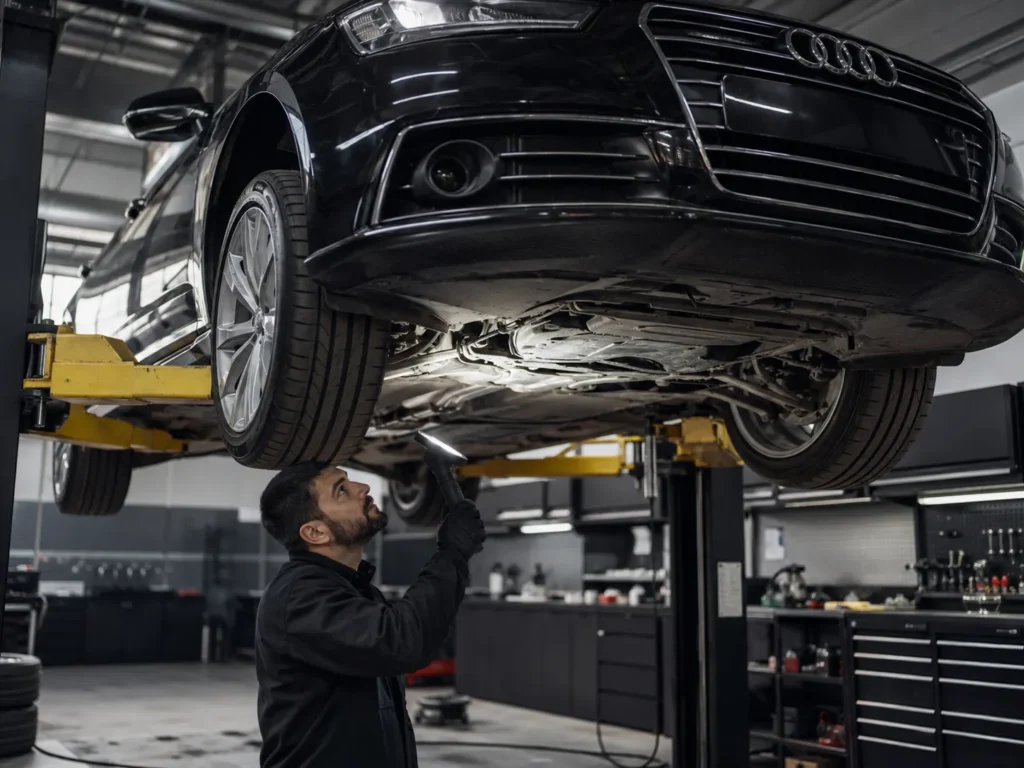
One Side Drops While Parked
On an air-suspension A7, photograph the height on level ground before startup and measure each corner. A leaking air spring, line or fitting may be involved, but valve, sensor, wiring and control faults can produce similar behavior. Long compressor operation after startup is useful evidence, not proof that the compressor caused the leak.
Avoid repeatedly commanding the car upward. Excess compressor operation can turn a leak complaint into a second repair.
Knock Over Small Bumps
The location, temperature and bump type matter. Inspect links, bushes, joints, damper mountings, brakes and underbody components with the suspension loaded appropriately. A quick unloaded shake may miss a part that moves only under road force.
Heavy Steering or a Crooked Wheel
Separate steering assistance, mechanical binding, tire pull and wheel alignment. Check tire pressures and condition, steering faults, suspension damage and geometry. A wheel that sits crooked after impact may need component repair before alignment. A pull only under braking requires brake and suspension checks.
Brake Vibration
Measure rotor and hub runout, thickness variation, friction material, caliper movement and wheel condition. Replacing discs without checking the mounting surface or suspension play may allow the vibration to return.
Electrical, MMI and Driver-Assistance Faults
Many Warnings Appear Together
Low voltage can interrupt several control units during startup. Test battery state of charge, battery health, cranking voltage and charging performance before replacing the systems named by the warnings. If the battery discharges while parked, sleep-current testing must wait until the car reaches its correct rest state.
Some A7 versions use electrical architectures beyond a conventional 12-volt system. The equipment must be identified before testing or disconnecting components.
MMI Screen Freezes or Restarts
Separate a display problem from a complete infotainment-network interruption. Record whether audio, cameras, navigation, phone connection and vehicle menus fail together. Check voltage, communication, software status, temperature and recent repair history before replacing the screen.
Camera or Radar Warning After Repair
A message after windscreen, bumper, suspension, wheel-alignment or accident work can involve mounting, wiring, geometry, calibration or an incorrect part. Calibration should follow correct physical repair and alignment. It cannot compensate for a bent bracket or unsuitable windscreen.
Water-Related Electrical Faults
The A7 Sportback body makes hatch, drain, seal and previous body-repair history relevant when faults follow washing or rain. Damp carpet, odor, misting or corrosion can point toward water entry, but water may travel before reaching a connector or module. Seal the entry path and inspect affected wiring before replacing wet electronics.
A Seven-Question Repair Priority Test
- Is there a red warning, smoke, severe shaking or loss of control? Stop and arrange recovery.
- Does the symptom depend on engine temperature? Reproduce it cold and hot without unnecessary restarts.
- Does it follow road speed or engine speed? This separates many wheel and driveline complaints from engine-related vibration.
- Did it begin after another repair? Check disturbed parts, fluid procedures, coding and calibration.
- Do several systems fail together? Test voltage and network communication before several module estimates.
- Is maintenance history incomplete? Separate catch-up service from the active fault.
- Can the repair be verified under the original condition? If not, the diagnosis is incomplete.
A useful workshop result should leave you with three lists
- Safety work now such as a tire, brake, steering, overheating or severe drivability fault.
- Cause-related repair supported by scan data, measurements and physical evidence.
- Planned maintenance based on the exact A7 and documented history, not added to make the fault estimate look larger.
Common Audi A7 Misdiagnoses
- Calling every overnight height loss a failed compressor.
- Replacing an MMI screen when voltage or network communication was interrupted.
- Replacing a turbocharger for reduced power without pressure and actuator testing.
- Calling a road-speed vibration an engine-mount problem.
- Replacing transmission parts before confirming the gearbox and testing engine torque.
- Performing alignment before repairing a damaged tire, wheel, bush or suspension arm.
- Replacing several control units when water entry or low voltage connects the faults.
What a Complete A7 Diagnosis Includes
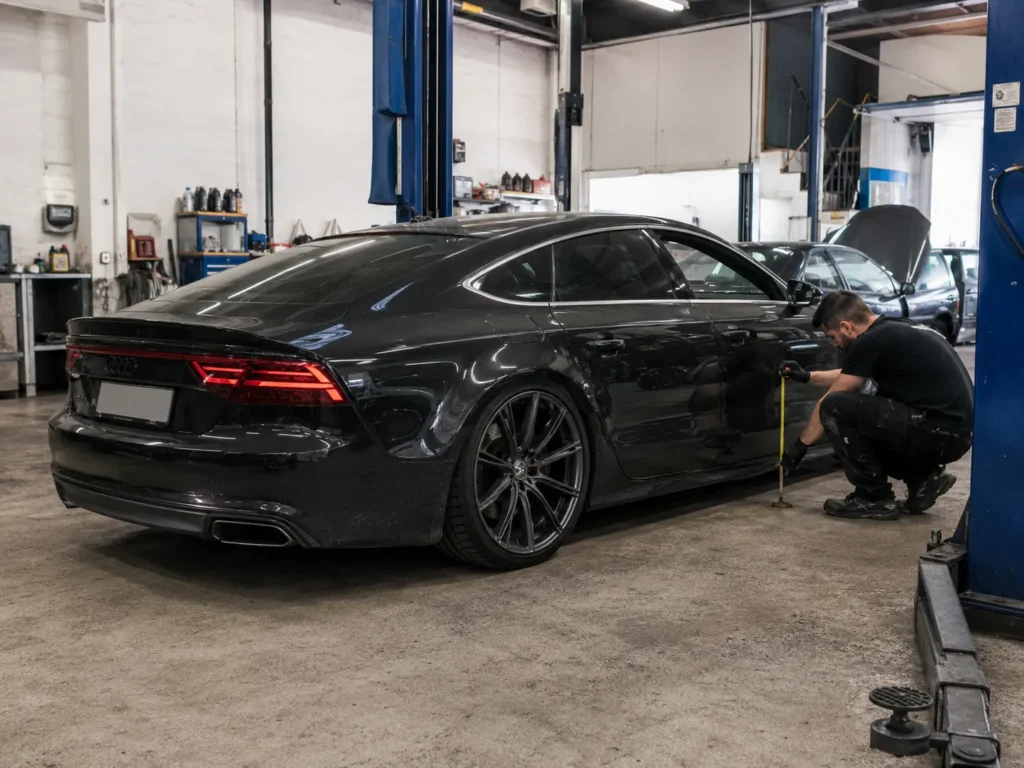
The process should begin with a written complaint and vehicle identification. The technician then performs a full-system scan without clearing the original evidence, reviews fault status and operating conditions, inspects the relevant system and measures the suspected cause.
Depending on the complaint, useful evidence may include pressure, temperature, voltage drop, current, wheel runout, suspension height, smoke-test results, misfire counts, adaptation data or requested-versus-actual values. The estimate should identify the confirmed cause, any secondary damage, required fluids and hardware, programming or calibration, and the checks needed after repair.
Verification matters as much as diagnosis. Repeat the cold start, hot traffic condition, acceleration event, road-speed range or parking period that originally produced the fault. Complete a final scan and leak or level check where relevant.
What Changes Audi A7 Repair Cost in Dubai
Cost depends on the exact generation, engine, transmission, drivetrain, suspension and electronic equipment. Access time, parts source, fluid specification, one-time-use hardware, software work, calibration and secondary damage can all change the estimate.
A warning message alone is not enough for a reliable price. The same “suspension fault” description could lead to a wiring repair, sensor replacement, air leak repair or compressor-related work. The Audi A7 maintenance and cost guide explains how to separate scheduled service, measured wear, active faults and catch-up work.
Arrange an Audi A7 Diagnostic Inspection
Send the VIN, model year, mileage, full warning message and the condition that triggers the symptom. Our Audi A7 repair team in Dubai can reproduce the complaint, test the relevant system and explain what needs immediate repair, what can be planned and what does not need replacement.
Send Your Audi A7 Symptom on WhatsApp
Frequently Asked Questions
What are the most common Audi A7 problems?
Owners may report coolant or oil loss, rough running, reduced power, shift complaints, vibration, suspension height changes, MMI faults and electrical warnings. The likely cause depends on generation, powertrain, equipment and the conditions in which the symptom appears.
Is it safe to drive an Audi A7 with a warning light?
It depends on the warning and vehicle behavior. Stop for a red oil-pressure or temperature warning, severe misfire, smoke, loss of braking or steering, an unsafe tire, sudden suspension collapse or loss of drive. An amber warning with normal behavior still needs prompt diagnosis.
Why does my Audi A7 sit low on one side?
On an air-suspension car, leakage, a valve, line, sensor, wiring or control fault may be involved. Measure height loss and leak-test the system before replacing the compressor.
Does an A7 power-loss warning mean the turbo failed?
No. Boost leakage, actuator control, sensors, ignition, fuel pressure, exhaust restriction, temperature protection and transmission faults can reduce power. Compare requested and actual data before approving a turbocharger.
Why does my A7 show several warnings after startup?
Low voltage can interrupt several control units at once. Test the battery, charging performance and network before replacing multiple systems.
Why does my Audi A7 vibrate at highway speed?
Start with tires, wheels, runout, balance and suspension condition. A vibration tied to road speed follows a different test path from one tied to engine speed or braking.
Do all Audi A7 models use the same transmission?
No. Transmission design varies by generation, engine and drivetrain. The gearbox code should be confirmed before selecting fluid, service procedure or repair parts.
How should an Audi A7 repair be verified?
Repeat the exact condition that produced the complaint, compare measured values, check fluid levels or leaks where relevant, complete a final scan and confirm that the warning or behavior does not return.