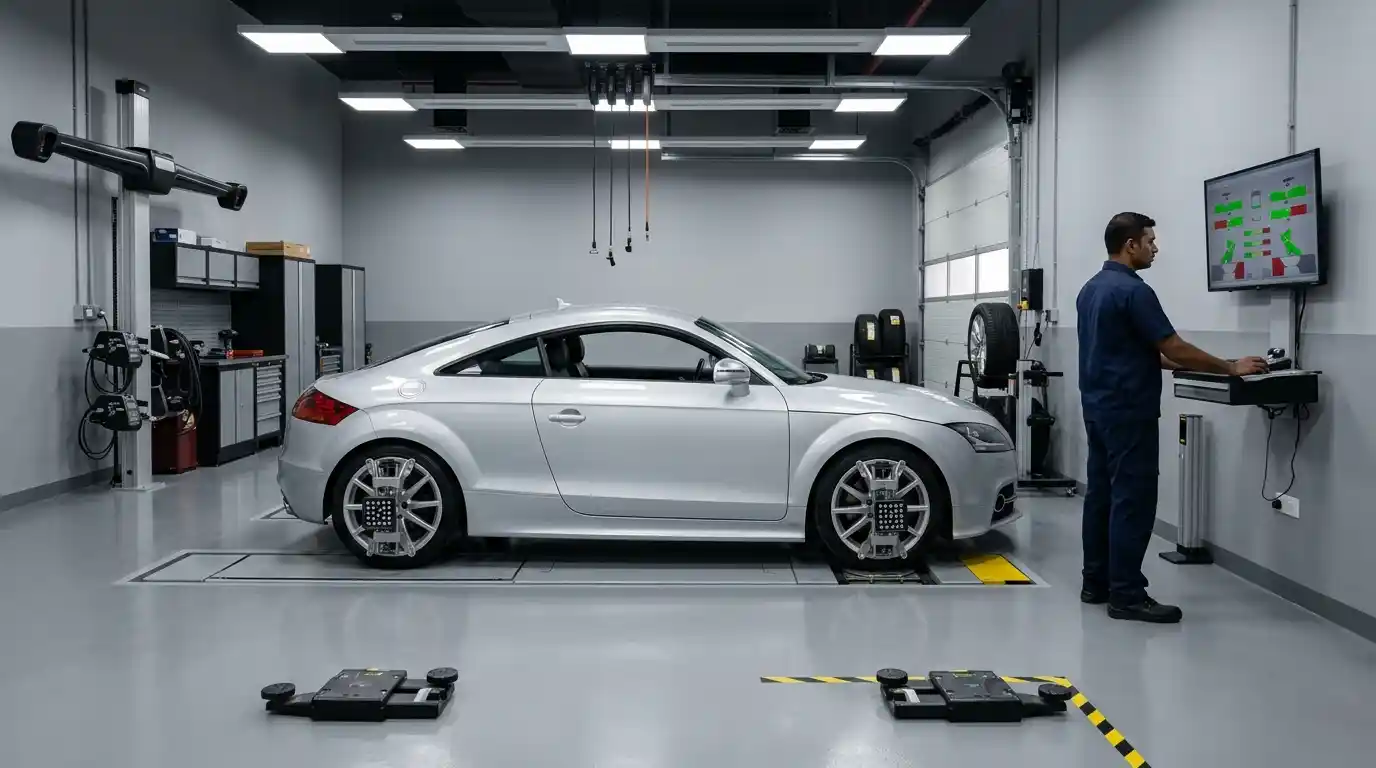
Audi TTS Repair and Service in Dubai
The Audi TTS combines higher-output calibration, performance brakes, quattro and option-dependent adaptive damping to the compact TT platform. Reliable repair starts by identifying the exact generation, engine, gearbox, market and installed chassis equipment, then reproducing the concern under its recorded operating condition. Owners of the standard coupe can use the Audi TT page, while five-cylinder cars require the TT RS repair route. Review Audi tire selection for UAE roads when wheel or quattro behavior is involved.
Send TTS detailsDefine the TTS before defining the job
An 8J and an 8S do not share every procedure, and imported or modified cars can differ again. Record the VIN, build date, market source, engine and gearbox codes, quattro hardware, brake and suspension options, wheel specification, software history and recent repair work.
8J TTS
Give attention to age-related cooling and sealing, timing-system evidence for the installed engine, boost plumbing, S tronic history, quattro coupling service, electronic damping where fitted and roof drainage on roadsters.
8S TTS
Later electrical integration makes battery condition, complete network scans, display and control inputs, and correct post-repair coding or calibration more important. Confirm the actual option list.
Coupe or roadster
Roadster roof, window and drain behavior needs a full operation and water-path inspection. Coupe checks still include hatch sealing, rear moisture and previous body repair.
Stock or modified
Intake, exhaust, engine software, lowered suspension and wheel changes influence test values, compatibility and warranty. Document the current configuration before conclusions.
Protect the engine, driveline and driver
Unsafe or damaging symptoms
Stop using the TTS when lubrication or cooling warnings turn red, fluid escapes quickly, smoke or fuel odor appears, or the engine misfires heavily. Recovery is also the correct choice when drive disappears, grinding begins, steering changes sharply, braking feels abnormal or a wheel touches the body.
Stable amber warning
Limited movement should be considered only when the car remains cool, controllable and free of leakage, slip or misfire. Keep the engine out of boost and avoid demanding shifts until it is inspected.
Noise without warning
Record whether the noise follows cold start, engine speed, gear, road speed, bumps or braking. Stop repeated testing if it becomes harsh or is accompanied by loss of power or control.
Intermittent fault
Save the message and trigger conditions. Do not clear codes or disconnect the battery before a complete scan because event data may contain the temperature, load or voltage clue.
Separate power, shifting, traction and chassis evidence

Boost, ignition and fuel
Pressurize the complete charge-air circuit and compare boost control targets with sensor response under the failing load. Review ignition corrections, cylinder events and fuel delivery before identifying a turbo, valve or fueling component.
Oil and cooling stability
Confirm approved oil and level, pressure-test a cold cooling circuit, inspect fresh leakage and log temperature under the complaint condition. Correct heat management before judging reduced power under load.
S tronic or manual equipment
Identify the exact gearbox. For S tronic, save faults and assess clutch or hydraulic data cold and warm. For manual equipment, separate clutch slip, release, linkage, mounts and internal noise.
Quattro and tire matching
Record the approved wheel specification, individual tire measurements and rolling-radius differences across both axles. Only evaluate coupling data after eliminating brake drag, bearing roughness and a mismatched tire set.
Dampers, joints and alignment
Measure wheel runout, joints, bushings, ride height and wear pattern. Where magnetic or adaptive damping is installed, repair mechanical faults before coding or calibration.
Brakes and thermal use
Record pad and disc dimensions, runout, caliper movement, fluid age and heat evidence. Distinguish brake judder from tire, wheel, hub, suspension and driveline vibration.

Move through six proof stages
Capture the owner complaint
Use the driver’s words, not a preselected part name. Add cold or warm state, road speed, gear, drive mode, load, warning text and recent work.
Establish a baseline
Check fluids, tire specification, battery condition, visible leaks and modifications. Complete a whole-vehicle scan before clearing any data.
Reproduce safely
Run the TTS from genuine cold state to operating temperature and recreate the trigger only within agreed stop limits. Link live data to the event.
Isolate the path
Use pressure, smoke, voltage-drop, mechanical, geometry or leakage tests. Record credible alternatives that passed as well as the failed measurement.
Approve a defined scope
Separate due service, confirmed repair and optional work. List parts category, fluid, hardware, access, coding, calibration and exclusions.
Verify completion
Repeat the original trigger after repair, complete applicable adaptation or calibration, re-scan affected systems and document the final result.
Build the plan from schedule, measurements and usage
Build the service record around the exact engine, transmission and coupling codes. Oil condition, ignition wear, brake-fluid history and drivetrain servicing should be reviewed against mileage, elapsed time and how the TTS is actually used in Dubai.
Record the specification
Keep date, mileage, part numbers, fluid approvals and quantity, single-use hardware, adaptations and the next due logic. Confirm the exact timing arrangement rather than assuming from model name.
Measure wear
Document tires, brakes, wheel condition, suspension, battery, cooling integrity and leakage. State present values and limits so advisories can be planned.
Cold-to-warm inspection
Match invoices and software history, inspect on a lift, scan all modules and road-test after full warm-up. Operate a roadster roof and check water paths separately.
Compare the complete scope
Review diagnosis, parts route, labor access, fluids, hardware, commissioning, verification and warranty boundary. Treat early phone prices as non-binding ranges.
For a used TTS, classify each finding as due service, measured wear, diagnosed failure or a monitored condition. This prevents normal maintenance from being used to disguise an unresolved powertrain or chassis fault.
Audi TTS repair FAQs
Can a TTS use the same service plan as a standard TT?
Do not assume so. Confirm the VIN-linked schedule, engine, gearbox, quattro system, brake package and installed suspension equipment.
Does harsh S tronic behavior require mechatronic replacement?
No. Fluid history, temperature, clutch data, hydraulic behavior, adaptations, mounts and software must be assessed before choosing a repair.
Can mismatched tires create quattro symptoms?
Yes. A difference in construction, inflation, tread loss or rolling radius can load the driveline, so measure the complete tire set before diagnosing quattro hardware.
Should adaptive damping be calibrated after suspension work?
Follow the procedure for the installed equipment. Mechanical condition, ride height, tires and alignment must be correct before calibration.
What evidence should be supplied at handover?
The handover should identify the triggering fault, show the measurements that supported the repair, record installed parts and fluids, and confirm coding, calibration and a condition-matched road test.
Prepare the TTS diagnosis
Send the VIN, generation, mileage, exact symptom, trigger condition and recent repair or modification history.