

Audi drive train repair in Dubai
A drivetrain warning, vibration, clunk or change in power delivery does not identify one failed part. We trace the symptom through the transmission, prop shaft, differentials, transfer components, axles and supporting controls before recommending Audi drivetrain repair.
Audi drive train repair starts by locating where torque delivery changes. The same vibration can come from a tyre, engine mount, transmission, prop shaft, CV joint or differential. Testing the condition before replacing parts protects the repair decision.
Start with the drivetrain symptom
What the driver feels, when it happens and whether it changes with speed, steering angle or engine load gives the workshop a better starting point than a guessed component name.
Warning or reduced power
Photograph the complete warning message before restarting the car. A drivetrain message may be connected to engine management, transmission control, voltage, communication or mechanical operation. The message is evidence, not a final diagnosis.
Shudder or vibration
Note whether the vibration follows road speed, engine speed, acceleration, a gear change or a tight turn. Those patterns help separate wheel-related vibration from mounts, shafts, joints, transmission behaviour and final-drive concerns.
Clunk, whine or grinding
A clunk when load changes, a whine that rises with road speed and grinding during a turn point towards different checks. Record whether the sound is front, centre or rear and whether it appears while accelerating or coasting.
Leak or poor engagement
Fluid position, colour and recent repair history matter. Delayed engagement, harsh selection or a leak should not be treated with a generic fluid top-up. The correct system, specification and leak source must be identified first.

A warning is not a diagnosis
Audi control units share information across the powertrain. A transmission controller may limit operation because another module reports an implausible value, low voltage, excessive temperature or a communication fault. A mechanical problem can also produce electronic evidence after slip, vibration or an unexpected speed difference is detected.
The first scan should preserve the controller, code status and surrounding event data. Clearing codes before the symptom is recorded can remove information about speed, temperature, voltage, selected gear and operating load. Codes are then compared with the driver complaint and physical checks rather than used as a shopping list.
Record the full display text and every warning lamp shown at the same time.
Note cold or warm, straight or turning, light throttle or hard acceleration, and the selected driving mode.
Mention battery work, water entry, impact, tyre replacement, software work or previous transmission and underbody repairs.
Say whether the car still selects gears, moves normally, enters reduced power or loses drive.
How power reaches the wheels
The drivetrain fitted to an Audi varies by model, engine, transmission, platform and driven axle. The route below is a practical inspection map, not a claim that every car contains the same arrangement.
Engine output and mounts
Torque begins at the engine, while mounts control movement under load. Misfire, uneven output or excessive mount movement can feel like a downstream drivetrain fault.
Transmission and control
The installed automatic, dual-clutch or other transmission manages ratio and engagement. Fluid condition, clutch operation, mechatronic control, adaptation and mechanical wear require different evidence.
Prop shaft and support
Where fitted, the prop shaft carries power along the vehicle. Joints, couplings, support bearings, alignment and balance can influence vibration and load-change noise.
Differential and distribution
Final-drive and quattro-related components distribute torque according to the installed layout. Fluid, bearings, gears, clutches and controls are assessed according to that exact system.
Axles, CV joints and wheels
Axle shafts and CV joints carry power through suspension and steering movement. Clicking on lock, vibration under load and damaged boots change the inspection route.
Match the observation to the next test
The table shows possible directions only. Several systems can create the same driver complaint, so the workshop must reproduce or measure the condition before approving parts.
| Driver observation | Possible system | Workshop check | Likely next decision |
|---|---|---|---|
| Shudder during take-off | Engine output, mounts, clutch control, transmission or shaft | Scan context, engine smoothness, mount movement and controlled engagement test | Separate an engine or support fault from transmission and driveline load behaviour |
| Vibration rises with road speed | Tyre, wheel, prop shaft, joint, bearing or axle | Road-speed pattern, wheel condition, runout and underbody inspection | Correct the rotating source shown by measurement rather than guessing a gearbox fault |
| Clunk on acceleration and lift-off | Mount, coupling, joint, differential clearance or support | Load-change reproduction, movement check and inspection for looseness or damaged bushes | Repair the confirmed free play or support problem and recheck under load |
| Whine changes between power and coast | Bearing, final drive, differential or tyre pattern | Locate the sound, compare load direction, inspect fluids and check rotating components | Open or replace a unit only when the source and internal condition are supported |
| Clicking during a tight turn | Outer CV joint, tyre contact or steering-related component | Low-speed turn test, boot inspection, joint play and surrounding clearance | Confirm the affected side and whether the joint or complete axle is the sensible repair |
| Delayed or harsh engagement | Transmission fluid, control, adaptation, clutch or internal wear | Correct fluid identification, scan data, temperature, pressure or adaptation checks as applicable | Choose service, control repair, adaptation work or deeper transmission diagnosis from evidence |
| Drivetrain warning after battery work | Voltage, calibration, communication or a pre-existing fault | Battery condition, charging voltage, network faults, basic settings and repeat behaviour | Restore supply or calibration only when mechanical operation is also confirmed |
Diagnosis comes before dismantling
A useful inspection moves from the complaint to measurable evidence, then towards the smallest justified access or repair. The sequence changes when the car cannot be safely operated.
Record the complaint
We note the exact warning, noise, vibration, operating condition, recent work and whether the vehicle still moves normally.
Identify the fitted system
VIN, model year and installed drivetrain guide the correct fluid, control, component and testing information.
Preserve scan evidence
Relevant controllers, code status and event data are recorded before faults are cleared or parts are disturbed.
Inspect fluid and hardware
Leaks, mounts, boots, joints, supports, fasteners, impact marks and fluid condition are compared with the complaint.
Reproduce or measure
A controlled road test, lift inspection or operational test is used when safe and appropriate to locate the behaviour.
Approve and verify
The repair scope is explained before deeper work. After repair, the original condition and relevant settings are checked again.
Different components need different decisions
This page covers the drivetrain as a connected system. When the evidence isolates a specialist unit, the detailed repair route belongs with that service rather than being duplicated here.
Transmission and control
Engagement quality, slip, shift behaviour, fluid condition, temperature, clutch operation, adaptation and electronic control must be separated. If the fault is inside this area, continue to the dedicated Audi transmission repair service.
Prop shaft and supports
A shaft fault can involve a coupling, joint, centre support, balance, alignment or impact damage. The rotation-speed pattern and physical condition decide whether a focused component or larger assembly requires attention.
Differential and final drive
Noise, fluid condition, bearing play, gear contact and electronically controlled distribution require different checks. Read the dedicated Audi differential repair information when the fault has been isolated here.
Axles and CV joints
Boot damage, grease loss, joint wear, shaft damage and hub-side concerns can create clicking or load-sensitive vibration. The affected side and actual wear should be confirmed before choosing a joint or axle replacement.
Quattro power distribution
Audi uses different all-wheel-drive arrangements across platforms and generations. Transfer components, clutches, differentials, fluid requirements, control logic and tyre circumference must be matched to the installed system.
Mounts and supporting signals
Engine and transmission mounts, wheel-speed signals, voltage, network communication and calibration can change how the drivetrain behaves. Supporting faults should be proven rather than hidden by replacing a major unit.
What an underbody drivetrain check can confirm
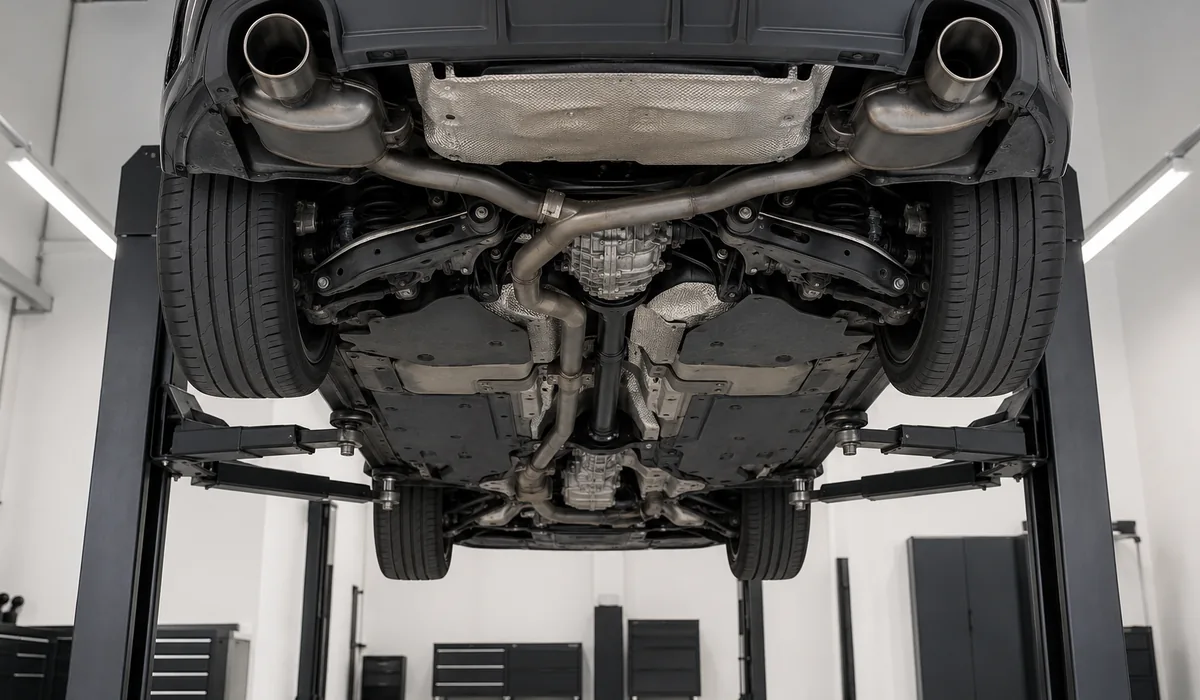
A scan result is compared with the hardware beneath the car. Fluid traces, damaged boots, loose supports, impact marks and movement at joints can help connect a warning, vibration or clunk to the correct part of the torque path.

The finding sets the repair depth
A repairable leak, worn support or damaged external joint is a different decision from contaminated fluid, internal bearing damage, repeated clutch slip or damage across several connected parts.
The workshop considers access, measured wear, secondary damage, component availability, part identification and the test needed after assembly. A local repair can be sensible when the surrounding unit remains serviceable and the corrected condition can be verified. Replacement may be more reliable when damage is internal, parts are not serviced separately or previous operation has affected a larger assembly.
Used, remanufactured, supplier and new component routes carry different fitment, condition, software and warranty questions. No option should be approved from the model name alone. The exact component number, revision and installed equipment must be checked.
What changes drivetrain repair cost
A reliable quotation follows diagnosis. A warning caused by voltage or an external support is not priced like internal transmission, differential or transfer-component damage.
External or internal damage
An accessible boot, seal, coupling or mount has a different labour and parts path from an internal clutch, bearing, gear or control fault.
Model, VIN and drivetrain
Engine, transmission, driven axle, quattro arrangement and component revision change the correct procedure and parts.
Access and related work
Exhaust, underbody, suspension or adjacent drivetrain parts may affect access. Related damage is separated from the original complaint.
Fluid, calibration and testing
Correct fluids, seals, one-time fasteners, alignment, adaptation, coding and final testing depend on the repair performed.
The exact drivetrain matters more than the badge
We assess drivetrain concerns across Audi A, Q, S and RS ranges. The booking should include the model year and VIN because the same model family can use different transmissions and power-distribution systems.
A3, A4, A5, A6, A7 and A8 models can differ by platform, engine position, driven axle and transmission. Q3, Q5, Q7 and Q8 models can add different quattro and transfer arrangements. S and RS variants may use different final-drive, cooling, calibration and component specifications.
For model-wide repair and maintenance information, use the Audi model repair hub. This drivetrain page remains focused on locating a power-delivery fault rather than repeating every model service.
Ask about your Audi drivetrain symptom
The form is optional. You can call or use WhatsApp directly without completing it. If you use the form, describe the exact warning, when the symptom occurs and whether the car can still move normally.
Audi drive train repair questions
What does an Audi drivetrain warning mean?
It means a powertrain-related controller has detected a condition that may affect normal operation. The message does not name one failed component. Engine management, transmission control, voltage, communication, sensors and mechanical operation may all need to be considered with the stored fault context.
Can I drive with an Audi drivetrain warning?
That depends on the vehicle response. Stop and call if the car loses drive, develops severe grinding or repeated heavy clunks, has a major fluid leak or cannot select a gear normally. If it still drives normally, preserve the exact warning and arrange diagnosis before relying on the car for a longer journey.
Why does my Audi shudder during acceleration?
Possible directions include uneven engine output, mounts, clutch or transmission engagement, a prop-shaft joint, CV joint, axle, tyre or final-drive component. The speed, gear, load and temperature at which the shudder occurs help decide which checks come first.
Does a drivetrain fault always mean the transmission has failed?
No. The transmission is one part of the drivetrain, and similar symptoms can come from engine operation, mounts, shafts, joints, differentials, wheel-related vibration, voltage or control signals. Transmission repair should be approved only when the evidence isolates that system.
Can drivetrain fluid simply be topped up?
A generic top-up is not a safe repair method. The correct unit and fluid specification must be identified, the level checked under the applicable conditions and the source of any loss found. Mixing fluids or hiding a leak can create a larger problem.
How is drivetrain vibration diagnosed?
The workshop records whether vibration follows engine speed, road speed, gear, steering angle or acceleration. A controlled road test where appropriate, scan data, wheel and tyre checks and an underbody inspection help locate the rotating or load-sensitive source.
Will my Audi need repair or component replacement?
The answer depends on the confirmed fault, access, wear, secondary damage, whether parts are supplied separately and how the completed work can be tested. An external seal, support or joint may have a focused repair path, while internal damage can justify deeper work or replacement.
What should I send before booking?
Send the Audi model, year, mileage, VIN if available, exact warning message, when the symptom occurs and any recent battery, tyre, accident or drivetrain work. A short video of a sound may help when it can be recorded safely.
Send the symptom before parts are chosen
Call if the Audi has lost drive or developed heavy mechanical noise. For a normal booking, send the model, year, warning message and the condition that triggers the fault.