

Audi timing chain replacement in Dubai
A brief rattle after a cold start, camshaft and crankshaft correlation faults, unstable running or an engine warning can point toward the timing system. They do not prove that the chain alone has failed. We identify the engine, preserve cold-start evidence, check timing data, oil pressure and mechanical condition, then define the complete repair boundary before parts are ordered.
Read the pattern before naming the part
A timing-chain fault changes how the crankshaft and camshaft relate, but several other faults can create similar noise, warning and running symptoms. The timing of the symptom matters as much as the symptom itself.
Rattle for the first seconds
A repeatable rattle after the car has stood may involve chain slack, a tensioner that is slow to build force, guide wear or delayed oil pressure. Record when it begins and stops.
Correlation or adjustment fault
Camshaft adjustment limits or crank-to-cam correlation faults are clues. Wiring, a control valve, an actuator, oil condition or installation position may still need to be separated from chain stretch.
Rough idle or reduced power
Unstable combustion can follow incorrect valve timing, but ignition, fuel, air leaks and compression faults can produce the same complaint. Timing data must agree with physical findings.
Low pressure or neglected oil
Hydraulic tensioners and camshaft adjustment systems depend on the correct oil supply. A replacement chain will not correct a pressure, pickup, pump, blockage or lubrication problem left in the engine.
The chain is one part of the timing system
The correct boundary depends on the exact Audi engine. A chain drive can include several chains or stages, guide rails, hydraulic tensioners, sprockets, camshaft adjusters, control valves, seals and single-use fasteners. Access layout also changes sharply between transverse, longitudinal and rear-mounted engines.
Chain and guide path
The chain transfers crankshaft rotation to one or more camshafts. Guide faces control the route. Broken, deeply worn or displaced guides can change tension and release debris into the lubrication system.
Tensioner and oil feed
The tensioner controls slack through mechanical preload and, on many designs, engine-oil pressure. Drain-back, restricted feed or low pressure can imitate or accelerate timing wear.
Adjusters and control
Camshaft adjusters and their oil-control valves change valve timing as the engine runs. A control or actuator fault can set timing-related codes without proving that the chain has lengthened.
Seals and fasteners
Covers, sealant joints, crank seals, gaskets and specified replacement fasteners sit inside the job boundary. Reusing the wrong item can create an oil or coolant leak after an otherwise correct timing repair.
Several faults can sound like chain wear
| Evidence | Possible timing cause | What else must be ruled out |
|---|---|---|
| Brief cold-start rattle | Slack, tensioner bleed-down or guide wear | Oil filter drain-back, oil pressure delay, accessory drive or another internal rattle |
| Cam and crank correlation fault | Chain elongation, jumped position or incorrect installation | Sensor signal, wiring, trigger wheel, adjuster or control-valve problem |
| Cam adjustment limit reached | Mechanical timing range has shifted | Dirty oil, restricted oil feed, actuator wear or basic-setting issue |
| Rough running after timing work | Incorrect position or assembly fault | Disconnected hose, ignition fault, fuel issue, adaptation or compression damage |

Diagnosis moves from evidence to access
Opening the engine is not the first step. The early checks decide whether internal access is justified and which parts should be available if the timing cover is removed.
Identify the engine
Record the VIN, engine code, model year, mileage, service history, previous timing work and any recent oil-pressure or overheating event.
Reproduce the complaint
Listen at a true cold start when possible. Note the sound location, duration, engine speed, warning lights and whether the pattern changes warm.
Scan and compare data
Read all relevant controllers, fault status, freeze-frame information, camshaft adjustment values and commanded versus actual positions where the system provides them.
Check lubrication
Inspect oil level and condition, filter history and visible contamination. Measure pressure or investigate oil supply when the evidence points beyond a simple timing-set fault.
Confirm mechanical timing
Use engine-specific reference positions, access points and locking methods. A data value should be supported by a physical or repeatable mechanical finding before replacement is approved.
A complete quotation follows the engine design
“Timing-chain replacement” can describe very different jobs. The quotation should state what the inspected engine needs rather than hide the scope behind a kit name.
Parts should be matched to the VIN, engine code and installed component information. Model badges alone do not identify the correct chain set or the access procedure.
The evidence decides how far the job goes
Correct a related fault
If chain position and mechanical timing remain correct, the right repair may involve an oil-control valve, sensor circuit, oil-pressure cause, calibration issue or another noise source. Replacing a sound chain would leave the actual fault in place.
Replace the timing set
A matched timing-set replacement becomes appropriate when measured or physical evidence confirms chain elongation, guide damage, tensioner failure, incorrect timing position or another component that cannot be corrected in place.
Assess internal engine damage
If timing has jumped, compression is low, the engine has stopped, debris is present or valve contact is suspected, the repair decision must include the cylinder head and lower engine. A chain set alone may be incomplete.

Installation must preserve the reference position
A moved chain can affect more than timing
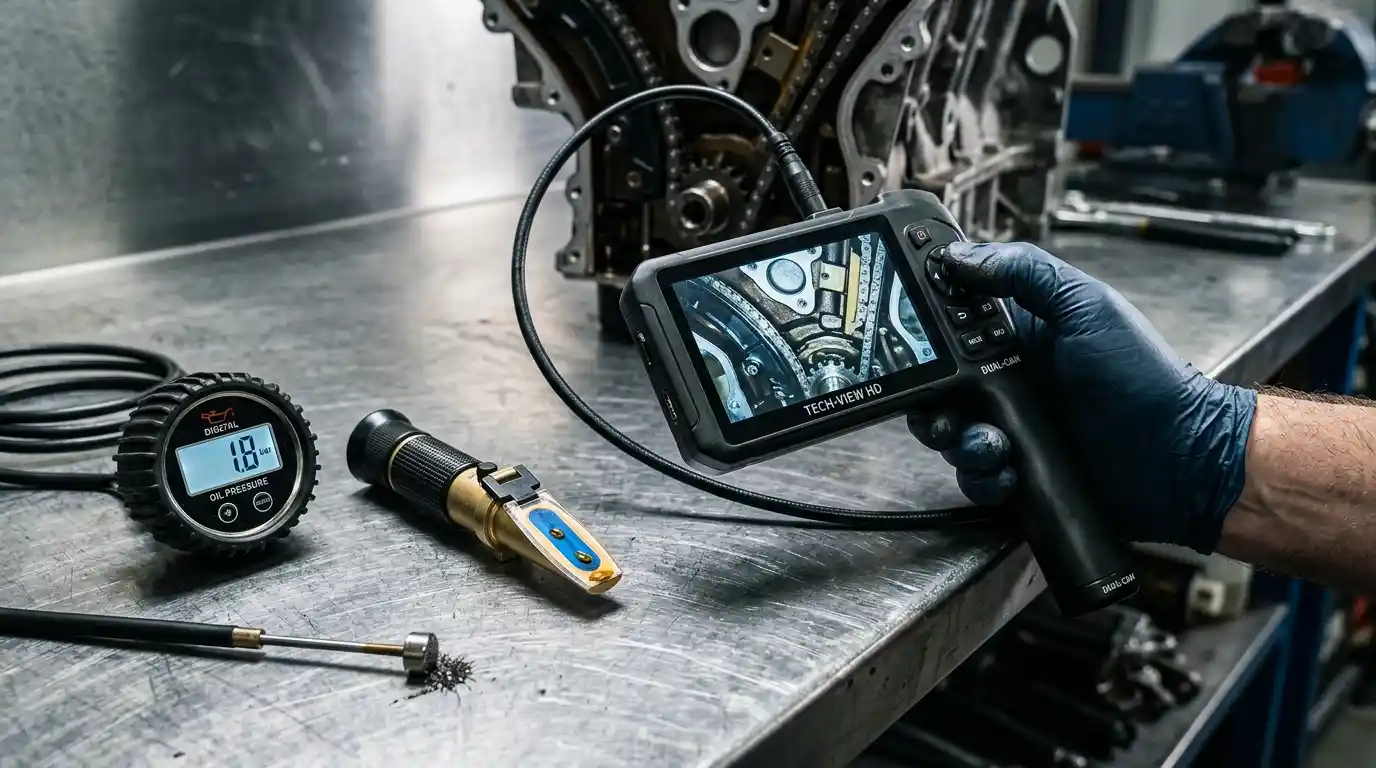
If the chain has jumped or broken, valve-to-piston contact may have occurred. The engine may also contain plastic guide fragments, metal particles or signs of an oil-supply problem. The next decision depends on compression, leak-down results where appropriate, borescope findings, oil and filter inspection, and the condition seen after access.
- Do not assume a non-starting engine only needs a new chain.
- Do not repeatedly crank an engine with a sudden timing noise or compression loss.
- Separate cylinder-head damage from lower-engine or lubrication damage.
- Explain additional findings before expanding the approved work.
When the evidence points to a wider internal fault, the dedicated Audi engine repair page explains repair, rebuild and replacement boundaries in more detail.

The Audi badge does not define the timing drive
A3, A4, A6, Q5 or S-model names can each cover different generations, engine families and markets. Some Audi engines use chains, some use belts, and some use more than one timing drive or a mixed arrangement. Electric e-tron powertrains do not have an internal-combustion timing chain.
Vehicle identity
The VIN narrows the production specification and parts catalogue path. It still needs to be checked against the engine and components actually installed.
Engine application
Engine code, displacement, fuel type and generation determine the chain layout, locking procedure, access route and many of the replacement parts.
Previous work
Invoices, fitted-part numbers and evidence of earlier cover removal can expose a previous partial repair, revised component or incorrect assembly.
Current condition
The installed engine, measured values, oil condition and physical wear remain the final basis for the repair scope.
If the vehicle uses a belt-driven timing system, use the separate Audi timing belt replacement information instead of applying chain advice to the wrong engine.
Oil supply can change the timing diagnosis
Oil is part of the timing system on engines that use hydraulic tensioners and oil-controlled camshaft adjustment. The correct oil approval, level, filter, pressure and service history all matter. Thick sludge, a restricted pickup, a damaged pump, internal leakage or an unsuitable filter can delay pressure or disturb actuator control.
Look for the cause of wear
Check whether low oil level, delayed pressure, contamination or an earlier lubrication warning contributed to the complaint. The new timing set should not be asked to operate inside an unresolved oil fault.
Restore the correct service basis
Use the applicable oil and filter, clean only where the confirmed condition requires it, and document the next service basis. The Audi maintenance schedule explains how vehicle identity, time, mileage and history shape ongoing service.
The first start is only the beginning of the check
A completed timing repair should be checked as a mechanical, lubrication and electronic system. The exact sequence follows the engine, but the handover should be supported by more than the absence of a warning light.
Mechanical rotation
Confirm free movement and the specified reference position before the controlled first start.
Oil pressure and noise
Watch warning status, build-up behaviour and abnormal sound. Investigate a delayed or unstable result before extended running.
Timing data
Check correlation and adjustment values, clear only the faults that were addressed, then confirm what returns.
Leak and road check
Inspect rebuilt sealing areas and disturbed fluid paths cold and warm. Road-test only when the engine condition supports it.
Keep adjacent decisions on the right page
This page owns diagnosis and replacement of an Audi timing-chain system. Broader engine damage, parts categories and symptom-led fault finding have separate guides so the timing decision stays focused.
Audi parts guideFor Genuine, OEM-supplier and aftermarket part boundaries
Audi problems guideFor warnings, noises and symptoms that do not yet have a confirmed cause
Audi timing belt replacementFor engines that use a belt-driven timing system
Audi timing chain replacement questions
Does a cold-start rattle prove the Audi timing chain is worn?
No. A repeatable cold-start rattle can involve chain slack, tensioner bleed-down or guide wear, but oil-pressure delay, filter drain-back, another internal component or an accessory drive can sound similar. The sound pattern, timing data, oil condition and mechanical checks should agree before replacement.
Can an Audi timing chain be checked with a diagnostic scan?
A scan can reveal correlation faults, camshaft adjustment limits, freeze-frame conditions and useful live data on supported engines. It cannot see a broken guide or confirm every mechanical cause. Scan evidence must be interpreted with cold-start, lubrication and physical checks.
Is the chain tensioner replaced with the timing chain?
The tensioner, guides, chain or chains and related components are assessed as a system. The correct scope follows the engine design, component condition and applicable parts information. Replacing only one worn part can leave another part of the same drive near failure.
Do all Audi models use a timing chain?
No. Timing-drive design follows the exact engine, not the model badge. Audi ranges can include chain-driven, belt-driven and fully electric powertrains. Send the VIN and engine information so the installed system can be identified before parts or interval advice is given.
Can a timing chain fault damage the engine?
Yes. If the valve timing moves far enough, pistons and valves can contact on many engine designs. Broken guide material and lubrication faults can also widen the damage. A non-start, severe misfire, heavy mechanical noise or sudden compression loss needs a wider engine assessment.
What changes the Audi timing chain replacement cost?
The engine layout, access time, number of chains, confirmed parts boundary, adjuster and sprocket condition, sealing items, specified fasteners, fluid work, previous repairs and any internal damage all affect the quotation. The VIN and diagnosis are needed before a meaningful scope can be prepared.
What should I send before booking?
Send the VIN if available, model, year, mileage, engine size, warning message or fault code, when the noise occurs, oil-warning history and any recent timing or engine work. A short cold-start recording can help preserve the complaint, but it does not replace workshop diagnosis.
Send the cold-start evidence before parts are ordered
Include the Audi model, year, mileage, VIN or engine code, dashboard message and when the sound occurs. Tell us if the engine has an oil warning, severe misfire, non-start condition or recent timing work.