

Audi engine mount replacement in Dubai
A shake at idle, a thump during gear engagement or excess engine movement can involve a mount, but it can also come from rough engine operation, a transmission support, drivetrain alignment or contact elsewhere. We identify the source and the exact mount fitted before replacement is approved.
Direct answer Audi engine mount replacement is appropriate when inspection confirms a collapsed, split, leaking, loose or incorrectly controlled mount. A vibration alone does not identify the failed part. The complaint should be matched to engine operation, mount movement, surrounding clearance and the vehicle’s exact mounting system.
The operating condition is the first clue
Noise, vibration and harshness are easier to diagnose when the workshop knows exactly when they begin, what changes them and where they are felt.
Roughness at idle
A worn mount can transmit normal engine pulses into the cabin. Uneven combustion, an air leak, ignition fault or incorrect idle behaviour can create a similar sensation, so engine smoothness is checked first.
Load in Drive or Reverse
The powertrain reacts differently as load changes. A stronger shake in one selected gear may guide inspection, but it is not automatic proof that one named mount has failed.
Clunk on take-up
A thump during acceleration, braking or gear engagement can follow excessive powertrain movement, a loose support, a worn torque link or clearance lost around the exhaust and underbody.
Start-up movement
Movement when the engine starts or stops may reveal a weak support, but the engine’s own start quality and the position of adjacent components also affect what the driver feels.
Vibration at speed
A vibration tied mainly to road speed needs wheels, tyres, shafts and related rotating components considered. Mount faults are more often linked to engine load or engine speed than one exact road speed.
Stored mount fault
Where a controlled mount is fitted, a stored fault may involve the mount, connector, wiring, supply, control output or another condition. Circuit evidence is needed before a controlled unit is ordered.
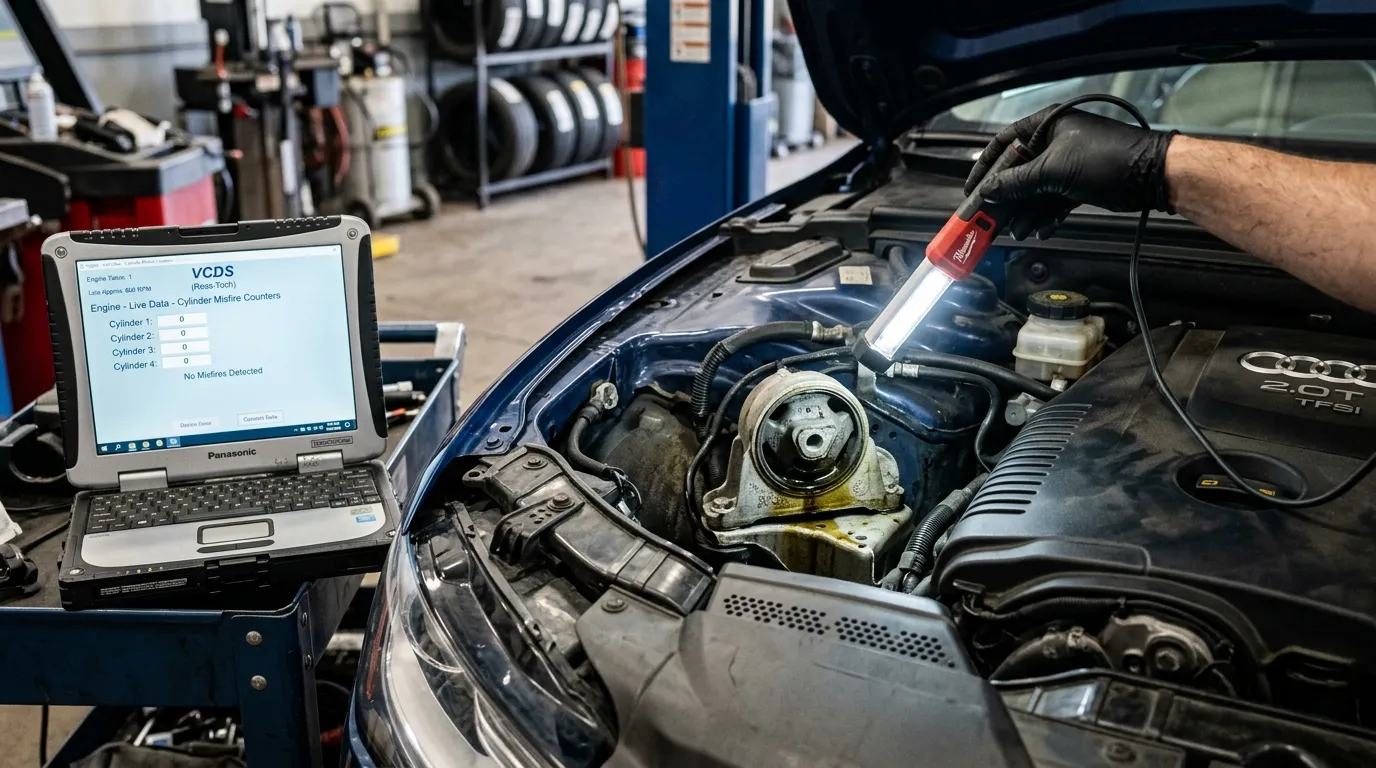
Several faults can imitate a failed mount
Replacing a mount cannot correct an engine that is producing an abnormal vibration. Before approving parts, the complaint is separated from rough running, misfire evidence, incorrect idle control and faults that change when electrical or air-conditioning load is applied.
The transmission support, lower torque link or pendulum support where fitted, exhaust clearance, heat shields, brackets and underbody contact can transmit a thump or buzz into the body. On applicable vehicles, clutch or flywheel behaviour and driveline movement may also influence the symptom.
- Engine operation and misfire evidence
- Transmission and torque-support condition
- Exhaust, shield and underbody clearance
- Loose brackets or previously disturbed hardware
- Wheel-speed vibration when the complaint occurs only while driving
- Mount wiring and command where electronic control is fitted
How the mounting system works
The engine, gearbox and torque supports work as one system. The exact Audi configuration determines which layer controls weight, vibration and movement.

Isolation layer
Rubber and hydraulic mounts carry the powertrain while limiting how much normal engine vibration reaches the body. Splitting, compression, separation or fluid loss changes that isolation.
Reaction layer
Transmission and torque supports control fore-and-aft reaction during gear engagement, acceleration and braking. Their condition affects alignment and how the engine-side mounts are loaded.
Control layer
Vacuum or electrically controlled mounts where fitted can change their behaviour with operating conditions. The unit, connector, wiring and control path must be separated before replacement.
Carry the weight
Engine-side and transmission mounts keep the assembly at its designed height and position. Collapse can remove clearance and transfer vibration into the body.
Control the reaction
Lower links and torque restraints where fitted limit movement as drive load changes. Worn bushes or loose hardware can create a clunk without a failed hydraulic mount.
Protect the geometry
Brackets, seating faces and correct fasteners preserve alignment. A new mount cannot work properly if the support point is damaged, loose or incorrectly positioned.
From vibration report to confirmed scope
Diagnosis follows the symptom through load, movement and part identification instead of treating every cabin shake as a mount failure.
Record the pattern
Confirm whether the concern appears cold or warm, at idle, in a selected gear, during start-up, with AC load, during acceleration or at a particular vehicle speed.
Check engine quality
Assess idle behaviour, relevant faults and operating evidence so an abnormal combustion or control problem is not disguised by replacing an isolator.
Inspect every support
Check accessible mounts, transmission support, torque restraint, brackets, fasteners, leakage, collapse, separation and nearby contact points.
Observe controlled movement
Compare powertrain movement under suitable controlled conditions without relying on unsafe loading or a visual guess from one angle.
Test control where fitted
Identify the actual system and check the connector, wiring and command path when a controlled mount or related fault is present.
Match the exact part
Use the VIN and installed configuration to confirm position, part reference, required hardware, access and the final approved repair boundary.
Similar vibrations lead to different work
This matrix keeps the repair tied to evidence and prevents one symptom from becoming an automatic parts decision.
| Observed behaviour | Possible source | Evidence required | Likely next step |
|---|---|---|---|
| Cabin shake at idle | Mount isolation or rough engine operation | Engine smoothness, idle data, mount condition and change with load | Repair the engine fault or confirm the affected support |
| Stronger vibration in Drive or Reverse | Load-sensitive mount, transmission support or engine-quality issue | Comparison by gear, temperature and AC load with controlled movement | Identify the support or operating fault before quoting |
| Clunk on acceleration or braking | Torque support, loose mount, bracket or driveline movement | Support inspection, fastener condition, clearance and movement direction | Repair the confirmed mount, support or hardware |
| Buzz against the body | Collapsed mount, exhaust contact or displaced shield | Clearance inspection under the condition that creates the buzz | Restore clearance or replace the failed support |
| Controlled-mount fault stored | Mount unit, connector, wiring, vacuum path or control output | Vehicle specification, circuit test and commanded response | Repair the circuit or replace the proven unit |
| Vibration at one road-speed range | Wheel, tyre, shaft or other rotating component | Vehicle-speed relationship and chassis inspection | Route diagnosis away from mounts when evidence supports it |
Replace the failed layer, not the assumption
A confirmed mount failure may require one engine-side mount, more than one support, a transmission mount or a torque restraint. The correct scope depends on measured condition, access, the relationship between the supports and whether another weak component would prevent the new part from sitting or working correctly.
Electronic or vacuum control faults require their own boundary. Damaged wiring, a poor connection or a leaking control line is not repaired by fitting a mechanically sound mount. Likewise, a persistent misfire or poor idle needs engine diagnosis. The dedicated Audi engine repair service explains that wider route, while the Audi fault-code guide shows why a stored description must be confirmed with physical evidence.
- Confirmed engine-side mount replacement
- Transmission or torque-support repair
- Bracket, seating or fastener correction
- Connector, wiring or control-path repair
- Engine-running diagnosis instead of mount replacement

Correct support and positioning matter
Mount replacement is a powertrain-support job, not a simple visual swap. Access and procedure vary by model, engine and mount position.
Identify the configuration
Confirm the VIN, engine, gearbox, drivetrain, mount position and control equipment before parts are approved.
Support the powertrain
Use the appropriate support method and remove only the components needed for safe access.
Inspect the surrounding area
Check brackets, seating faces, fasteners, related supports, wiring and clearances before the new mount is secured.
Install without preload errors
Position the powertrain and mount according to the applicable procedure. Exact tightening information must match the vehicle.
Reconnect control systems
Where fitted, protect and reconnect electrical or vacuum control components and address any confirmed circuit defect.
Verify the original complaint
Repeat the relevant idle, load, start-up and road conditions, then recheck movement, contact and applicable faults.
What changes the installed cost
There is no dependable single price for every Audi engine mount replacement. Two vehicles with the same model badge can use different engines, gearboxes, drivetrains and mount systems.
- Vehicle identity Model, year, VIN, engine and drivetrain determine the correct application.
- Mount position Left, right, transmission and lower supports have different parts and access.
- Mount design Conventional, hydraulic and controlled units have different diagnostic needs.
- Access Covers, intake parts, supports or other components may need removal.
- Related condition Brackets, hardware, wiring or another failed support can widen the approved scope.
- Verification Post-installation checks must reproduce the original complaint where practical.
The Audi repair cost guide explains why installed scope matters when comparing quotations. Send the VIN for a useful parts and access review.
Model name does not define the mount
A3, A4, A5, A6, A7, A8, Q3, Q5, Q7, Q8, TT, S and RS vehicles can use different mounting layouts across generations and powertrains.
Model year
Engine code
Gearbox
Drivetrain
Mount position
Control connector
Confirm before ordering
The vehicle identity and original part information help distinguish visually similar mounts, revised references and application differences. A model list is not a substitute for a parts match.
Confirm before replacing
The vibration pattern, engine operation and physical inspection determine whether the matched mount is actually the failed component.
A fitted mount still needs verification
The result is checked against the complaint that brought the Audi to the workshop.
Idle and cabin feel
Compare idle quality and transmitted vibration cold and warm where relevant.
Load and movement
Recheck gear engagement, start-up, shutdown and controlled powertrain reaction as applicable.
Clearance and control
Confirm no new contact, looseness, leakage or applicable controlled-mount fault remains.
Audi engine mount FAQs
What are the signs of a failed Audi engine mount?
Possible signs include increased cabin vibration at idle, a thump during gear engagement, excessive powertrain movement, a buzz caused by lost clearance, visible splitting, collapse or fluid leakage from a hydraulic mount. These signs still need comparison with engine operation, other supports and surrounding contact points.
Can a rough-running engine feel like a bad mount?
Yes. A misfire, air leak, poor idle control or another engine-running problem can create vibration that a mount then transmits into the body. Replacing the mount may change how the vibration feels without correcting its source, so engine quality is checked before parts approval.
Can I drive with a damaged engine mount?
Risk depends on the amount of movement, noise, contact and whether the powertrain remains securely supported. Stop and request advice if there is a severe clunk, sudden change, visible displacement, contact with another component or concern that a support is loose. Avoid repeated hard acceleration while the condition is unknown.
Must all engine mounts be replaced together?
Not automatically. The decision depends on the condition and interaction of every support, parts configuration, access and whether one failed mount has overloaded another. The quotation should identify which mount is confirmed faulty and why any additional support is included.
Why is the vibration worse in Drive or Reverse?
Selecting a gear changes the load and direction of powertrain reaction. That can make a weak support more noticeable, but it can also magnify a rough idle or reveal contact elsewhere. The difference between Drive, Reverse and Neutral is useful diagnostic evidence rather than a final diagnosis.
Do some Audi models use controlled engine mounts?
Some Audi applications use mounts with vacuum or electrical control, while others use conventional rubber or hydraulic designs. The exact system must be confirmed from the vehicle specification and physical installation. A control fault can involve the circuit as well as the mount.
Can a transmission mount cause similar symptoms?
Yes. The engine and transmission are supported as one powertrain assembly. A worn transmission support or lower torque restraint can affect movement, alignment, vibration and clunks during load changes, so the complete support system is considered.
What information is needed for an accurate quotation?
Send the VIN, model, year, engine if known, where the vibration is felt and when it occurs. Mention whether it changes in Drive, Reverse, Neutral, with AC load, during start-up or at road speed. A final quotation may still require physical inspection and parts confirmation.
Why might vibration remain after replacing one mount?
The original vibration may also involve another support, an engine-running fault, exhaust contact, driveline behaviour or incorrect positioning during installation. Verification should reproduce the initial condition and continue diagnosis if the complaint has not been resolved.
How is Audi engine mount replacement verified?
The workshop rechecks idle and cabin vibration, gear engagement where applicable, start-up and shutdown movement, surrounding clearance and any controlled-mount faults. A road test may be used when the original complaint occurred under driving load or at speed.
Confirm the source before ordering a mount
Share the Audi model, year, VIN if available, and whether the vibration occurs at idle, during gear engagement, under acceleration or at road speed. A short video can help describe the symptom when it is safe to record.