
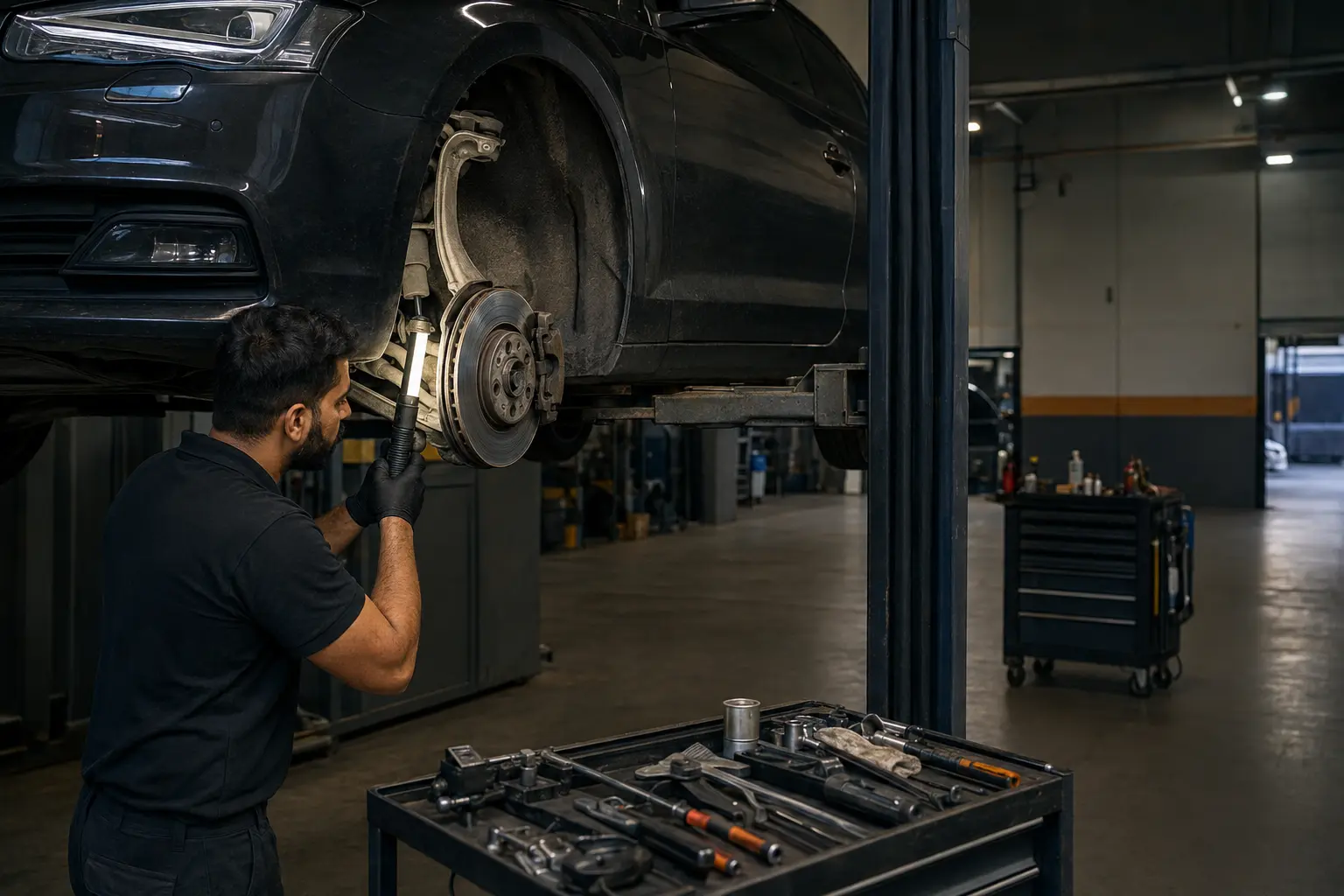
Audi Ball Joint Replacement in Dubai
Audi ball joint replacement should follow proof of play, stiffness, boot damage, corrosion, or attachment failure at the exact wheel corner. We inspect the joint under the loads that create the complaint, separate it from control-arm, tie-rod, bearing, brake, tire, and mount faults, then choose a separate joint or complete-arm repair and verify geometry.
The right repair for your ball joint
We identify the worn connection and confirm whether your Audi needs a separate ball joint or a complete control arm.
Find the affected joint
Check the exact wheel corner and isolate movement from nearby arms, tie rods and wheel bearings.
Check wear and damage
Inspect for play, stiffness, torn boots, corrosion and loose or damaged attachments.
Choose the replacement
Match a separate joint or complete arm to the fitted suspension, then verify the repair and geometry.
A clunk alone does not prove a failed ball joint. We show you what needs repair before parts are replaced.
Movement has to be tested in the joint’s working directions
Suspension position and where force is applied can hide or exaggerate play. The correct support points and test direction depend on joint design.
Lift, bump, and body load
Vertical force can reveal movement in a load-carrying joint, but it can also move a wheel bearing, strut, spring seat, mount, or bushing. The suspected stud and socket must be observed directly while force is applied safely.
Steering and cornering
Side-to-side wheel movement can come from a tie rod, steering rack, wheel bearing, ball joint, or control-arm connection. Steering may need to be held or each linkage isolated to identify where the clearance begins.
Braking, acceleration, and articulation
A worn outer joint or neighboring bushing can change wheel position under braking. A joint that rotates roughly or binds may affect steering return and suspension articulation without obvious free play.
Common complaints and the faults that imitate them
| What you notice | Ball-joint possibility | Important lookalikes | Confirmation path |
|---|---|---|---|
| Clunk over sharp bumps | Clearance can knock as suspension load reverses. | Control-arm bushing, anti-roll-bar link, strut mount, damper, spring seat, brake hardware, or loose undertray. | Bump direction Reproduce safely, inspect the corner, and load each relevant joint while observing the suspected connection. |
| Steering feels loose | Outer-joint play can allow dynamic wheel-angle change. | Tie rod, rack, wheel bearing, tire sidewall, loose wheel, control-arm bushing, rear steering effect, or alignment. | Steering chain Trace movement from steering input through the linkage to the wheel and compare both sides. |
| Squeak or creak while steering | A dry, contaminated, or binding joint can make noise as it articulates. | Top mount, spring contact, bushing, steering column, rack mount, tire scrub, trim, or brake shield. | Articulation Listen and feel at the joint under controlled steering and suspension movement. |
| Uneven tire wear | Play can change camber or toe under load. | Static misalignment, bent arm or knuckle, ride-height fault, wheel runout, tire pressure, subframe position, or another loose joint. | Geometry Measure tire wear, ride height, all joint movement, wheel runout, and complete axle geometry. |
| Pull or movement while braking | A worn connection can let the wheel shift as braking force rises. | Control-arm bushing, brake imbalance, tire fault, wheel bearing, tie rod, subframe, or road surface. | Brake load Compare loaded movement and braking evidence rather than assuming the loudest side is the failed side. |
| Change after curb or pothole impact | Stud, joint, arm, carrier, or attachment can be damaged. | Wheel, tire, tie rod, strut, knuckle, subframe, bearing, brake shield, or body mounting point. | Impact map Inspect the full force path and compare geometry side to side before approving one isolated part. |
How ball-joint condition is separated from neighboring movement
The exact procedure changes with suspension layout, support point, joint orientation, and manufacturer limits. The principle is always to isolate the source.
Road-load description
Record bump type, steering angle, braking or acceleration, speed, temperature, wet or dry conditions, and whether the sound or movement comes from one corner. A safe road check can reproduce the complaint.
Visual and attachment check
Inspect boot, grease leakage, corrosion, stud, nut, taper or pinch connection, arm, wheel carrier, witness marks, previous work, brake hose, ABS wiring, and surrounding contact.
Loaded movement test
Support the suspension as required, apply force in the relevant direction, and observe the socket, stud, arm, carrier, bearing, tie rod, and bushings. Measurement is used when the design specifies a limit.
Geometry and comparison
Compare left and right while respecting normal design differences. Tire evidence, ride height, wheel position, alignment values, and impact history can reveal movement or bent structure beyond the joint.
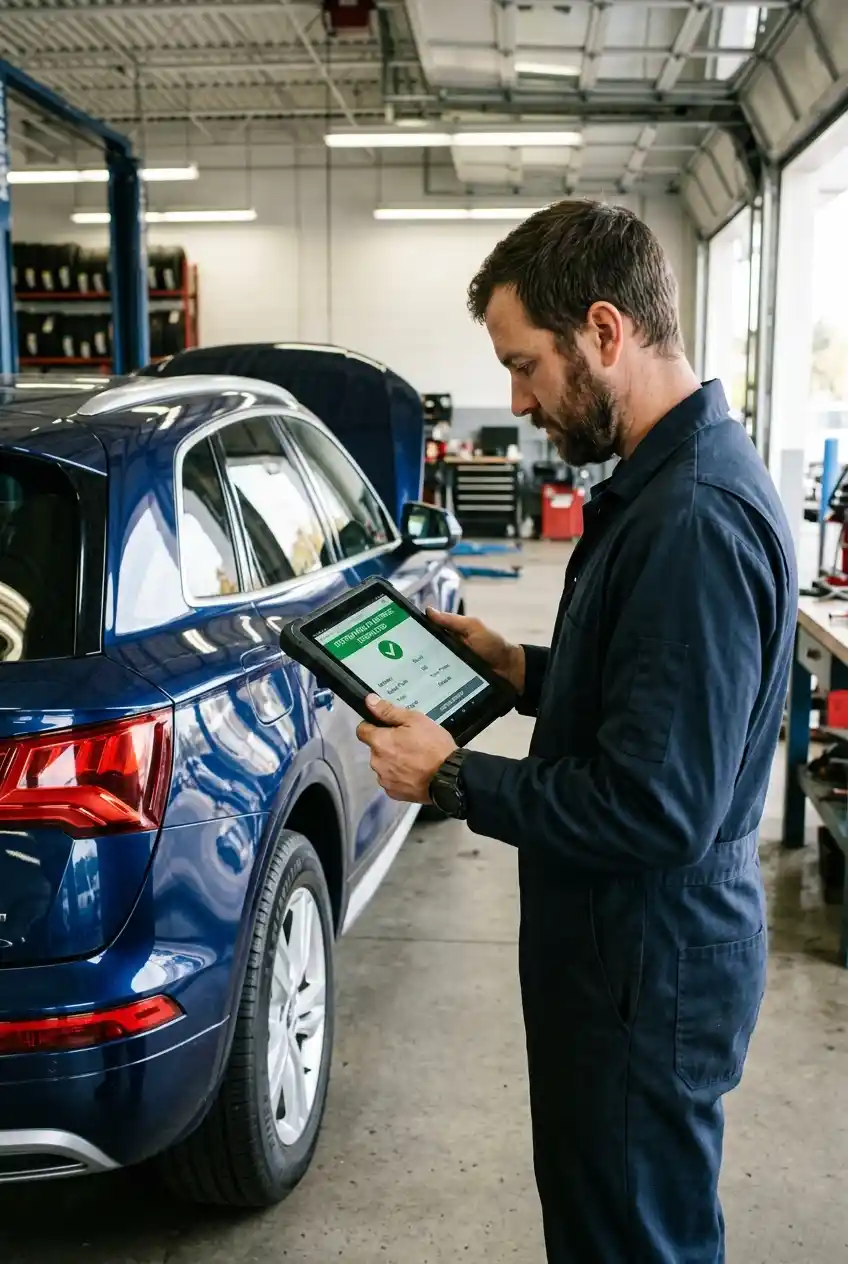
The boot, socket, stud, and attachment tell different stories
The stud pivots inside a lubricated socket. A protective boot helps retain lubricant and exclude water and abrasive contamination. The stud connects to an arm or wheel carrier through a taper, pinch arrangement, bolts, or an integrated design. Damage in any of these areas can affect retention and movement.
A torn boot with no measured play may still justify action because contamination can accelerate wear, but the available service boundary matters. Some boots are not separately approved. A joint with excessive play requires replacement of the serviceable unit. A stud that spins, damaged taper, stretched attachment, cracked arm, or distorted carrier can expand the repair.
Separate joint, complete arm, or wheel-carrier repair
Parts catalogs and suspension design determine what can be replaced safely. A loose component should not be pressed into a damaged bore or attached to a distorted carrier.
Separate ball joint
This can be correct when the joint is individually serviceable, the arm or carrier bore is sound, the required retaining method is available, and removal or pressing can be completed without damage. Orientation, support, depth, and retention must follow the design.
Complete control arm
Many Audi links use an integrated outer joint or are supplied as an assembly. A complete arm can also be appropriate when the arm is bent, cracked, corroded, damaged at the joint housing, or its bushings are worn enough to make a separate joint poor value.
Supporting repair
A damaged taper, wheel carrier, pinch area, fastener seat, subframe mounting, or neighboring link may require additional parts. Alignment, tire, wheel, bearing, brake, sensor-wire, and impact damage are written separately so the ball joint is not blamed for the whole corner.
For integrated-arm decisions, our Audi control arm replacement page explains bushing, arm, hardware, ride-height tightening, and geometry considerations.
How the approved joint or arm is replaced
A separating ball joint can compromise wheel control
Noise severity does not always match structural risk. If the vehicle feels unstable or the joint is visibly moving, do not drive it.
Mild repeatable noise
A light clunk or creak without steering change still needs inspection. Reduce unnecessary driving and watch for tire wear, looseness, or rapid change.
Play or changing steering
Confirmed movement, wandering, pulling, braking shift, or uneven tire wear increases urgency. Avoid high speed, heavy load, and rough roads while arranging assessment.
Heavy knock or visible movement
Do not continue if the wheel changes position, steering becomes loose, the joint moves substantially, a tire rubs, or the behavior worsens suddenly.
Separation risk or instability
Recovery is required for a partially separated joint, damaged attachment, broken arm or carrier, wheel out of position, severe instability, or loss of steering control.

Alignment measures the result, not the joint’s health
A ball joint or complete arm influences wheel location. Whether a specific replacement changes an adjustable angle depends on its position, the suspension layout, released fasteners, subframe, ride height, and previous damage. A tight new joint can also reveal existing geometry that was masked by movement.
We recommend measurement when the joint or arm controls wheel position, an adjustment point or subframe was disturbed, the car pulls, the steering wheel is off-center, tire wear exists, or impact damage is involved. Alignment cannot make a loose joint safe or correct a bent arm, carrier, strut, subframe, or body mounting point.
What changes the quotation
- Exact axle, side, upper or lower link, joint design, and part availability
- Separate ball joint versus complete-arm replacement
- Steel or aluminum arm, integrated joint, press fit, taper, or pinch connection
- Seized pinch bolts, corrosion, damaged threads, broken boots, or distorted bores
- Specified fasteners, retainers, supporting parts, and ride-height tightening
- Wheel carrier, control arm, bushing, tie rod, bearing, brake, sensor, or impact damage
- Alignment measurement, adjustment, seized adjusters, and post-repair testing
Send the VIN, affected corner, symptom, impact history, and inspection report. The final estimate follows physical confirmation and exact parts identification.
Protect suspension joints from avoidable load
Ball joints are condition-based wear components, not automatic mileage replacements. Maintain suitable tires and pressures, slow for potholes and sharp road edges, avoid wheel and ride-height changes that overload the geometry, and investigate a torn boot or new knock before contamination and movement increase.
After curb contact, pothole impact, wheel work, or suspension repair, watch for a shifted steering wheel, pull, new noise, vibration, tire rubbing, or uneven wear. Keep alignment reports so changes can be compared rather than judged from memory.
Do not inject grease, fit a universal boot, hammer a stud, or add a spacer unless the exact joint design and approved repair procedure support it. An unsafe attachment can appear quiet while retention continues to fail.
Audi ball joint replacement FAQs
What are the signs of a worn Audi ball joint?
Possible signs include a clunk over bumps, steering looseness, a creak while turning, movement under braking, uneven tire wear, or visible joint play. These symptoms also come from bushings, tie rods, wheel bearings, strut mounts, brakes, tires, and other links, so the movement must be isolated to the joint.
Can a ball joint fail without making noise?
Yes. A joint can develop play, binding, boot damage, corrosion, or attachment trouble without a loud warning. Noise can also disappear under certain suspension loads. Direct inspection of retention, articulation, and loaded movement is more reliable than judging the joint only by sound.
Can I drive with a worn ball joint?
Do not drive with substantial play, a partially separated joint, damaged attachment, a wheel out of position, tire rubbing, or unstable steering. A mild noise still needs prompt inspection because severity can change. Call before moving the car when the condition has not been measured.
Can only the ball joint be replaced?
On some Audi applications, yes. The joint must be separately serviceable and the arm or carrier bore must remain sound. Other joints are integrated into a control arm or supplied only as an assembly. A damaged arm, joint housing, taper, pinch area, or wheel carrier changes the repair scope.
Should ball joints be replaced in pairs?
Not automatically. Both sides should be inspected because they share age and road conditions, but impact, previous replacement, boot damage, and measured wear can differ. The recommendation should follow evidence, parts design, labor relationship, and the customer’s repair objective.
Does ball joint replacement require wheel alignment?
Measurement is appropriate when the joint or complete arm controls wheel position, adjustment points or the subframe were disturbed, symptoms or tire wear exist, or impact damage is involved. The exact need depends on suspension design. Alignment does not repair looseness or bent components.
Can a bad ball joint cause tire wear or vibration?
Excessive movement can change toe or camber under load and contribute to tire wear or vibration. Wheels, tires, brakes, bearings, driveshafts, control-arm bushings, tie rods, struts, and alignment can create the same complaints. Frequency, load condition, tire evidence, and measured joint movement must agree.
How long does Audi ball joint replacement take?
Time depends on joint location and design, separate-joint versus complete-arm service, access, seized pinch bolts, corrosion, damaged threads, pressing, specified hardware, carrier condition, ride-height tightening, alignment, and additional impact or suspension work. The schedule is confirmed after inspection.
What information helps with an accurate quotation?
Send the VIN, model year, mileage, front or rear corner, left or right side, exact noise or handling symptom, when it occurs, impact history, recent suspension or tire work, and any photos, video, inspection report, or alignment printout. Physical testing confirms the final repair unit.
Book an Audi suspension inspection in Al Quoz 4
Send the VIN, affected wheel corner, and the exact bump, steering, braking, or tire-wear symptom. If the wheel position has changed or steering is unstable, call for recovery guidance instead of driving.